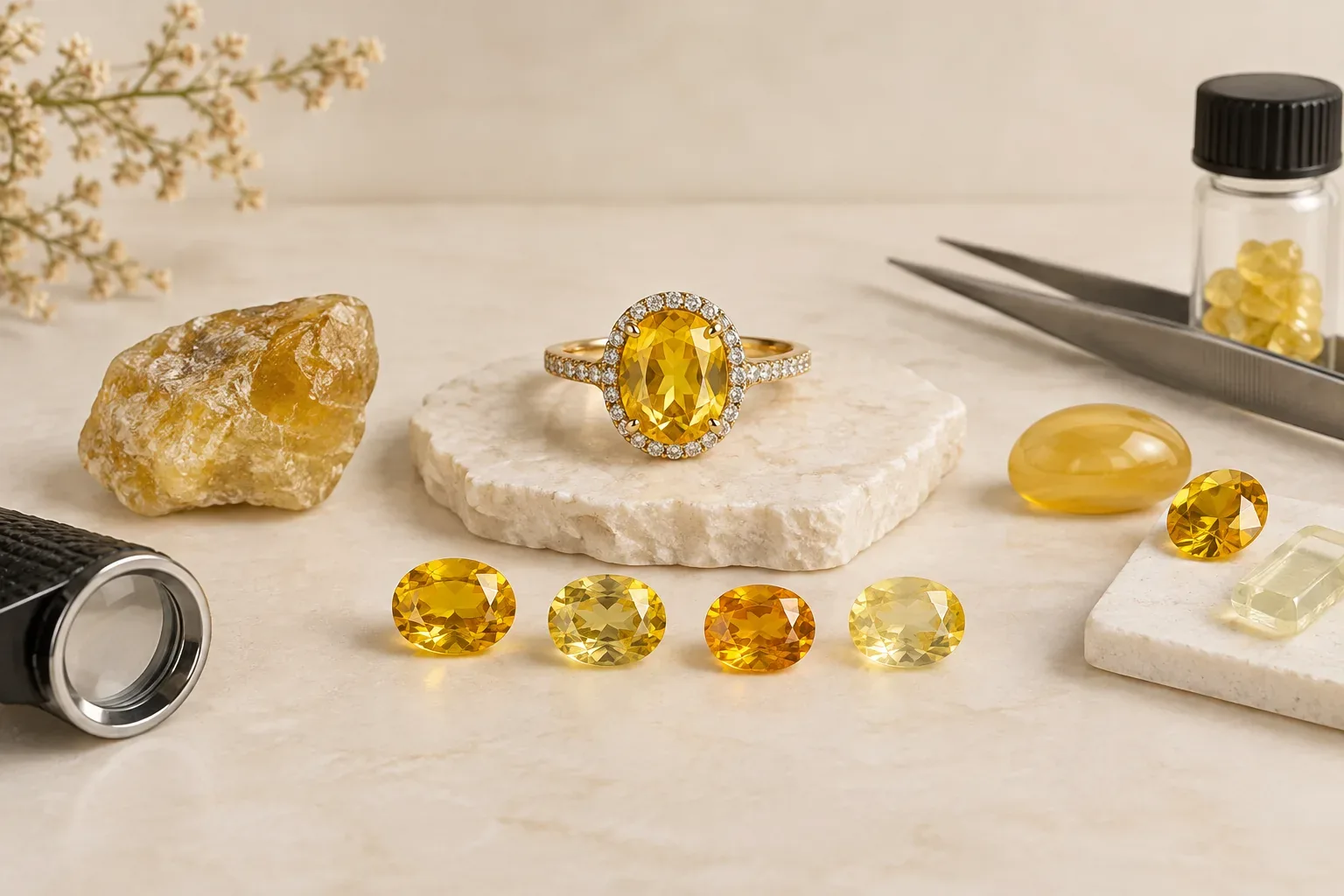
Meaning at a glance
This guide defines natural, lab-created, treated, and imitation yellow sapphires; describes decision criteria and trade-offs for buyers; explains what can and cannot be verified without a gemological lab; outlines safe care and disclosure expectations; and offers practical selection and gifting advice based on consumer-protection and gemological guidance.
Definitions and decision criteria
Natural: A natural yellow sapphire is corundum (aluminum oxide) formed by geological processes. Sellers should disclose the stone as natural and ideally provide a laboratory report for claims about geographic origin or whether the stone is untreated. The Federal Trade Commission emphasizes that consumers need clear distinctions among natural, lab-created, treated, and imitation materials and written seller disclosures.
Lab-created: A lab-created yellow sapphire is synthetically produced and has essentially the same chemical, optical, and physical properties as natural corundum. Ethical and price trade-offs are straightforward: lab-created stones often cost less and are chemically the same, but they are not natural and must be disclosed as such under consumer-protection guidance cited by the Federal Trade Commission.
Treated: Treatments—most commonly heating—alter a natural stone’s color or clarity. The Gemological Institute of America explains that treatments, disclosure, detectability, durability, and special care create distinct consumer questions for gemstones. Some treatments are routine and stable, while others may require special care or affect resale value.
Imitation: An imitation is a material that simulates the look of yellow sapphire but is not corundum. Imitations can be glass, synthetic spinel, or other materials. These should be labeled clearly and sold for what they are; the FTC advises consumers to demand precise language and written disclosure.
Historical evidence and cultural notes (what our sources do and do not document)
Among the approved sources for this article, modern trade and market sources focus on consumer trends rather than detailed ancient cultural history. Professional Jeweller reports growth in birthstone necklaces and a broader consumer interest in gemstone rings and sculptural jewelry, which is the modern context in which yellow sapphire appears. Imaginaire Digital’s recent market analysis similarly shows strong ongoing demand for rings, necklaces, and classic gemstone pieces in the UK market.
These trade publications document contemporary trends and product categories in which yellow sapphire appears, but they do not serve as primary evidence for historical symbolic meanings in specific cultures or periods. Where historical or cultural symbolism of yellow sapphire is offered by jewelers, astrologers, or family tradition, those interpretations are modern or community-specific and should be distinguished from documentary historical evidence. When a shopper requires a claim about long-standing cultural practice or an ancient origin story, seek specific academic or primary historical sources beyond the market- and consumer-focused documents cited here.
Documented historical meanings versus modern personal interpretation
Documented meanings are those supported by primary historical research or acknowledged by authoritative bodies; the approved sources here emphasize treatment, disclosure, and market use rather than ancient symbolism. The Gemological Institute of America provides technical documentation about treatments and their consumer implications, which is a form of documented evidence about how stones have been handled in trade.
Modern personal interpretations—such as beliefs about healing, luck, or astrological power—are community, retail, or individual claims. Those interpretations are common in marketing and personal gifting but are not the same as documented cultural history. Shoppers should label such meanings as personal or commercial when presenting a gift and avoid asserting universal historical claims without specific academic sources.
How yellow sapphire appears in jewelry today
Market reporting indicates that yellow sapphires appear across many contemporary jewelry categories. Professional Jeweller’s trend reporting notes growth in gemstone rings and birthstone necklaces, and Imaginaire Digital’s search and market analysis shows sustained interest in engagement rings, necklaces, and classic gemstone pieces. In practice, yellow sapphire is used in rings, pendants, earrings, and cluster or halo settings where the color serves as a focal point.
Designers use yellow sapphire for warm, sunny tones that complement yellow and rose gold as well as neutral metals. Lab-created and treated yellow sapphires allow designers to achieve consistent color at lower cost, while natural untreated stones are marketed at a premium. Imitations may be used for costume or fashion pieces where price and wearability are priorities.
What a buyer can and cannot verify without a qualified jeweler or gemological laboratory
What you can reasonably verify on your own includes comparing seller statements, checking for written disclosure, inspecting the stone for obvious indications of being glass or plastic, confirming weight and measurements, and assessing return policies and warranties. The Federal Trade Commission recommends that consumers demand clear, written distinctions among natural, lab-created, treated, and imitation materials.
What you cannot reliably verify without professional help is whether a yellow sapphire is truly natural versus lab-created when both are well finished, whether the stone has been heated or otherwise treated in ways that are not visible to the naked eye, or a claim of geographic origin (for example, ‘‘Ceylon’’ versus another deposit). The Gemological Institute of America states that detection and assessment of treatments and origin require laboratory-grade testing and expertise. For definitive answers on treatment, origin, or certification, obtain a report from a recognized gemological laboratory.
Practical selection and gifting guidance
Decide what matters most to you: natural origin, untreated status, color and durability, resale value, or budget. Natural untreated stones typically cost more and may carry greater resale value for collectors, while lab-created options offer predictable color and lower cost. Treated natural stones are a middle ground: they can deliver attractive color at lower cost but should be disclosed and documented.
Ask the seller for written disclosures and for any available laboratory reports. Check return policies, warranties, and the seller’s history. If the item is being bought as a high-value gift, request a recognized gemological laboratory report that explicitly states whether the stone is natural, lab-created, or treated, and what tests were used to reach that conclusion. The FTC emphasizes that written seller disclosures are important for consumer protection.
When gifting a stone with cultural or spiritual meaning, be explicit about whether the meaning is a personal belief, a family tradition, or a documented historical practice. Avoid claiming universal historical authority unless you have specific historical sources to support that claim. If the recipient values origin or certification, include the lab report or sales documentation with the gift.
Care and durability
Sapphire (corundum) is hard and durable compared with many other gemstones, but treatments may alter how a stone should be cared for. The Gemological Institute of America notes that certain treatments affect durability and care needs and that consumers should be informed about any treatment. General care includes avoiding harsh chemicals and extreme heat, cleaning with mild soapy water and a soft brush, and having the setting inspected regularly by a jeweler.
If a stone has been surface-treated or fracture-filled, ask the seller for specific cleaning and wear guidance. For any high-value piece, professional cleaning and inspection at least annually will protect both the stone and the mounting.
Final trade-offs and recommended steps before purchase
Trade-offs are straightforward: natural untreated stones cost more but are prized for rarity; lab-created stones offer value and consistency; treated stones balance appearance and price; imitations are lowest cost but not corundum. For meaningful purchases, insist on written disclosure and a clear return policy. For significant purchases, require a current laboratory report from a recognized lab that specifies the stone’s status and any treatments.
Start by asking the seller the simple questions: Is the stone natural, lab-created, or imitation? Has it been treated? Can I have a written disclosure and a laboratory report? What is the return policy? If the seller cannot provide clear written answers and suitable documentation, consider walking away or seeking a different vendor.
Frequently asked questions
How can I tell if a yellow sapphire is natural or lab-created without a lab report?
Without a laboratory report, you cannot reliably distinguish a well-made lab-created sapphire from a natural one by eye. You can and should demand written disclosure from the seller and ask for any available gemological reports. The Federal Trade Commission advises that sellers provide clear written distinctions among natural, lab-created, treated, and imitation materials.
Are most yellow sapphires treated?
Treatments such as heating are common in the trade to improve color and clarity. The Gemological Institute of America explains that treatments are an important consumer consideration and should be disclosed; the prevalence of treatment varies by market and individual stone.
Is a lab-created yellow sapphire less durable than a natural one?
Lab-created sapphires share essentially the same chemical and physical properties as natural corundum, so they are typically equally hard and durable. Durability can be affected if a stone has received surface treatments or fracture-filling, and the Gemological Institute of America advises checking whether specific treatments affect care and longevity.
What documentation should I ask for when buying a yellow sapphire as a gift?
Ask for written disclosure specifying whether the stone is natural, lab-created, or imitation, a description of any treatments, a return policy, and, for higher-value purchases, a current gemological laboratory report that states treatment details and whether the lab tested for origin.
Can an independent jeweler help verify a sapphire?
A qualified, experienced jeweler can provide an initial assessment and may spot obvious imitations or surface treatments, but tests for subtle treatments, origin, or definitive natural versus lab-created status require a recognized gemological laboratory and specialist instruments, as noted by the Gemological Institute of America.
Sources and further reading
- Imaginaire Digital — Imaginaire Digital
- Professional Jeweller / PRYA Jewellery Search Insights — Professional Jeweller / PRYA Jewellery Search Insights
- Gemological Institute of America — Gemological Institute of America
- Federal Trade Commission — Federal Trade Commission