Meaning at a glance
Kyanite is an aluminum silicate notable for direction-dependent hardness and cleavage; calm or alignment meanings are modern interpretations and should not obscure its special setting and care needs.
Direct answer: what kyanite jewelry meaning is and is not
Kyanite jewelry meaning combines two facts: a mineral fact and a modern, often personal interpretation. Mineralogically, kyanite is an aluminum silicate known for hardness and cleavage that vary depending on crystallographic direction; that physical behavior is the primary near-universal reason jewelers treat kyanite differently from other gems. Separately, many contemporary wearers and sellers describe kyanite as symbolizing calm, mental alignment, or clearer communication, but those are modern interpretations rather than documented historical, cross-cultural meanings. Keep the stone’s material properties and care needs in mind when selecting or giving kyanite jewelry.
Documented historical and mineralogical evidence
Most of the reliable documentation about kyanite is mineralogical and geological rather than mythological. The Smithsonian National Museum of Natural History frames kyanite within the broader context of gem materials and geology, noting how minerals are identified, their crystal systems, and how those properties influence use as gems and building blocks. That institutional context emphasizes kyanite’s physical identity more than long-standing cultural symbolism.
Because major museum and mineral-collection records emphasize geological classification, published institutional sources do not present a clear, consistent record of ancient or widespread cultural meanings attached to kyanite. In short: we have strong scientific documentation of what kyanite is and how it behaves as a gem material, but little authoritative museum-backed evidence tying kyanite to a single ancient cultural symbolism or ritual use.
Separating documented history from modern interpretation
Documented history: authoritative sources catalog kyanite as a mineral with particular cleavage and anisotropic hardness; those are physical facts about the stone. That mineralogical record is the primary historical evidence available in museum and geological literature.
Modern interpretations: claims that kyanite represents calm, alignment, or enhanced communication are contemporary meanings promoted by many sellers, crystal-enthusiast communities, and individual wearers. These uses and personal attributions are valid as modern symbolic practice but are not documented as ancient or universal cultural beliefs. Treat these symbolic meanings as personal or contemporary cultural expressions rather than as historical facts.
How kyanite appears in jewelry
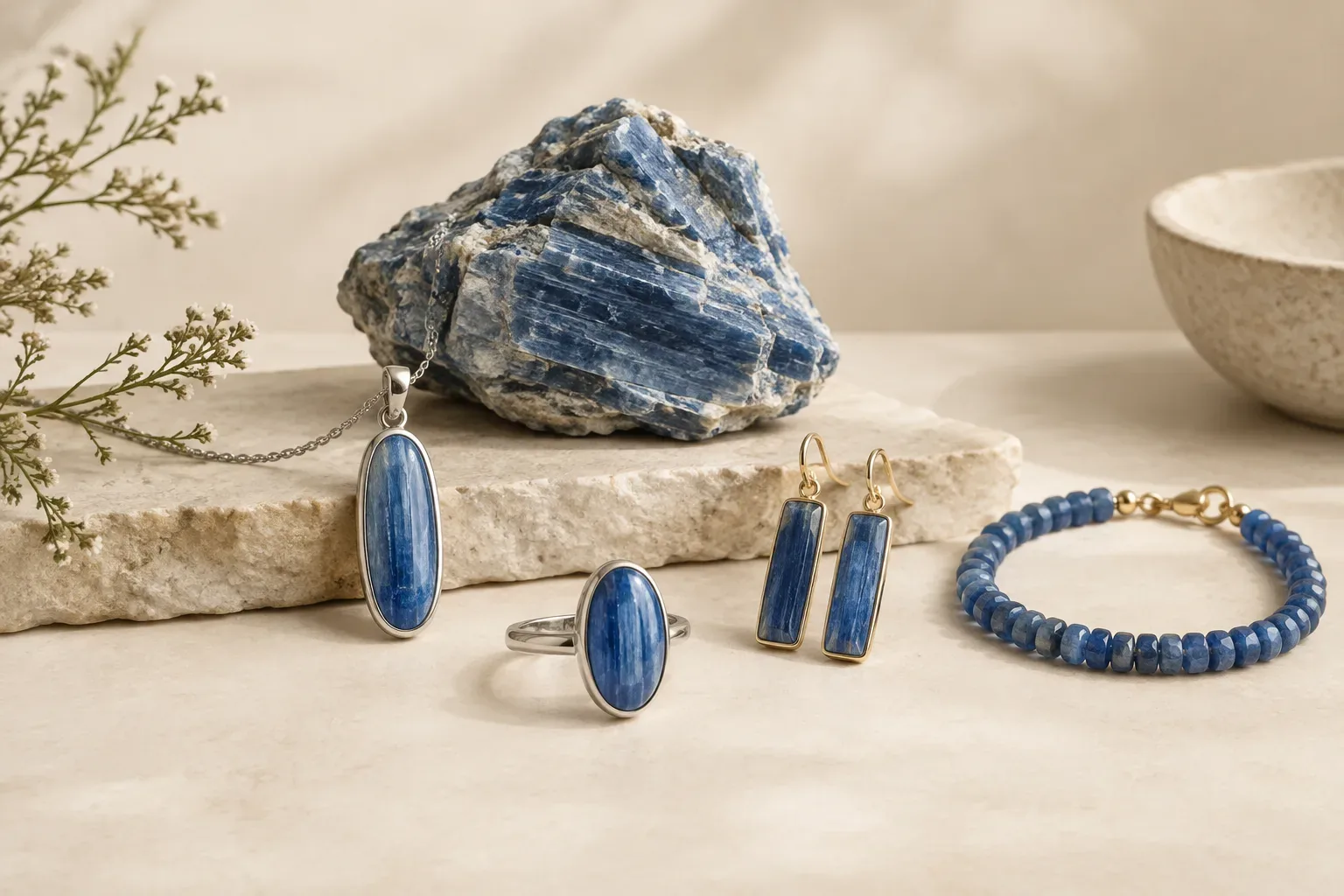
Kyanite is most commonly used for its attractive blue tones, which range from pale to deep blue and sometimes greenish-blue or gray-blue. Jewelers facet or cut kyanite to show color and luster, and it is also shaped as cabochons and beads. Because of its elongated crystal habit and the way it cleaves, cutters often choose shapes and orientations that both display color and minimize the chance of breakage during cutting and setting.
In design, kyanite appears in rings, pendants, earrings, and bracelets. It can be set as a single center stone for a pendant or ring, or it may appear as part of a multi-stone composition. Because of its sensitivity to mechanical stress in certain directions, many makers place kyanite in protective settings such as bezels or halo frames, or set it in jewelry pieces that avoid heavy everyday wear. The stone’s blue range pairs well with white metal settings and warm-toned accents, but aesthetic choices are personal.
Durability: what the material facts mean for wear
Kyanite’s durability differs from more familiar gemstones because its hardness is direction-dependent: it measures harder in one crystallographic direction and softer in another. That anisotropic hardness and distinct cleavage mean kyanite can be relatively brittle and vulnerable to chipping or splitting if struck or pried in a weak direction. These mineral properties are why jewelers and gemologists treat kyanite as a gem that needs careful handling.
For practical purposes, kyanite can be worn successfully in jewelry, but its placement and the wearer’s lifestyle matter. Pieces expected to take knocks—such as everyday rings worn during manual tasks—are higher risk unless the stone is very well protected. Less exposed pieces like pendants, brooches, and earrings are generally more practical uses for kyanite if the wearer wants to reduce the chance of damage.
Buying and disclosure: what to ask and expect
Kyanite buyers should treat the purchase like any other gemstone transaction and ask straightforward questions about origin, treatment, and durability. The Gemological Institute of America advises buyers and sellers to disclose treatments or enhancements to any gem, so ask whether the kyanite has been treated, dyed, or stabilized in any way. The GIA resource on gem treatments explains why transparent, honest disclosure matters for value and long-term care.
The U.S. Federal Trade Commission recommends consumers expect clear descriptions of whether a gem is natural, treated, lab-grown, or an imitation and advises asking for written confirmation of those facts. Following that guidance will help you compare pieces fairly and avoid surprises about value, care needs, and warranty or return policies. Keep receipts and any seller documentation about treatments and return terms.
Selecting and gifting guidance (practical and respectful)
If you are choosing kyanite as a gift, start with the recipient’s lifestyle and taste. For someone whose daily activities include hands-on tasks, select settings that protect the stone, such as a low-profile bezel or a pendant that stays tucked under clothing. For someone who appreciates occasional wear or jewelry for special events, a more open or decorative setting may be appropriate.
Respect the recipient’s relationship to gemstone meaning. If you intend the piece to symbolize calm, alignment, or another personal sentiment, present that as your contemporary intention rather than a claim of historical universality. A short note acknowledging that these meanings are modern personal interpretations is both respectful and informative. If durability is a concern, consider alternative blue gems with greater toughness, or choose kyanite for pieces the recipient will enjoy under gentler conditions.
Care and maintenance
Because of kyanite’s direction-dependent hardness and cleavage, avoid subjecting the stone to hard knocks, sharp impacts, or prying pressure. Store kyanite jewelry separately from harder gems and metals to reduce the risk of scratching or chipping. A soft pouch or lined jewelry box compartment is a sensible precaution.
For routine cleaning, gentle methods are safest: warm water, a mild soap, and a soft cloth or soft-bristled brush used with care. Avoid harsh abrasives, and ask the seller whether the specific piece can tolerate ultrasonic or steam cleaning; if in doubt, do not use those methods. Confirm any recommended cleaners or contraindications with the seller or a trusted jeweler, and retain the seller’s documentation about treatments and recommended care.
Final summary
Kyanite jewelry meaning has two layers: mineral reality and modern symbolic use. The Smithsonian-backed mineral record emphasizes kyanite’s unique physical behavior—direction-dependent hardness and pronounced cleavage—which drives how the gem is cut, set, and cared for. Contemporary symbolic claims about calm or alignment are meaningful to many wearers but are modern personal interpretations rather than a documented historical tradition.
If you choose kyanite, prioritize an appropriately protective setting, ask sellers about treatments and disclosure, follow gentle cleaning and storage practices, and present any symbolic intent as a personal gift rather than a universal historical claim. Doing so honors both the stone’s material nature and the recipient’s personal meaning.
Frequently asked questions
Is kyanite suitable for everyday wear like engagement rings?
Because kyanite’s hardness varies with direction and it has pronounced cleavage, it is more vulnerable to chipping than many common engagement-stone choices. If you want a kyanite engagement ring, choose a very protective setting and accept that extra care and occasional repair risk are likely; many people prefer kyanite for less exposed pieces.
How should I clean kyanite jewelry?
Clean kyanite gently with warm water, a mild soap, and a soft cloth or soft-bristled brush used carefully. Avoid aggressive scrubbing, harsh chemical cleaners, and, unless the seller explicitly confirms safety, avoid ultrasonic or steam cleaning.
Are kyanite stones commonly treated or enhanced?
Treatments can occur with many gems; the Gemological Institute of America recommends that any treatments be disclosed. When buying kyanite, ask the seller whether the stone has been dyed, filled, stabilized, or otherwise treated and request written documentation if available.
Can kyanite be imitated or lab-grown?
Gem imitations and lab-grown alternatives exist for many gem colors and types. The Federal Trade Commission advises consumers to expect honest labeling about whether a stone is natural, treated, lab-grown, or an imitation. Ask the seller for clear identification and documentation.
What do people mean when they say kyanite symbolizes calm or alignment?
Those meanings are modern symbolic attributions that many contemporary wearers find personally meaningful. They are not documented as ancient or universal cultural beliefs; treat them as contemporary or individual interpretations rather than proven historical facts.
How should I store kyanite jewelry?
Store kyanite separately from harder gems and metals to minimize the risk of scratching or chipping. A soft pouch or a lined compartment in a jewelry box provides basic protection against knocks and abrasion.
Sources and further reading
- Gems and Minerals: Beauties and Building Blocks — Smithsonian National Museum of Natural History
- An Introduction to Gem Treatments — Gemological Institute of America
- Buying Gemstones, Diamonds, and Pearls — Federal Trade Commission