Meaning at a glance
Diamond inclusions explained: internal or surface irregularities that affect appearance, clarity grade, and sometimes durability; choose by personal priorities, verify clarity with a certificate and a qualified professional, follow GIA guidance for treatment and care, and expect seller disclosure per FTC rules.
Direct answer — diamond inclusions explained
Diamond inclusions explained in one sentence: inclusions are natural internal or surface features within a diamond that influence its clarity grade, visible appearance, and in some cases its wearability, and explaining them clearly requires definitions, decision criteria, practical trade-offs, safe-care guidance, and limits on what a shopper can verify without a qualified jeweler or a gemological laboratory.
What diamond inclusions are (definitions and types)
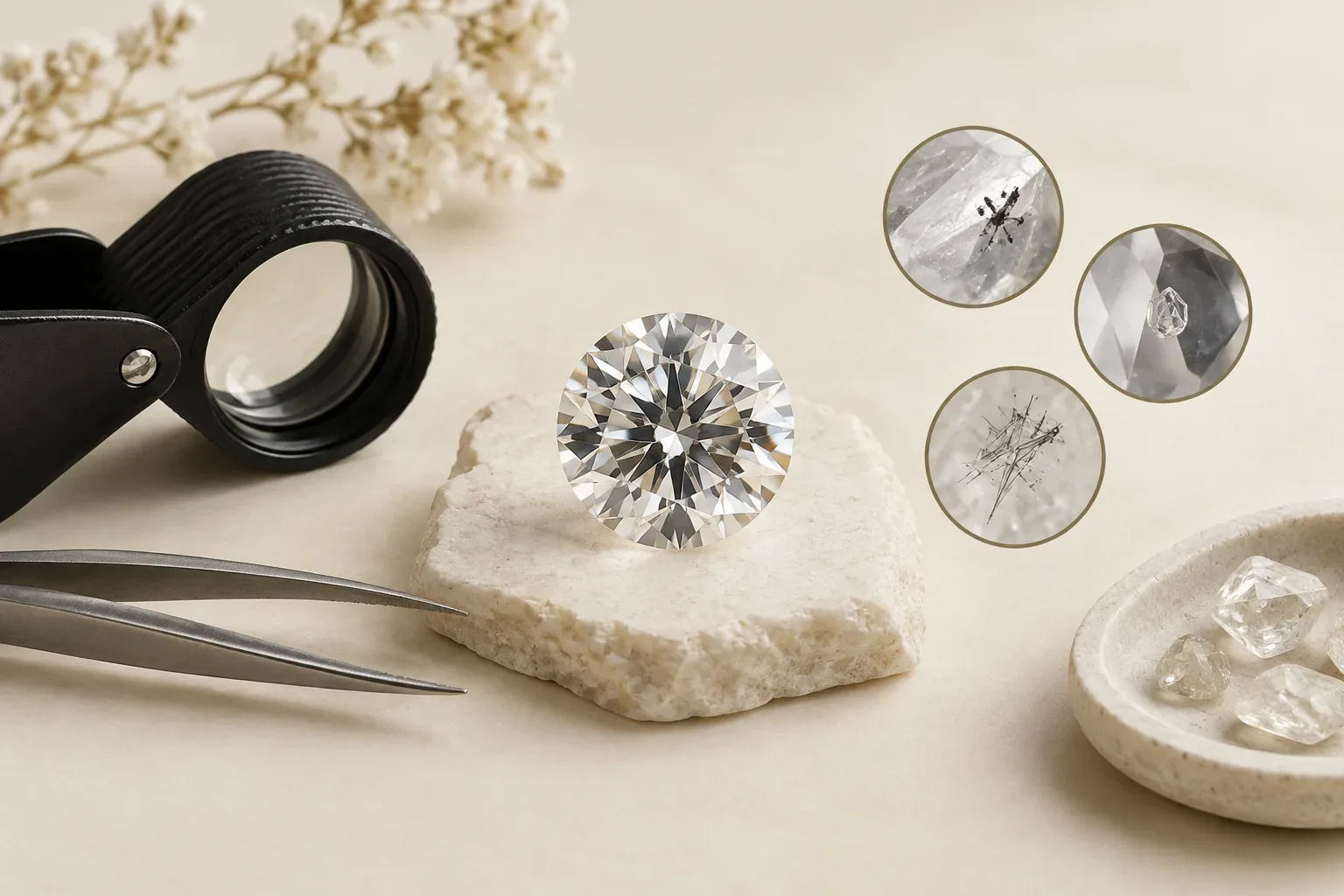
An inclusion is any internal characteristic or surface irregularity in a diamond. The term covers crystal inclusions (tiny crystals of another mineral or of diamond), needles and feathers (thin lines or hair-like fractures), clouds (groups of pinpoint inclusions that can create a hazy area), and naturals or chips where the original rough surface remains. Some features are internal and some are on or near the surface; both affect how light moves through a stone and how it looks to the observer.
Jewelry professionals distinguish clarity-impacting inclusions from purely cosmetic marks. A clarity grade, issued by a qualified laboratory or trained grader, describes both the type and the visibility of inclusions and is one of the standard factors used to compare diamonds along with cut, color, and carat weight.
Historical evidence and cultural context
Systematic, evidence-based study of diamond clarity and internal features emerged alongside the modern field of gemology as institutions formalized grading and testing methods. The Gemological Institute of America (GIA) codified many of the technical terms and consumer guidance still used today around treatments, detectability, durability and care for gemstones.
Before modern gemology—as recorded in broader histories of jewelry and gem trading—jewelers and buyers relied on visual inspection and practical experience to assess an individual stone’s beauty and suitability for a setting. Those traditions varied by region and period and were largely practical rather than standardized; the modern clarity grading frameworks used to describe inclusions are products of 20th- and 21st-century gemological practice rather than uniform ancient beliefs.
As the marketplace matured, consumer-protection and disclosure expectations developed as well. The Federal Trade Commission (FTC) emphasizes clear distinctions among natural, lab-created, treated, cultured and imitation materials and requires sellers to provide accurate written disclosures to protect buyers.
Documented historical meanings versus modern personal interpretations
Documented historical meanings around diamonds and imperfections are limited. Diamond lore in different cultures often focused on symbolic ideas—such as strength, fidelity, or protection—but those symbolic associations were not typically derived from the scientific observation of inclusions. The standardized language used to describe inclusions today is a modern technical development rooted in gemological study rather than in pre-modern symbolism.
Modern personal interpretations, by contrast, are common and varied. Some wearers prefer a completely eye-clean stone and view inclusions as flaws that detract from value. Others embrace visible inclusions as signs of a natural origin or as unique fingerprint-like features that make a stone personally meaningful. Both positions are contemporary consumer choices; neither is a universal cultural fact and neither replaces laboratory-based grading when objective assessment is required.
How inclusions appear in jewelry
Inclusions affect how a diamond looks once it is set. A very small, well-located inclusion may be invisible to the naked eye and disappear behind a prong or in the shadow of a bezel. Larger or centrally located inclusions can be visible in solitaire engagement rings or open-backed settings where light enters the diamond from behind.
Different jewelry types influence perceived visibility. For example, the strong market demand for engagement rings and classic diamond jewelry—engagement rings, diamond studs and tennis bracelets—means many shoppers prioritize an eye-clean appearance for pieces that are viewed up close, according to industry search data cited by Imaginaire Digital. In contrast, fashion pieces or pavé settings often use many small diamonds where small inclusions are less noticeable when the stones are viewed as part of an overall texture.
Decision criteria and practical trade‑offs
When deciding how much clarity to pay for, start with three personal priorities: appearance, budget, and durability. If appearance (an eye-clean look) is paramount, you may spend more for a higher clarity grade or for expert selection of stones whose inclusions fall behind prongs. If budget is the primary constraint, you can save by choosing a diamond with inclusions that are invisible at a normal viewing distance but note how they appear under magnification.
Durability matters for some inclusion types. Large feathers that reach the surface or that lie near a girdle can increase the risk of chipping if the stone is struck. A qualified jeweler or gemologist can advise whether a particular inclusion affects the stone’s structural integrity. The Gemological Institute of America (GIA) highlights that treatments, detectability and durability are distinct considerations buyers should understand when evaluating gemstones.
Trade-offs also include priorities between carat, color, cut and clarity. Many shoppers accept slightly lower clarity to gain carat size or a superior cut because a well-cut diamond can disguise some inclusions by maximizing sparkle.
What a shopper can verify without a lab — clear limits
You can perform several practical checks yourself, but you cannot replace a qualified gemological report. With good lighting and a 10x loupe you can spot visible inclusions and get a general sense of whether a diamond is eye-clean. Ask to view the stone mounted and unmounted, and view it both face-up and face-down if possible so you can see how inclusions sit in the pavilion or under prongs.
However, certain facts cannot be reliably determined without a trained professional or a laboratory certificate. You cannot reliably determine treatments, origin (natural versus laboratory-grown provenance in some cases), or whether a clarity characteristic compromises structural durability without proper equipment and expertise. The Federal Trade Commission (FTC) requires clear disclosure about natural, lab-created, and treated gemstones, and many reputable sellers will provide a laboratory report from an accredited lab for high-value stones. For full certainty about clarity grade, treatments, and durability implications, request a report from a recognized gemological laboratory and consult a qualified jeweler.
Care and longevity (safe care guidance)
Diamonds are chemically and physically durable, but inclusions and surface-reaching features can change a stone’s behavior under impact. Clean diamonds regularly with mild detergent and warm water and soft brushes; avoid aggressive knocks that might press against internal fractures or surface-reaching inclusions. The Gemological Institute of America (GIA) outlines how treatments, detectability and special care raise distinct consumer questions and recommends consulting a professional for stones with significant surface-reaching features.
For settings that expose the girdle or pavilion, periodic checks by a jeweler are sensible to ensure prongs and bezels are secure and that no chips or movement have developed around inclusions that reach the surface. If a clarity feature increases the risk of damage, a protective setting such as a bezel or lower profile can help reduce exposure to knocks.
Selection and gifting guidance — practical and respectful advice
When selecting or gifting a diamond, balance aesthetic goals, budget, and the intended wearer’s priorities. If the recipient values a classic, eye-clean look for an engagement ring, prioritize a clarity grade or an examined stone that appears eye-clean at normal viewing distance. If the recipient values authenticity or unique character, a stone with visible inclusions may carry personal meaning as a natural signature.
Always ask for documentation and written disclosure. The FTC places responsibility on sellers to disclose treatments and the stone’s origin; request a laboratory report for higher-value purchases and have the seller describe any known treatments or enhancements. If you plan to purchase online, request certified images or videos of the specific stone and, where possible, an independent certificate.
If you are gifting without the receiver’s input, consider an exchange or upgrade policy so the recipient can make a personal choice about clarity and appearance. Respectful gifting also includes understanding that many people prefer to choose their own engagement ring style or clarity level; offering a ring that can be resized or exchanged is common practice in many contemporary markets.
Takeaway
Diamond inclusions are technical features with practical impacts: they influence appearance, clarity grade, price and occasionally durability. The right choice depends on personal priorities and informed verification. Use simple checks yourself, insist on seller disclosure and lab reports for significant purchases, consult a qualified jeweler about durability concerns, and follow recommended care guidance to protect stones with surface-reaching features. For market context, demand for engagement rings and classic diamond jewelry remains strong, so knowing how inclusions affect the look and value of a stone is essential for confident buying.
Frequently asked questions
What exactly is a diamond inclusion?
A diamond inclusion is any internal characteristic or surface irregularity in a diamond such as a crystal, needle, feather, or cloud. Inclusions influence clarity grades and can affect how light moves through the stone and how it appears to the eye.
Do inclusions make a diamond less durable?
Some inclusions—notably surface-reaching feathers or large internal fractures—can increase the risk of chipping or damage if the stone is struck. For safety assessments, consult a qualified jeweler or gemologist who can evaluate whether a specific inclusion compromises structural integrity.
Can I tell if a diamond has inclusions without a lab report?
You can check for visible inclusions using good lighting and a 10x loupe and ask the seller to show the stone both mounted and unmounted. However, you cannot reliably determine treatments, origin, or full durability implications without a trained professional or a laboratory certificate.
Should I always ask for a laboratory certificate?
For high-value diamonds or when clarity is an important purchase factor, request a report from a recognized gemological laboratory. The Federal Trade Commission also expects sellers to disclose treatments and provenance, and many reputable sellers will provide independent certification.
How should I care for a diamond with noticeable inclusions?
Clean the diamond gently with mild soap and warm water, avoid hard knocks, and have prongs and settings checked regularly by a jeweler. If a stone has surface-reaching inclusions, consider protective settings such as bezels to reduce exposure to impact.
Are inclusions ever desirable?
Desirability is subjective. Some buyers view visible inclusions as natural signatures that mark a diamond’s uniqueness, while others prefer an eye-clean stone. Neither position is universal; choose based on the intended wearer’s preferences and budget.
Sources and further reading
- Imaginaire Digital — Imaginaire Digital
- Gemological Institute of America — Gemological Institute of America
- Federal Trade Commission — Federal Trade Commission