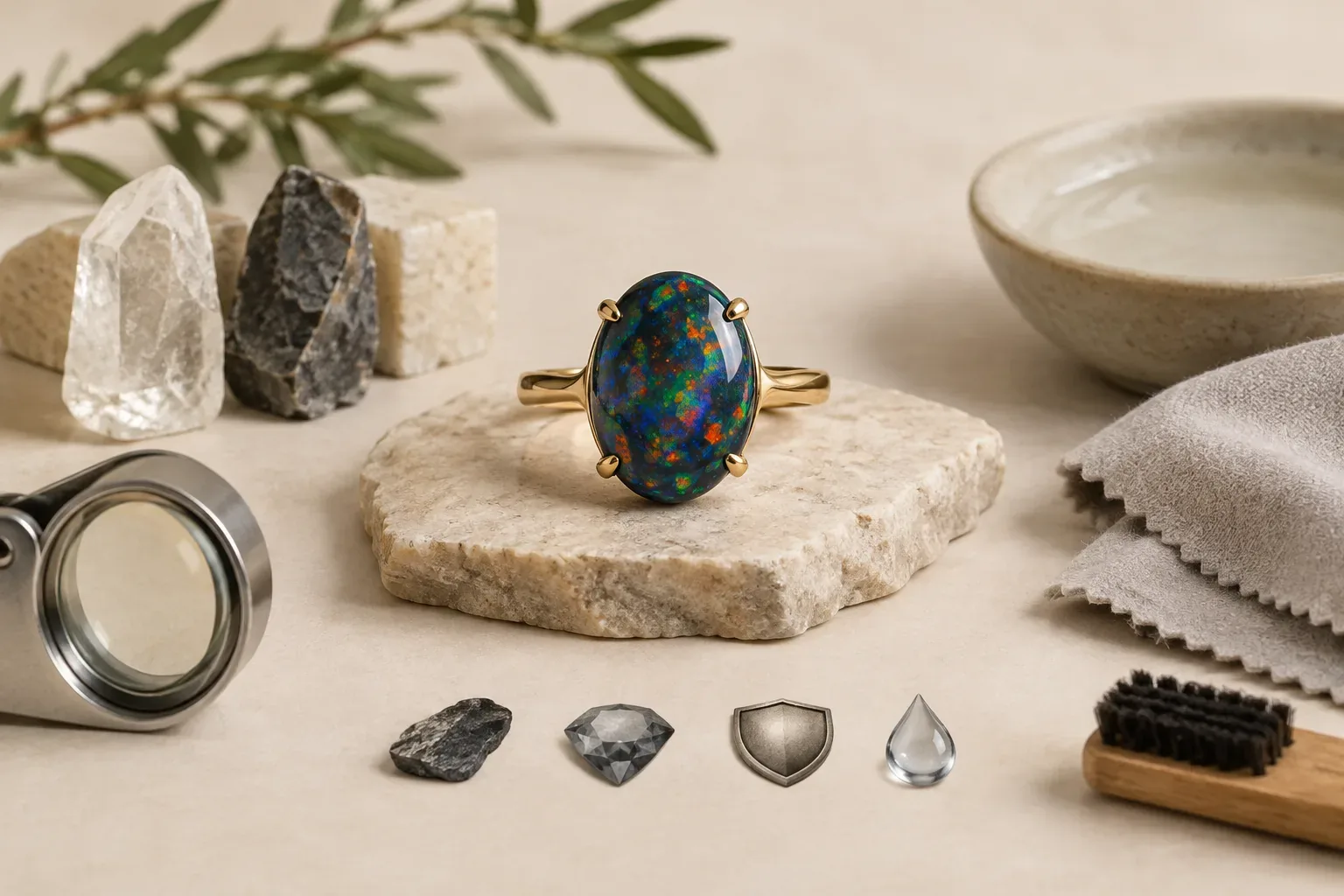
Meaning at a glance
This guide answers the search intent behind "black opal durability guide" by defining the durability factors that matter for black opal, giving decision criteria for buying and wearing, outlining practical trade-offs for daily use, listing safe care steps, and explaining which attributes require a qualified jeweler or gemological laboratory to verify.
Direct answer — what this guide will give you
Answer thesis: This black opal durability guide defines the specific durability concepts—hardness, toughness and stability—that determine whether a black opal is suitable for daily wear, gives clear decision criteria and practical trade-offs for buyers and gifters, provides safe-care steps, and explains what can only be verified by a qualified jeweler or gemological laboratory. The rest of the article explains those items in plain language and cites the consumer- and trade-focused sources used to form those recommendations.
What gem durability means: hardness, toughness and stability
Durability for any gemstone is the combination of at least three related properties. Hardness describes resistance to surface scratching; toughness covers a stone's resistance to breaking, chipping or cleaving when struck or stressed; and stability (sometimes called chemical or environmental stability) covers how a stone reacts to light, heat, moisture and chemicals. Together these determine how a gem will perform in different types of jewelry and in everyday life.
For black opal, all three properties matter. Because opal is an internal mosaic of silica and water (and, in the case of black opal, interrupted by black or dark background material that makes play-of-color vivid), surface scratches, sudden impacts and rapid environmental change can affect appearance. Consumer guidance and gemological resources emphasize that 'durability and special care' are distinct concerns for different gem materials, so buyers should treat opal with more caution than harder, tougher gems typically used for daily-wear engagement rings (Gemological Institute of America).
Historical evidence and cultural meanings — what the approved sources show
The four approved sources used for this guide focus on modern consumer, trade and laboratory concerns—market demand, treatment and disclosure, and consumer protections—and do not provide detailed primary historical documentation of cultural beliefs about black opal. That means there is insufficient material in the reviewed sources to attribute precise historical meanings to specific cultures or time periods. Stated differently: the evidence base for this article is contemporary trade and consumer guidance rather than primary historical scholarship.
Where writers and sellers discuss opal’s historical symbolism outside these sources, they often mix legend, literary references and modern marketing. Because the approved sources do not document those historical claims, this article separates modern interpretation and folklore from the verified, contemporary durability and disclosure guidance that matters for buying and caring for black opal today.
Documented gem treatments, disclosure and consumer protections
The Gemological Institute of America highlights that treatments, disclosures and detectability are core consumer questions for gemstones. Sellers and buyers should expect full disclosure when a gem has been treated to improve appearance or durability, because treatments can change how a stone should be cared for and its long-term behavior. The Federal Trade Commission also requires clear distinctions among natural, lab-created, treated and imitation materials, and recommends written seller disclosures for gemstones, so shoppers should ask for documentation before purchase.
Practically, that means when you consider a black opal you should explicitly ask whether it is natural, treated, assembled, doublet or triplet (constructions that combine thin opal with backing and/or a clear cap), or a simulant. These construction and treatment choices alter durability and care needs, and they are exactly the sort of information that, by law and good practice, a reputable seller should supply (Federal Trade Commission; Gemological Institute of America).
Documented historical meanings versus modern personal interpretations
Because the approved source set does not provide precise historical documentation for cultural meanings attached to black opal, any historical claims presented without proper citation should be treated as modern interpretation or folklore rather than fact. Modern personal interpretations—what individuals feel the stone symbolizes today—are valid as contemporary meaning but are not the same as documented historical beliefs.
When selecting or gifting a black opal for symbolic reasons, distinguish between confirmed historical facts (which are not provided in the reviewed sources) and personal or cultural meanings you or the recipient may bring to the stone. Be clear in conversation or in a gift note whether you are invoking a documented tradition or a personal sentiment.
How black opal appears in jewelry and why that matters for wear
Black opal is most commonly used as a focal gem because of its color play and visual impact. Jewelers set it into rings, pendants, earrings and brooches, or they use opal doublets and triplets when cost or durability is a concern. Settings that protect the edges and face—such as bezel or partially bezel settings—reduce the risk of chipping, while prong settings can expose the stone to knocks.
Because the way a gemstone is set directly affects how it tolerates daily wear, a black opal set in a protective bezel or used as a pendant will generally fare better in everyday use than an exposed stone in a high-profile ring. Trade and consumer trend reporting also shows a rise in demand for sculptural and gemstone-centric jewelry, including opal rings and necklaces, so artisans and retailers increasingly offer designs that balance showiness with protective settings (Professional Jeweller / PRYA Jewellery Search Insights; Imaginaire Digital).
Selection and gifting guidance: what to ask and what to expect
Ask the seller for the following before you buy or gift a black opal: whether the material is natural or treated; whether it is solid opal, a doublet or triplet; and whether any stabilization or filling has been applied. Request written disclosure and, if possible, a gemological report for higher-value pieces. The Federal Trade Commission recommends written seller disclosures so buyers have clear evidence of what they are purchasing.
Match the setting to the intended use. For frequent wear—daily rings or bracelets—choose a protective setting and consider lower-profile designs. For occasional wear or for pieces primarily intended as keepsakes or occasional statement jewelry, you can prioritize visual impact. If you are gifting a black opal as a symbol or for its beauty, include care instructions and be explicit about whether the stone is natural or assembled; that transparency helps the recipient care for the jewel appropriately and protects the value of the gift.
Practical care guidance for daily wear and maintenance
Treat black opal gently. Avoid ultrasonic cleaners, steam cleaning and exposure to harsh chemicals or prolonged direct sunlight and heat, because those factors can affect the stone’s appearance or hydration state. The GIA emphasizes that durability and special care needs vary by gem material, and some gems require gentler cleaning and handling.
Routine care: store opal jewelry separately from harder gems to avoid scratches, remove opal pieces before sports, gardening, dishwashing or heavy manual tasks, and clean with a soft cloth and mild water-based soap if needed. If the opal is in a cleaned or complex mounting, follow the jeweler’s care guidance and have settings checked periodically for security.
Trade-offs and repair options to consider when buying
Budget, appearance and durability often compete. Solid black opal gives the most direct, long-term beauty but may require more careful handling. Doublets and triplets offer cost savings and extra surface protection but involve bonded layers that can delaminate if exposed to heat or solvents. Sellers should disclose these constructions; if they do not, walk away from the purchase or insist on written confirmation (Federal Trade Commission).
If damage occurs, repairs such as re-polishing, re-cutting or re-setting are possible in many cases, but such interventions change the stone and its value. High-value pieces should be assessed and repaired only by experienced lapidaries or qualified jewelry professionals, because amateur repairs can worsen problems or decrease resale value.
What you can and cannot verify without a jeweler or laboratory
You can verify some basic purchase facts yourself: ask for written disclosure about whether the opal is natural, treated, assembled or a simulant, and inspect the piece visually for obvious layered constructions like triplets (which often show a clear cap over a thin slice of opal on a dark backing). Reputable retailers should supply this information in writing.
You cannot reliably verify more technical attributes—such as whether a subtle treatment has been applied, precise origin claims, or the presence of certain treatments—without testing by a qualified jeweler or a gemological laboratory. When in doubt about treatment, permanence, or origin—items that affect care needs and long-term value—request a report from a recognized gemological lab or a professional appraisal; the GIA notes that detectability and disclosure of treatments are key consumer issues and that laboratory testing is the authoritative route for complex questions.
Making a final decision: practical checklist
Before buying or gifting a black opal, confirm whether it is solid, a doublet or triplet; get written disclosure on treatments; choose a protective setting that matches intended wear; understand cleaning and storage needs; and, for high-value purchases, obtain a gemological report or appraisal. This sequence of checks aligns with both consumer protection guidance and best practice in the trade.
If you want an everyday ring, prioritize protective design and lower-profile settings; if you want a striking showpiece for occasional wear, you can prioritize the largest or most spectacular play-of-color, but accept increased care needs. The contemporary trade and consumer sources reviewed here confirm rising consumer interest in opal and gemstone jewelry, which means more options are available to match whichever trade-off you prefer (Imaginaire Digital; Professional Jeweller / PRYA Jewellery Search Insights).
Conclusion
A black opal’s suitability for daily wear depends not on a single number but on a combination of hardness, toughness and stability, as well as the stone’s construction and the setting chosen. Use the decision criteria in this guide—request written disclosure, choose an appropriate setting, follow gentle care rules, and consult a jeweler or gem lab for technical verification—to enjoy black opal safely and responsibly. The GIA and FTC resources highlighted here are the basis for those practical recommendations, and trade trend reporting underscores that opal remains a fashionable and increasingly available gemstone choice.
Frequently asked questions
Can I wear a black opal ring every day?
You can wear a black opal ring every day only if you match the stone’s construction and setting to daily use—choose a protective setting (for example, a bezel or low-profile mount), avoid exposure to heat, chemicals and hard impacts, and follow gentle cleaning and storage practices. For high-value pieces or those with delicate constructions, consider reserving daily wear for low-impact activities.
How can I tell if an opal is a solid opal, doublet or triplet?
Some layered constructions can be seen with the naked eye: triplets often show a clear cap over a thin opal layer on a dark backing, and doublets typically have a visible seam where the opal slice meets the backing. Ask the seller for written disclosure, and obtain a gemological report for high-value pieces to confirm construction and treatments.
What cleaning method is safe for black opal?
Clean black opal with a soft cloth and mild soap in lukewarm water; avoid ultrasonic and steam cleaners, harsh chemicals, and extreme temperature changes. Dry gently and store separately from harder gems to prevent scratches.
Do treatments affect how I should care for a black opal?
Yes. Treatments, stabilization, and layered constructions affect both durability and care. Treated or assembled opals may delaminate or discolor under heat or solvent exposure. Always request written disclosure and follow any care advice the seller or lab report provides.
When should I get a lab report or professional appraisal?
Obtain a gemological report or qualified appraisal for high-value purchases or when the seller makes claims about rarity, origin or subtle treatments. A laboratory report is the authoritative way to verify treatment, origin, or whether a material is natural versus synthetic or assembled.
Can scratches, chips or delamination be repaired?
Some surface scratches can be polished out and some chips can be re-cut or re-set, but repairs alter the stone and can reduce value. Delaminated doublets or triplets may be difficult to restore; consult an experienced lapidary or jeweler for an assessment before attempting repairs.
Sources and further reading
- Imaginaire Digital — Imaginaire Digital
- Professional Jeweller / PRYA Jewellery Search Insights — Professional Jeweller / PRYA Jewellery Search Insights
- Gemological Institute of America — Gemological Institute of America
- Federal Trade Commission — Federal Trade Commission