Meaning at a glance
Opals can make beautiful, distinctive engagement rings but require different selection criteria and care than harder gemstones; buyers should weigh aesthetic appeal against durability and disclosure needs and rely on qualified jewelers or gem labs for definitive identity and treatment reports.
What the evidence-led thesis means here
This article follows the stated thesis: it defines decision criteria for choosing an opal engagement ring, explains practical trade-offs between beauty and durability, gives safe-care guidance, and clarifies what shoppers can and cannot verify without a qualified jeweler or a gemological laboratory.
Historical evidence and cultural claims
Among the approved sources for this article there are no specialist historical studies that document cultural attitudes to opal across named periods or societies. The sources provided focus on contemporary market trends, consumer protections, and gem-treatment issues rather than primary cultural history. Because of that gap, this guide does not attribute specific historical meanings to particular cultures or periods as factual claims. Readers who need precise historical source citations should consult dedicated gemological history works or museum archives.
Documented meanings versus modern personal interpretations
Where the available evidence is documentary, it concerns how gemstones are treated, disclosed and sold, not cultural beliefs about their symbolism. Modern personal interpretations are common with opal: some buyers prize opal for its shifting flashes of color and associate it with individuality or creativity. Those modern, personal meanings are subjective and vary by wearer; they should be treated as personal symbolism rather than documented historical fact. For legal and commercial matters—such as whether a stone is natural, lab-created, treated or imitation—consult the seller’s written disclosure and, for confirmation, an independent lab report as recommended by the Federal Trade Commission.
How opal appears in jewelry and common settings
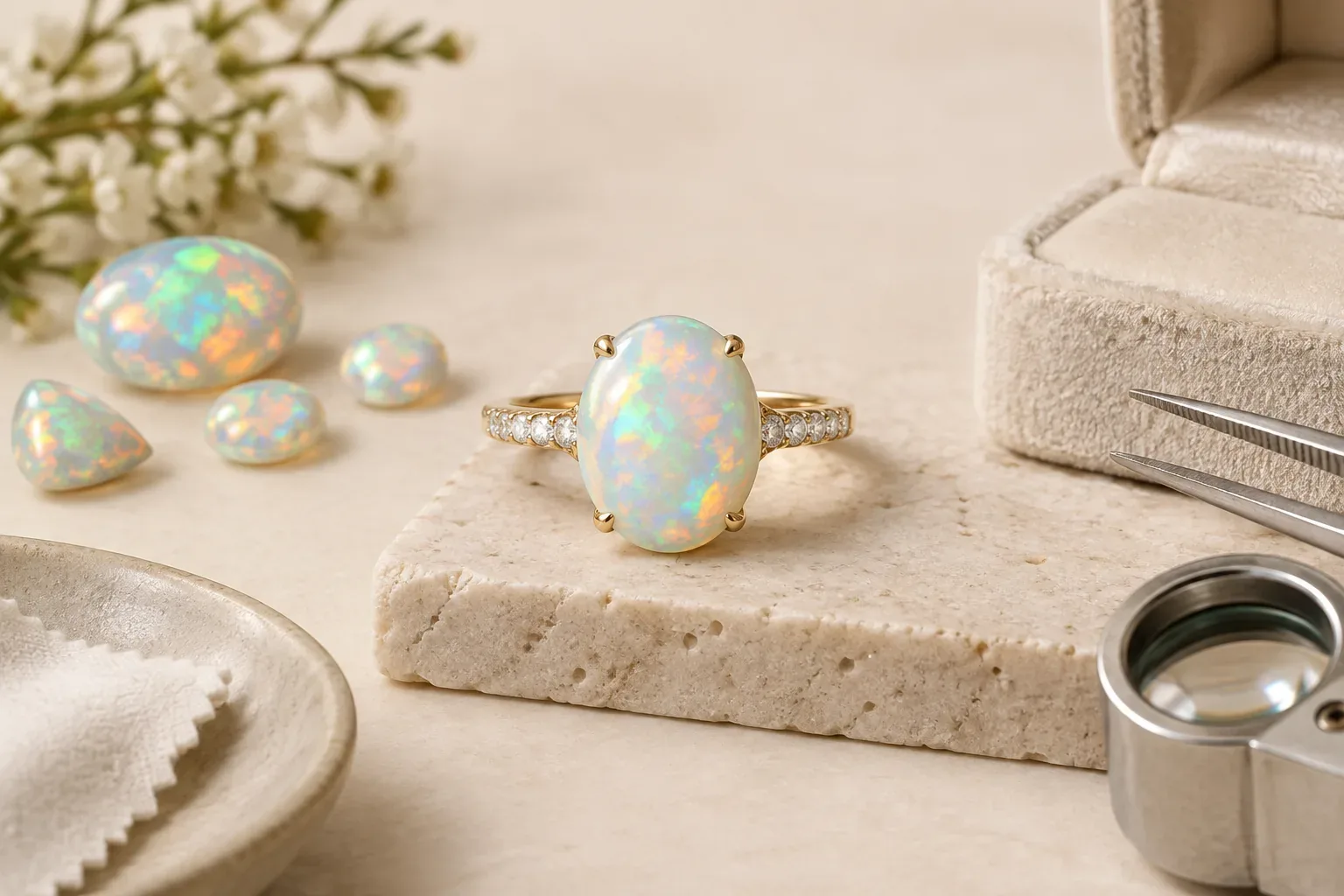
In contemporary jewelry opals are used as single-stone centerpieces, in clusters, as accents in halos, and as accent or pendant stones. Designers often highlight an opal’s color play by surrounding it with small accent stones or by using contrasting metalwork to draw the eye. Because opals are generally softer than many traditional engagement gemstones, jewelers commonly use protective settings such as bezels or partial bezels that surround the stone’s edge to reduce the risk of chips and impacts. Prong settings are also used when the design emphasizes maximum light exposure, but they leave more of the stone exposed to knocks and abrasion. If a design exposes the table and shoulders, expect to accept higher maintenance needs.
Suitability: decision criteria and practical trade-offs
When deciding whether an opal makes a suitable engagement ring, weigh three practical criteria: the wearer’s lifestyle, the chosen setting, and the kind of opal or material being offered. If the wearer has an active hands-on job or does frequent manual tasks, a softer gemstone increases the chance of scratches, chips, or surface crazing over time unless the ring is worn only for special occasions. A protective setting and a low-profile design reduce risk, but cannot eliminate it. The aesthetic payoff is that opals offer color play and individuality not found in most colorless stones, and they suit nontraditional or artistic tastes.
Selection and gifting guidance
Start by asking the seller for clear written information about whether the opal is natural, lab-created, treated or an assembled product, as the Federal Trade Commission advises that such distinctions be disclosed to consumers. Ask whether the opal is a solid specimen or an assembled stone, and whether it has undergone any stabilizing treatments or dyeing. For trend context, recent trade reporting shows growing interest in opal and gemstone rings in current market searches, so you will find a wider range of styles and settings than a few years ago, but that does not substitute for disclosure or inspection.
What you can and cannot verify without a lab or qualified jeweler
Without a qualified jeweler or a gemological laboratory you can verify visual attributes such as color play, body tone, approximate size and whether a stone appears to be assembled, but you cannot definitively determine treatments or origin. The Gemological Institute of America warns that treatments, detectability and durability issues create distinct consumer questions that often require instrumentation and expertise to resolve. If the purchase price or personal importance warrants certainty about natural origin, treatment history or permanence, obtain an independent laboratory report from a recognized lab.
Care and maintenance: practical safe guidance
Opals generally require gentler care than harder gems. Avoid exposing an opal engagement ring to strong heat or rapid temperature changes, harsh household chemicals, bleach, or acid-based cleaners, and avoid ultrasonic or steam cleaning unless a qualified jeweler confirms the stone’s suitability. Remove the ring for heavy manual work, sports where impact is possible, or prolonged exposure to water and detergents. Gentle cleaning with mild soap, lukewarm water and a soft cloth is the safest routine for most opals. Store the ring separately in a soft pouch or lined box to prevent abrasion. Regularly inspect settings for loose prongs or mounting wear, and have repairs carried out by a jeweler experienced with softer gems.
Trade-offs, warranty, and professional services
Expect trade-offs between visual impact and long-term wearability. A low-profile bezel will protect an opal but will reduce how much light reaches the stone compared with an elevated prong setting. Many retailers offer warranties or service plans; read those terms closely because they are not a substitute for correct disclosure about the stone’s identity. If you want permanent documentation, commission a gemological report that lists identification, treatments, and any assembled construction. The GIA and FTC materials remind consumers that treatment disclosure and lab verification are the routes to clarity when certainty matters.
Concluding guidance
An opal engagement ring is a good choice for someone who prioritizes distinctive color and is willing to accept additional care and conservative setting choices. Before buying, get written seller disclosures about natural versus treated or lab-created materials, consider a protective setting, arrange for routine inspection and maintenance, and secure an independent lab report when identity or treatment is consequential to value or sentimental importance.
Frequently asked questions
Are opals suitable for everyday engagement ring wear?
Opals can be worn daily, but they are softer and more fragile than many traditional engagement gemstones. Expect to take precautions such as choosing a protective setting, avoiding heavy manual work while wearing the ring, removing it for sports or strenuous activity, and committing to gentler cleaning and routine inspections.
How can I tell if an opal is natural, treated or lab-created?
You should obtain written disclosure from the seller about whether the opal is natural, lab-created, treated or an imitation, as recommended by the Federal Trade Commission. For conclusive identification of treatments or origin you will need evaluation by a qualified jeweler or an independent gemological laboratory, because some treatments and assembled constructions are not reliably detectable by unaided inspection.
What settings are safest for protecting an opal center stone?
Protective bezel or partial-bezel settings are commonly used to shield an opal’s edges from knocks. Low-profile designs and settings that minimize the stone’s exposure reduce the risk of chips. Prong settings expose more surface area and therefore carry greater risk but may be chosen for aesthetic reasons.
How should I clean an opal engagement ring at home?
Clean most opals gently with lukewarm water, a mild soap, and a soft cloth, avoiding steam or ultrasonic cleaners unless a qualified jeweler confirms the stone is safe for those methods. Avoid harsh chemicals, prolonged soaking, and rapid temperature changes.
When should I get a laboratory report for an opal?
Obtain an independent gemological report when the stone’s identity, treatment status or origin materially affects value or your peace of mind. A lab report provides objective documentation that sellers’ written disclosures can be compared against, and it is particularly useful for higher-value purchases or heirloom pieces.
Sources and further reading
- Imaginaire Digital — Imaginaire Digital
- Professional Jeweller / PRYA Jewellery Search Insights — Professional Jeweller / PRYA Jewellery Search Insights
- Gemological Institute of America — Gemological Institute of America
- Federal Trade Commission — Federal Trade Commission