Meaning at a glance
This alexandrite cleaning guide gives clear, conservative home-care steps (gentle warm water, mild soap, soft brush, careful drying and storage), explains trade-offs and limits when treatments or delicate settings might require professional care, and outlines what only a qualified jeweler or gemological laboratory can verify about authenticity or treatment history.
Direct answer — what this alexandrite cleaning guide delivers
This alexandrite cleaning guide gives a practical, conservative plan: inspect the piece, clean gently at home using warm water, a mild detergent and a soft brush, dry and store carefully, and avoid ultrasonic or steam cleaners unless a qualified jeweler has confirmed that the specific stone and any treatments are compatible. The guide also explains decision criteria and trade-offs for buyers and gifters, and clearly states what verification requires a jeweler or a gemological laboratory.
What the documented evidence (and approved sources) supports about care and disclosure
The approved sources used to create this guide do not provide a detailed historic narrative about alexandrite itself. Instead those sources establish a framework you should use when caring for or buying any significant gemstone: the Gemological Institute of America (GIA) emphasizes that treatments, disclosure, detectability, durability and special care are distinct consumer questions for gemstones. The U.S. Federal Trade Commission (FTC) advises consumers to obtain clear written disclosures separating natural, lab-created, treated and imitation materials. Industry trend reports from Professional Jeweller and Imaginaire Digital show continuing demand for gemstone rings, engagement pieces and other fine jewelry, which is relevant when deciding how often a piece will be worn and what kind of care is practical.
Documented historical meanings vs modern personal interpretation
The approved sources used here do not document historical symbolic meanings specific to alexandrite. That means there is no verified historical narrative in this article about how particular cultures used or symbolized alexandrite. Modern meanings—what a giver or wearer personally attaches to a gem—are subjective and culturally variable; they are not verified facts and should be described as personal interpretation. When a seller or family member describes a sentimental or cultural meaning, treat that as contemporary, personal context rather than a documented historical claim. For legal and purchasing clarity, follow FTC guidance and ask for written disclosure about origin or treatments rather than relying on symbolic descriptions.
How alexandrite and similar gemstones typically appear in jewelry today
Industry trend reports indicate where gemstones commonly appear in modern jewelry. Professional Jeweller’s 2026 reporting highlights growth in gemstone rings, charm clusters and birthstone necklaces, and Imaginaire Digital’s 2026 UK search analysis shows strong consumer demand for engagement rings, bracelets, earrings and necklaces. Although these sources do not name alexandrite specifically, they show the commercial contexts where a gemstone of this type is likely to be set: as a center stone in rings, in pendants and necklaces, in earrings and sometimes as part of cluster or halo designs. Understanding the likely setting helps you evaluate practical care needs—rings worn daily will require different protection and inspection frequency than occasional wear pendants.
Safe home cleaning methods (conservative, evidence-led approach)
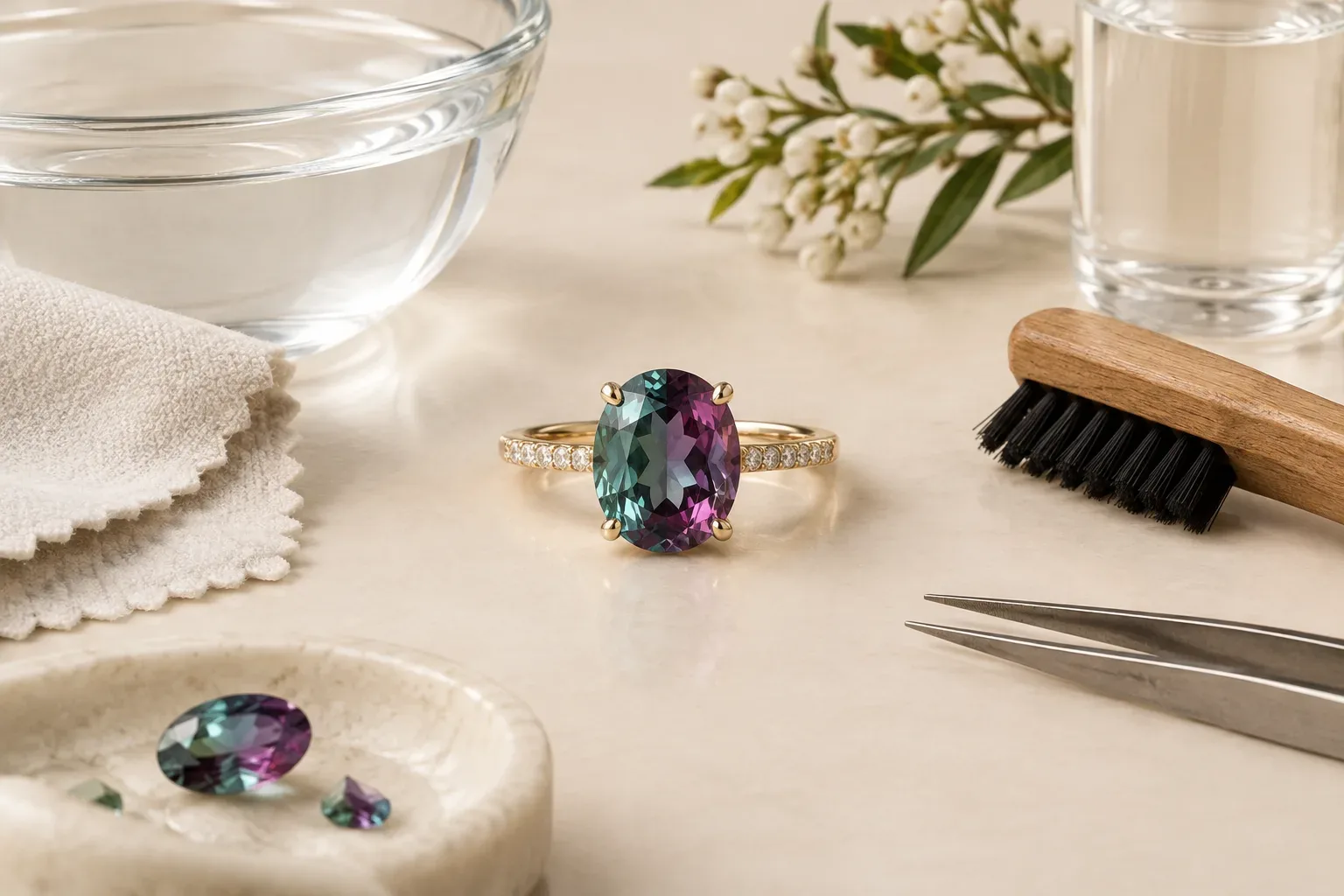
Before cleaning, visually inspect the mounting and stone for loose prongs, chips or inclusions that reach the surface. If you see visible damage, stop and consult a jeweler; attempting to clean a compromised setting can make problems worse. For routine cleaning, use a conservative method that minimizes risk: prepare a bowl of lukewarm water with one or two drops of a mild, phosphate-free dish detergent, gently swish the jewelry to loosen dirt, and carefully work a soft-bristled brush (for example, a new soft toothbrush or a brush made for jewelry) around the setting and under the stone. Rinse with clean lukewarm water, blot dry with a soft lint-free cloth, and let the piece air-dry fully on a soft surface before storing it. This method balances cleanliness with low mechanical and chemical stress and is consistent with the cautious approach advised by gem-care guidance.
What to avoid when cleaning—practical limits and trade-offs
Avoid using household bleach, chlorine-based cleaners, acetone or abrasive polishes; these can damage metal settings and potentially affect any surface treatments. Do not use steam or ultrasonic cleaners unless a qualified jeweler has confirmed that the specific stone, its cut and any treatments are compatible with those methods; the Gemological Institute of America warns that treatments and durability issues create distinct care questions for gemstones. High heat, rapid temperature changes, and aggressive mechanical scrubbing can stress settings and may worsen existing cracks or hairline fractures. Removing jewelry before swimming, sports, gardening or heavy manual work reduces the chance of impact damage or exposure to chemicals. The trade-off is convenience: professional cleaning can be more thorough, but routine gentle home care greatly reduces the need for frequent professional intervention.
When to see a jeweler or request a gemological report
Take the piece to a qualified jeweler or gemological laboratory if you need a definitive answer on authenticity, treatment history or origin, or if the stone or setting shows damage. The FTC advises getting clear written disclosures about whether a stone is natural, lab-created, treated or an imitation; the GIA notes that detectability and disclosure of treatments are important consumer concerns. For high-value purchases or gifts, request a current gemological report from an accredited laboratory and obtain written disclosure from the seller. A professional can also advise whether ultrasonic or steam cleaning is safe for your specific item, and can professionally tighten prongs and polish settings without risking the stone.
Selection and gifting guidance—practical and respectful choices
When selecting or gifting a gemstone piece, balance aesthetics, budget and the recipient’s lifestyle. If the recipient wears jewelry daily, prioritize secure settings and ask the seller about maintenance recommendations and warranties. For higher-value purchases, request written disclosure about whether the stone is natural, treated or lab-created and, if appropriate, a gemological laboratory report. The FTC recommends written disclosures to prevent misunderstandings about what you are buying. If provenance or symbolic meaning matters to the gift, ask for documented history from the seller or evidence such as paperwork, but recognize that many sentimental narratives are contemporary interpretations rather than verifiable historical facts. Finally, communicate care needs with the recipient—simple instructions about cleaning frequency and storage show respect for both the gift and the recipient’s life.
Practical storage and routine maintenance
Store gemstone jewelry separate from other pieces to prevent scratching—soft pouches or individual compartments in a jewelry box work well. Avoid storing jewelry in places with extreme temperature or humidity swings. Inspect prongs and mounts every few months if the piece is worn regularly; look for loose stones, bent prongs or any signs of wear. Schedule a professional check-up if you wear the piece daily or if it has complex settings that trap dirt. Regular, conservative home care reduces abrasive buildup and helps keep the piece in a condition that professional maintenance can preserve rather than repair.
Final recap and conservative defaults for non-specialists
In short: use a conservative home-cleaning routine (lukewarm water, mild detergent, soft brush), avoid harsh chemicals and mechanical shocks, and do not use ultrasonic or steam cleaners unless a qualified jeweler confirms they are safe for your specific stone and any treatments. Ask for written disclosure on origin and treatments per FTC guidance and seek a gemological report if you need definitive authentication or if you’re purchasing a high-value piece. When in doubt, err on the side of professional inspection and cleaning—this minimizes the risk of accidental damage and aligns with the GIA’s emphasis on treatment, durability and special care considerations.
Frequently asked questions
Can I safely clean alexandrite at home?
You can follow a conservative home routine: inspect for damage, clean in lukewarm water with a mild dish detergent, use a soft brush, rinse and dry thoroughly. Stop and consult a jeweler if you find loose prongs, chips or other damage.
Is it safe to use an ultrasonic or steam cleaner?
Do not use ultrasonic or steam cleaners unless a qualified jeweler has confirmed the stone and any treatments are compatible. The Gemological Institute of America warns that treatments and durability raise specific care questions for gemstones.
How often should I clean or have a professional check the piece?
Clean gently at home as needed based on wear; visually inspect settings every few months if worn regularly. Have a professional check and service the setting annually or sooner if you notice looseness or damage.
What should I ask the seller before buying or gifting?
Ask for written disclosure about whether the stone is natural, lab-created, treated or an imitation, and request a current gemological report for high-value purchases, in line with FTC guidance on clear seller disclosures.
Can I verify a stone’s origin or treatments at home?
No. Definitive verification of origin, treatments or whether a stone is lab-created requires testing by a qualified jeweler or accredited gemological laboratory.
How should I store the jewelry to prevent damage?
Store each piece separately in a soft pouch or a compartmented jewelry box to avoid contact and abrasion, and keep pieces away from extreme temperature or humidity changes.
Sources and further reading
- Imaginaire Digital — Imaginaire Digital
- Professional Jeweller / PRYA Jewellery Search Insights — Professional Jeweller / PRYA Jewellery Search Insights
- Gemological Institute of America — Gemological Institute of America
- Federal Trade Commission — Federal Trade Commission