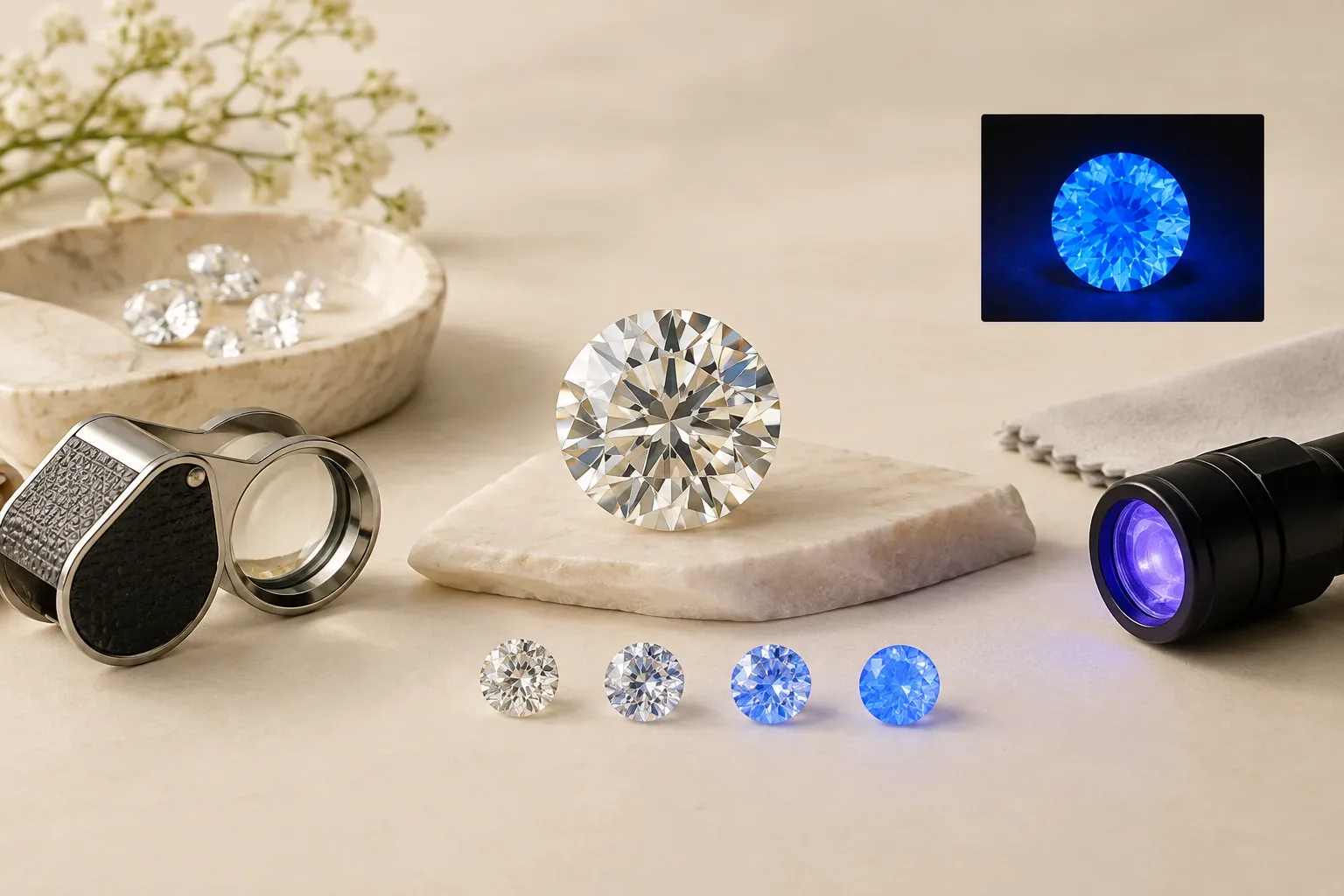
Meaning at a glance
Diamond fluorescence is a measurable optical reaction — usually a blue glow under ultraviolet light — that modern gemology records as a physical property; its practical effects on appearance, price, and care are context-dependent, and a shopper should rely on lab reports and seller disclosure to make an informed choice.
What fluorescence is and how gemology records it
Fluorescence in diamonds is a light-emitting response to ultraviolet radiation. In contemporary gemology this is described and recorded as a trait of the stone rather than as a damage or repair. Laboratories and sellers record the presence and strength of fluorescence so buyers and appraisers can evaluate appearance, durability, and disclosure.
Modern gemological and consumer-protection literature treats fluorescence alongside other measurable properties such as clarity, color, and treatments. The Gemological Institute of America (GIA) describes treatments, detectability and the need for clear disclosure when a gemstone has characteristics or modifications that affect its appearance or value. The Federal Trade Commission (FTC) also emphasizes written seller disclosures so consumers can distinguish among natural, lab-created, treated and otherwise altered materials.
Historical evidence and cultural meanings
In the sources reviewed for this article there is little or no documented evidence that pre-modern cultures assigned consistent symbolic meanings specifically to diamond fluorescence. Historical literature and cultural histories of gemstones tend to focus on color, hardness, and ownership rather than on ultraviolet-induced glow.
The emphasis on fluorescence as a recorded property appears in the modern period with the development of systematic gemology, gemological laboratories, and consumer-protection frameworks. Because the modern record is where fluorescence is primarily measured, documented meanings in our cited sources are derived from laboratory and regulatory practice rather than from ancient cultural symbolism. For discussion of treatments, disclosure and detectability in the contemporary marketplace, see the Gemological Institute of America and the Federal Trade Commission.
Documented (scientific and regulatory) meanings versus modern personal interpretations
Documented meanings in the modern record treat fluorescence as a physical, measurable property. Laboratories note its presence and strength to inform grading, disclosure and valuation. The GIA and consumer-protection authorities focus on detection, disclosure and whether the property has practical consequences for appearance or durability.
Modern personal interpretations — why someone might prize or avoid fluorescence — are a separate category. Some buyers appreciate fluorescence because it can give a stone a lively appearance under certain lighting conditions, while others prefer 'no fluorescence' for predictability. Those preferences are personal and market-driven rather than universal cultural meanings. Sellers and appraisers should not present such preferences as objective facts.
How fluorescence shows up in jewelry
In finished jewelry, fluorescence behaves the same as in loose stones: it may be visible under ultraviolet-rich light sources and less obvious under typical indoor lighting that is low in UV. Under blacklight or certain daylight conditions, a fluorescent diamond can show a soft glow — most commonly blue — that changes the perceived tone and sparkle.
Designers and retailers place fluorescent diamonds in rings, studs, pendants and other pieces without any special structural requirements. The visual effect depends on the stone's fluorescence strength, the diamond's color grade, the cut, and the lighting. In some rings a faint to moderate blue glow can offset slight yellow tint in lower color grades; in other cases buyers prefer a non-fluorescent stone for a more consistent look across lighting types.
Decision criteria and practical trade-offs for buyers
When evaluating whether fluorescence matters for you, start with three practical questions: how important is absolute color consistency across lighting, how sensitive are you to price differences, and in what lighting will the piece be worn most? If you prize a guaranteed uniform appearance under all lighting, prioritize stones with minimal or no fluorescence and insist on lab documentation. If you are budget-conscious, consider that market pricing sometimes reflects fluorescence and that a stone with some fluorescence can offer better value for the same apparent color in many everyday lighting situations.
Trade-offs include visibility versus price and predictability versus perceived liveliness. Fluorescence does not automatically mean a diamond is defective. Conversely, strong fluorescence can sometimes create a milky or oily look in a small number of stones; because this outcome is stone-specific, advice from a qualified gemological laboratory or experienced independent grader is the only way to determine whether a particular stone will show that effect.
Safe care guidance
Fluorescence is an optical response and not a surface treatment, so ordinary cleaning and care for diamonds apply. That said, the GIA notes that treatments and alterations to gemstones are distinct matters that may carry special care or durability considerations, so always confirm that a stone has not been treated in ways that require unusual handling. Because fluorescence itself does not alter the diamond's hardness, standard cleaning with mild detergent, warm water and a soft brush is appropriate for most diamond jewelry.
If a seller or certificate indicates any treatments or enhancements, ask for details and any special care instructions. The FTC advises buyers to obtain written disclosures so the consumer understands whether a gemstone is natural, lab-created, treated or otherwise altered.
What you can and cannot verify without a lab or qualified jeweler
You can perform simple, preliminary checks yourself: ask to see the lab report, inspect the certificate for a fluorescence notation, and view the stone under different lighting (indoor, outdoor, and under a UV source such as a dealer's blacklight) to see whether it exhibits a glow. Sellers should readily provide certificates and let you view the stone in the settings and light conditions you care about.
You cannot, with confidence, assign a fluorescence grade or determine whether a particular visual effect is caused by fluorescence alone without a qualified assessment. Determining whether a fluorescence-related appearance (for example, a milky look) is intrinsic to the stone or the result of surface residue, recutting, or another factor requires microscopy and expert analysis. For authoritative grading, origin, or treatment identification you need a qualified gemological laboratory report.
How to buy or give fluorescent diamonds respectfully and practically
If you are buying for yourself, decide how much weight to give appearance versus price. Ask for the certificate, view the diamond in the lighting you expect to encounter, and request a written note on any fluorescence so you have documentation for insurance and resale. If the jeweler cannot or will not provide clear disclosure, walk away.
If you are gifting, consider the recipient's likely priorities. For recipients who wear jewelry predominantly indoors with artificial lighting, fluorescence is often less noticeable and can be a means to obtain larger or higher-color-appearing stones at better value. For recipients who value consistent, predictable color under all lighting, select a diamond with minimal fluorescence and provide the lab certificate with the gift. Always respect the buyer's or recipient's taste and ask questions rather than assuming fluorescence is a flaw.
Final practical checklist
Before you buy, ask for the diamond's laboratory report and confirm the fluorescence notation. Inspect the stone under the lighting conditions you expect to use it in. Ask whether any treatments have been applied and request written disclosure as recommended by consumer-protection guidance. If in doubt about how fluorescence will affect a specific stone, obtain an independent opinion from a qualified gemological laboratory.
Frequently asked questions
What is diamond fluorescence and when is it visible?
Diamond fluorescence is the emission of visible light from a diamond when exposed to ultraviolet radiation. It is typically visible under a UV source such as a blacklight and can sometimes be noticeable in strong sunlight, but it is often much less apparent under ordinary indoor lighting.
Does fluorescence make a diamond worth less?
Fluorescence does not automatically reduce a diamond's worth. Market pricing can reflect fluorescence, and in some cases a stone with fluorescence offers better value. The effect on value depends on the stone's color, the strength of the fluorescence, and buyer preferences; a laboratory report and clear disclosure are essential for assessing value.
Can fluorescence make a diamond look milky or hazy?
A small number of diamonds with strong fluorescence may show a milky or oily appearance, but this is not universal. Determining whether a given stone will display this effect requires expert grading or laboratory assessment, not just casual inspection.
How can I verify fluorescence before I buy?
Ask the seller for the laboratory report that lists fluorescence, view the diamond under the lighting conditions you expect to wear it in, and request a demonstration under a UV source if available. For definitive grading or treatment identification, obtain a report from a qualified gemological laboratory.
Does fluorescence affect how I should clean or care for a diamond?
Fluorescence is an optical property and does not change a diamond's hardness, so routine cleaning methods for diamonds apply. If any treatments are disclosed, follow specific care instructions associated with those treatments as advised by the laboratory or seller.
Are lab-created diamonds fluorescent?
Lab-created diamonds can exhibit fluorescence, just as natural diamonds can. Whether a stone is natural or lab-created should be disclosed in writing; the FTC advises consumers to obtain clear documentation distinguishing natural, lab-created and treated stones.
Sources and further reading
- Imaginaire Digital — Imaginaire Digital
- Gemological Institute of America — Gemological Institute of America
- Federal Trade Commission — Federal Trade Commission