Meaning at a glance
This opal buying guide gives shoppers definitions and decision criteria for color, clarity, cut and value, explains treatments and disclosure expectations, offers practical trade-offs and care advice, and clearly states which verifications require a qualified jeweler or gemological laboratory.
Quick answer
If you want a concise answer to the search intent behind "opal buying guide": focus first on brightness and play-of-color, then body tone and transparency, then durability and treatment status. Ask the seller for written disclosure about whether the stone is natural, treated, synthetic, a doublet or triplet, and for any lab reports. Choose a cut and setting that protect the stone if you expect daily wear, and consult a qualified jeweler or a gemological laboratory when you need objective grading or an authoritative origin or treatment determination.
Historical evidence and what is documented
Documentation about opal across historical periods is patchy and often treated as folklore in modern gemological literature. Contemporary gemological resources emphasize that many cultural stories surrounding gemstones are anecdotal and not verifiable in a laboratory sense. For this reason, reliable modern guidance about opals focuses on their physical and optical properties rather than on universal cultural meanings, a position consistent with general gemological practice and the way treatments and durability are presented in reference works from institutions such as the Gemological Institute of America.
Separating documented history from modern interpretation
Documented historical claims about specific beliefs or ritual uses vary by source and are not a substitute for physical grading. Modern gemological authorities treat historical anecdotes as distinct from provable characteristics of a stone. By contrast, contemporary personal and cultural interpretations—such as choosing an opal for a creative or emotional gift—are valid personal meanings but should be described as modern interpretations rather than documented historical fact. When sellers or designers present symbolic meanings, treat those as present-day choices rather than verifiable history.
How opal appears in jewelry
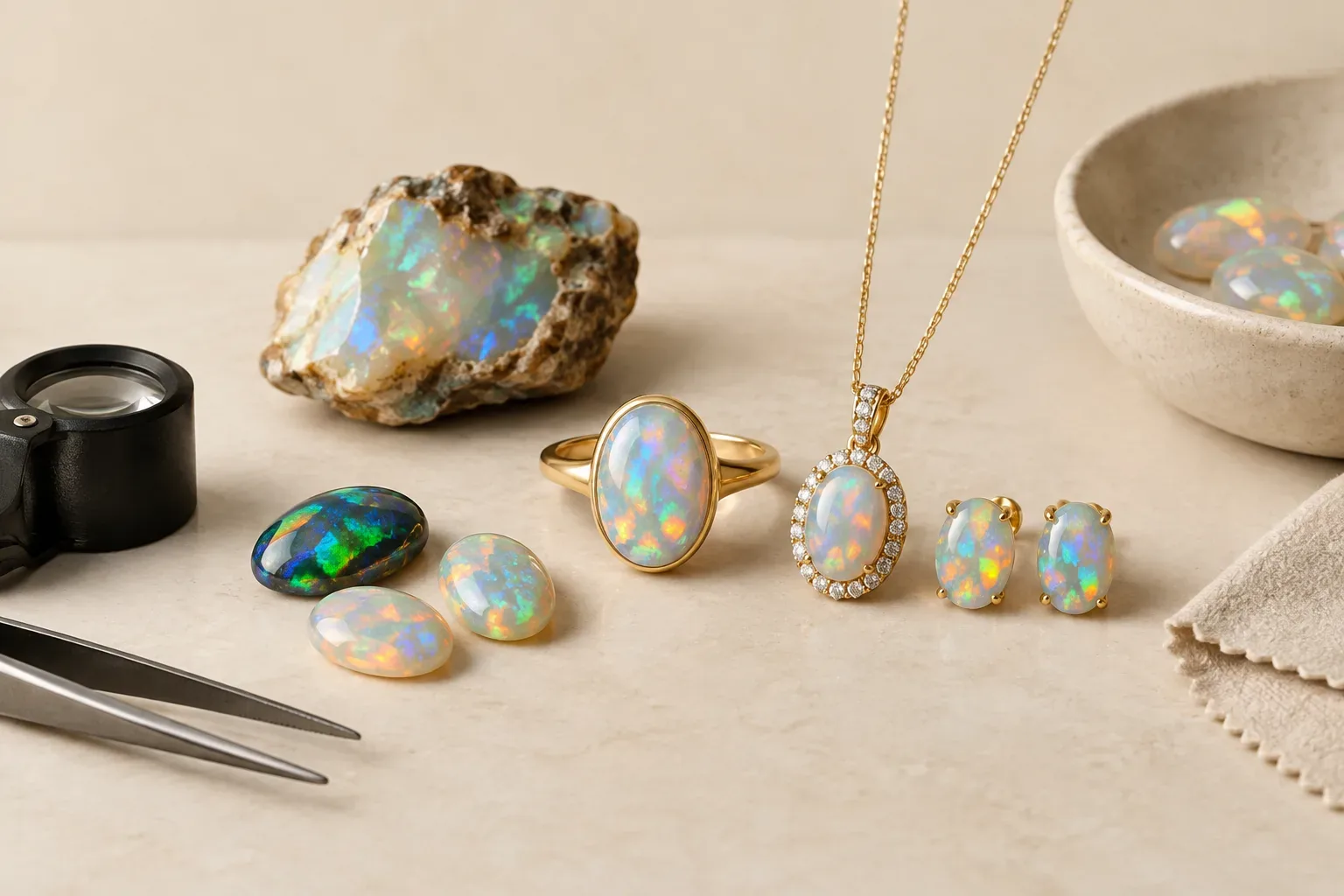
Opal appears in jewelry as single solid stones, doublets and triplets, incabochons, and occasionally faceted gems depending on the material. Because many opals show dramatic play-of-color, jewelers set them as centerstones in rings, pendants and brooches where that optical effect is visible. Designers also use opal accents in cluster rings and inlaid work where the stone is supported by metal or other gems. The choice of setting often reflects durability concerns: bezel settings, protective halos, and lower-profile mounts are common when a piece is intended for frequent wear to reduce the risk of chipping or impact damage.
How to evaluate opal: color, clarity, cut and value
Color assessment in opal is primarily about three attributes: body tone, play-of-color, and brightness. Body tone ranges from very dark (often marketed as black opal) to white, and darker body tones can make play-of-color appear stronger and are often priced higher. Play-of-color is the shifting spectral color you see as the stone moves; its intensity, distribution across the surface, and the specific pattern (for example, broad flashes versus pinfire) all influence desirability.
Clarity in opal is not the same metric as for transparent gems. Instead, clarity observations note inclusions, crazing (surface or internal cracks), potch (non-precious common opal areas) and uniformity of color. Transparent or crystal opals allow light through and can show vivid internal color, while opaque white opals show color differently. Internal fractures and crazing materially affect durability and value.
Cut and shape are primarily about maximizing play-of-color and protecting the stone. Most opals are cut en cabochon to display color rather than faceted, and the height, dome and symmetry of that cabochon change how the colors appear. A well-cut cabochon will centre color and show it across the face; a thin or poorly domed cut can flatten the effect and reduce value.
Value depends on the combination of these factors. In general, stones with strong, multi-hued play-of-color, a dark body tone, bright intensity and a clean, well-cut surface command the highest prices. Trade-offs are common: a large stone with weak color can be less valuable than a smaller stone with vivid brightness. Market interest in opal and gemstone rings has been growing, reflecting broader consumer search trends for opal and gemstone rings reported by trade publications and search estimates.
Treatments, synthetic stones, and required disclosures
Opals may be sold as natural solid opal, assembled doublets or triplets, treated to enhance stability or color, or as laboratory-grown synthetics. The Federal Trade Commission requires clear seller disclosure distinguishing natural, lab-created, treated and imitation materials in jewelry transactions. The Gemological Institute of America explains that treatments, detectability, durability and disclosure are central consumer questions for gemstones. Before purchase, request written confirmation of whether the opal is a solid natural stone, a doublet or triplet, treated or synthetic, and whether any laboratory report accompanies the stone. Sellers should provide return policies and written statements about treatments and origin when asked.
What you can verify without a lab and when to consult experts
Without specialized equipment you can check several practical things: view the stone under different light angles to judge play-of-color and brightness; look at the stone’s edge and profile for layers (a sharp rim line often indicates a doublet or triplet); inspect for glue lines or an artificial backing; and look for crazing lines or visible fractures. Confirm weight, dimensions and the setting type, and ask for a written description that matches what you see. However, origin claims, subtle treatments and whether a stone is a high-quality natural opal versus a synthetic may require microscopic inspection, spectroscopy or other lab tests. For authoritative grading or origin conclusions, consult a qualified jeweler or an accredited gemological laboratory.
Practical selection and gifting guidance
Decide the intended use first: if the recipient will wear the piece daily, prioritize durability, a protective setting and avoid fragile high-domed rings without protective halos. If you are buying for display or occasional wear, you can select more delicate or dramatic stones with higher domes. Choose brightness and pattern according to taste: broad, dramatic flashes often read as bold and showy, while pinfire patterns can be subtle and painterly. For gifting, request seller disclosures and, when appropriate, an independent lab report; keep receipts and ensure a reasonable return policy. Market trends indicate interest in opal and gemstone rings as part of sculptural and birthstone jewelry searches, so consider the recipient’s style and the occasion when deciding size and setting.
Care and handling
Opals are less hard than many other gemstones and can be sensitive to sudden temperature change, strong solvents and impact. Modern gemological guidance underscores that proper care and disclosure about durability are part of responsible sales. Clean opals gently with a soft cloth and mild soap and avoid prolonged soaking, ultrasonic cleaners, and steam. Remove opal jewelry for heavy work, sports and exposure to household chemicals. Store opal pieces separately to prevent scratching from harder gems and metals, and consider periodic checks of the setting to ensure the stone remains secure.
Summary of buyer’s checklist
Ask for written disclosure about whether the opal is natural, treated, synthetic, a doublet or triplet. Evaluate brightness and play-of-color first, then body tone and clarity/crazing. Choose cuts and settings that protect the stone for the intended use, and confirm return and certification policies. Use visible inspection to catch obvious assembled stones, but consult a qualified jeweler or accredited gem laboratory for treatment or origin verification. When in doubt, prioritize sellers who provide clear, written descriptions and are willing to support their claims with documentation.
Frequently asked questions
Are opals durable enough for everyday wear?
Opals are generally softer and more brittle than many gemstones and need protective settings and careful wear. For daily rings choose lower-profile or halo-protected settings, avoid heavy impact, and remove the piece for chores or sports. For authoritative advice about a specific stone’s durability consult a qualified jeweler or an accredited gemological laboratory.
How can I tell a solid opal from a doublet or triplet without a lab?
Look at the stone’s profile and edge for a visible line or layered appearance, examine the back for a dark backing, and check for glue or resin at the join. Brightness that seems confined to a thin top layer suggests an assembled stone. If you remain unsure, ask the seller for written disclosure or a lab report.
What disclosures should I request from a seller?
Request written confirmation whether the opal is natural, treated, lab-created, a doublet or triplet, and ask for any available lab reports. The Federal Trade Commission expects clear distinctions in these categories, so ask for a return policy and a clear, written description accompanying the sale.
Can I clean opal at home and how?
Clean opal gently with a soft cloth and mild soapy water and dry promptly. Avoid ultrasonic cleaners, steam cleaning and strong solvents. Do not subject opal to sudden temperature changes.
When should I get a laboratory report?
Request a laboratory report when you are buying a high-value stone, when the seller claims a rare origin or treatment-free status, or when you need an independent verification for insurance. Labs provide objective tests for treatments, synthetics and origin that visual inspection or seller documentation alone cannot fully confirm.
Sources and further reading
- Imaginaire Digital — Imaginaire Digital
- Professional Jeweller / PRYA Jewellery Search Insights — Professional Jeweller / PRYA Jewellery Search Insights
- Gemological Institute of America — Gemological Institute of America
- Federal Trade Commission — Federal Trade Commission