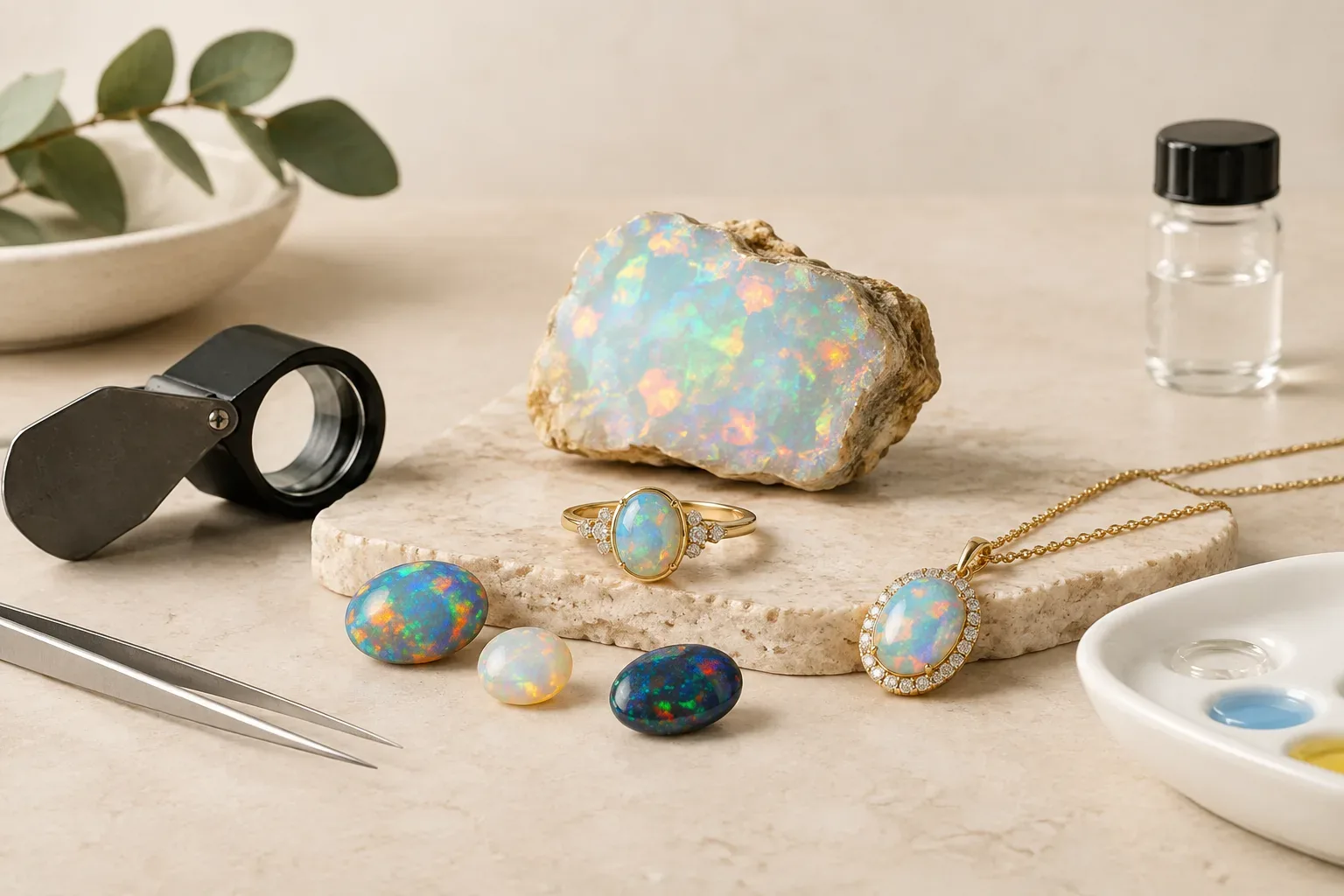
Meaning at a glance
This opal treatment guide defines the treatments buyers commonly encounter (assembled stones, stabilization, color treatments, synthetics and imitations), explains detection and disclosure expectations, outlines the practical trade-offs for value and durability, and sets clear limits on what you can verify without a qualified jeweler or a gemological laboratory.
Common opal treatments — what they are and practical trade-offs
Assembled opals (doublets and triplets) are among the most common 'treatments' you will see in the market. A doublet is a thin slice of natural opal cemented to a dark backing to improve body tone and make the piece durable enough for jewelry. A triplet adds a transparent cap, often quartz or glass, to protect the opal slice and magnify its play-of-color. These constructions conserve rare material and create dramatic appearance at lower cost, but they are less durable than a solid opal and can delaminate if exposed to heat, solvents, or rough wear.
Stabilization and impregnation involve filling porous opal (or its host rock) with a resin, polymer or oil to reduce porosity and improve toughness. Stabilized opals are more wearable in rings or bracelets than untreated, porous opals, but the filling may alter surface luster and may be sensitive to heat or harsh chemicals. The GIA notes that treatments affecting durability and detectability require clear disclosure because they change a gem’s care profile.
Color treatments include dyeing or smoke treatments that darken body tone so play-of-color stands out. They alter appearance significantly and usually reduce resale value compared with naturally dark opals. Some color treatments are difficult to detect with the naked eye and may require magnification, immersion, or laboratory analysis to identify reliably.
Synthetic and lab-grown opals and man-made imitations are widely available. Synthetic opals have ordered internal structures and consistent play-of-color patterns that differ from natural opal microstructures; imitations (glass, plastic) simulate appearance without being opal. The Federal Trade Commission and GIA both emphasize that sellers must clearly identify synthetic and imitation materials and that a gemological lab report is the reliable route to confirmation.
Each of these options balances appearance, price and durability. Solid natural opal (no treatment) is usually highest in perceived value but can be fragile. Assembled and stabilized stones make opal more practical for everyday jewelry and for larger settings at lower cost, but they come with special care needs and lower intrinsic value.
Historical evidence and precise periods for treatments and market practices
Documented evidence for opal-related treatments is primarily a record of how artisans and the gem trade adapted to material constraints. The Gemological Institute of America (GIA) records that assembled stones such as doublets and triplets were developed in the 19th century to make thin opal slices usable in jewelry and that various impregnation and surface treatments have been used since the late 19th and 20th centuries as commercial gem technology evolved.
Trade records and gemological literature show that as opal sources and consumer tastes shifted during the Victorian era and later periods, the market introduced technical solutions (backings, caps, and stabilizers) so manufacturers could present attractive stones without relying only on large, solid opals. These are documented changes in working practice rather than uniform cultural beliefs about the gem.
When we speak of 'historical evidence' here, we are referring to documented manufacturing and trade practices captured in gemological studies and industry records, as summarized by GIA and reflected in modern seller disclosure standards enforced by bodies such as the FTC.
Documented historical meanings versus modern personal interpretations
Documentation about opal in historical records tends to focus on trade, manufacture and classification rather than universally shared symbolic meanings. Scholarly and trade sources record how opal was handled and treated in different commercial periods; these are factual and verifiable in museum records and gemological archives. The GIA and related reference works address those technical histories.
Modern symbolic or emotional interpretations—such as associating opal with inspiration, emotion, or personal symbolism—are contemporary, subjective responses and vary widely between individuals and cultures. Those modern meanings are legitimate personal or cultural interpretations but are not interchangeable with the technical, documented history of how opal was prepared and sold. In other words, whether an opal feels meaningful to the wearer is personal; whether an opal has been stabilized, assembled, or synthetically produced is a technical fact that should be disclosed.
How opal appears in jewelry and how treatments affect style choices
Opal appears in jewelry in several common forms: solid cabochons, thin slices set as doublets, capped triplets, inlay panels, and beads. Solid cabochons display uninterrupted play-of-color and are favored for high-value rings and pendants. Doublets and triplets are popular where dramatic color at lower cost is desired, commonly in fashion rings, earrings and pendant clusters.
Settings for opal often prioritize protection: bezel settings, smooth collars, and low-profile mounts reduce snagging and protect edges. Triplets are frequently set in bezel or rub-over settings because their caps and backs can trap moisture or get dislodged. Stabilized or impregnated opals are more commonly used in rings and bracelets where daily wear is expected.
Motifs using opal range from single-stone solitaires to floral clusters, birthstone jewelry and vintage-inspired designs. Industry trend reporting from Professional Jeweller and search visibility data from Imaginaire Digital indicate growing interest in gemstone rings, sculptural settings and birthstone necklaces—contexts in which opal is frequently chosen for its iridescence and color play.
Practical selection and gifting guidance
Decide your priority first: visual impact, longevity, or budget. If you want the longest-lasting wear and the highest traditional value, choose a solid natural opal and insist on written disclosure and, for higher-value pieces, a gemological report. If you want a showy look on a budget or for occasional wear, a well-made doublet or triplet gives strong color at a lower price.
Ask sellers three clear questions before purchase: Is the opal solid, assembled (doublet/triplet), stabilized, dyed, or synthetic? Does the stone come with a written disclosure or laboratory report? What care and warranty terms do you receive if discoloration or delamination occurs? The FTC emphasizes that clear, accurate description is a consumer right and that sellers should not obscure material facts.
For gifts intended for everyday wear, choose settings and treatments that match. A ring wearer with an active lifestyle should be guided toward stabilized or hard-capped stones and protective settings. For a delicate jewelry collector who values original material, a solid untreated opal in a protective bezel or pendant might be the better choice.
If provenance and long-term value matter, plan for a gemological report from a recognized lab. Professional Jeweller’s market reporting and search trends show renewed interest in gemstone rings and birthstone jewelry; a documented solid opal in a well-crafted setting will better retain collectible value than an untreated but heavily worn piece without provenance.
Care advice and what you can verify without a lab
Opals are sensitive to heat, sudden temperature changes, harsh chemicals, and prolonged immersion in water in some construction types. Avoid ultrasonic cleaners and steam; clean gently with warm water, mild soap and a soft cloth. Be mindful that assembled stones (doublets/triplets) can delaminate when soaked or exposed to solvents.
Visually you can identify some signs: a layered appearance at the edge suggests a doublet or triplet; bubbles or an unnatural uniformity of pattern can indicate synthetic or imitation material. Weight and heft may suggest glass or plastic imitations, while movement of a cap or a dark line at the junction can indicate an assembled stone. However, these are not definitive tests.
Only a qualified jeweler using magnification and simple non-destructive tests, or a gemological laboratory using instruments and microscopic analysis, can reliably distinguish many treatments and confirm natural versus synthetic origin. The GIA cautions that detectability varies by treatment and that laboratory reports are the reliable evidence of a stone's identity and treatment history. The FTC also underscores that written disclosure by the seller is required when treatments, synthetics or reconstituted materials are present.
Frequently asked questions
What are the most common opal treatments I should know about?
The most common treatments are assembled stones (doublets and triplets), stabilization/impregnation, color treatments (dyeing or smoke), synthetics and imitations. Each has different effects on appearance, durability and resale value, and the GIA recommends disclosure for treatments that change durability or appearance.
How can I tell if an opal is a doublet or triplet without lab testing?
You can often see a layered edge under magnification, or a visible line between cap and body in triplets. A bezel-mounted stone may hide layers, so these visual checks are not definitive; a qualified jeweler or lab can confirm construction reliably.
Do treatments make opals less durable?
Some treatments, such as stabilization, are designed to improve durability, while others (assembled stones) can introduce failure points like delamination. Avoid exposing treated opals to heat, solvents and ultrasonic cleaning. The GIA explains that durability varies by treatment and requires corresponding care.
What should I ask the seller before buying an opal?
Ask whether the opal is solid, assembled, stabilized, dyed, synthetic or an imitation, and request written disclosure or a laboratory report for higher-value purchases. The FTC emphasizes that sellers should provide clear information about treatments and origin.
Will a gemological report always detect treatments?
Qualified gemological laboratories use instruments and microscopy that identify most common treatments and synthetic origins. The GIA advises that detectability depends on the treatment and the tests used, so a recognized lab report is the most reliable way to confirm identity and treatment history.
Can I wear opal jewelry every day?
You can wear opal jewelry daily if the construction and treatment suit daily wear: choose stabilized or capped stones in protective settings for rings. Solid high-quality opal can be worn daily with care, but all opals benefit from protective settings and avoidance of harsh chemicals, extreme heat or impact.
Sources and further reading
- Imaginaire Digital — Imaginaire Digital
- Professional Jeweller / PRYA Jewellery Search Insights — Professional Jeweller / PRYA Jewellery Search Insights
- Gemological Institute of America — Gemological Institute of America
- Federal Trade Commission — Federal Trade Commission