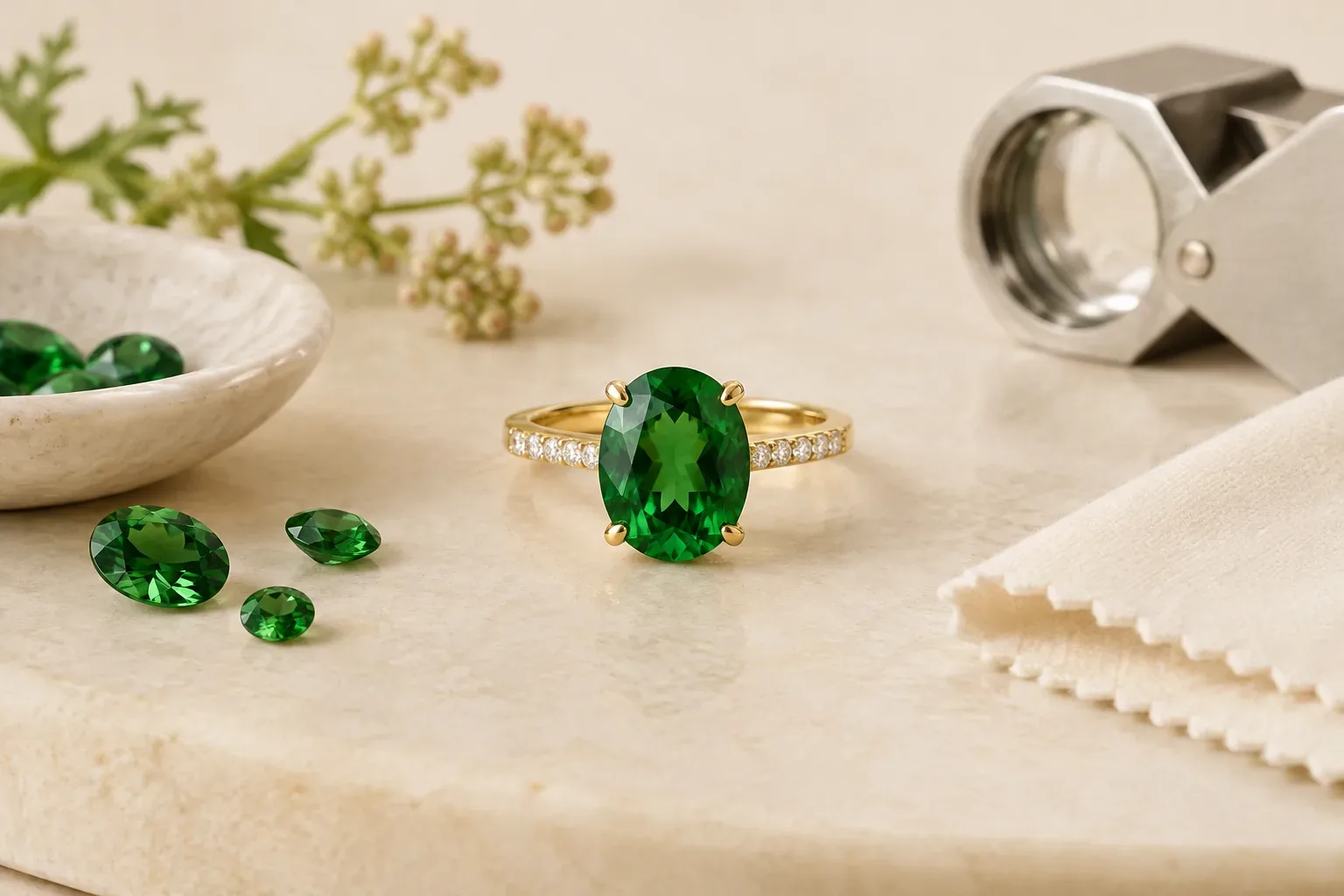
Meaning at a glance
Tsavorite garnet makes a striking and perfectly acceptable choice for an engagement ring when you balance color and durability expectations, choose suitable settings, insist on written seller disclosures, and obtain laboratory or qualified-jeweler verification for origin and treatments.
Short answer — direct guidance
Short answer: A tsavorite garnet engagement ring can be a beautiful, durable, and distinctive alternative to diamond or other colored-stone rings, provided you use evidence-based decision criteria: evaluate the stone’s color and clarity against your style priorities, choose settings that protect the stone, insist on written disclosure about whether the gem is natural, treated, or lab-created, and get independent verification from a qualified jeweler or gemological laboratory for anything the seller does not document. This guide explains the practical trade-offs, how tsavorite is used in ring design, safe care, and the limits of what consumers can verify without professional services.
What documented historical evidence exists for tsavorite?
Documented historical evidence for tsavorite is limited because tsavorite entered modern gem markets in the 20th century and does not have a long pre-modern cultural record. Sources focused on consumer gemology emphasize that many questions about modern gemstones concern treatments, disclosure, detectability, and durability rather than ancient cultural meaning; for example, the Gemological Institute of America (GIA) highlights how treatments and disclosure shape consumer questions about gemstones.
Contemporary market and trend reports place tsavorite in the wider context of rising consumer interest in colored gemstones. Industry analyses note growing demand for gemstone rings, sculptural settings, and vintage-inspired styles, which influence how recently discovered gems such as tsavorite are used by designers in engagement jewellery; Professional Jeweller and PRYA Jewellery Search Insights identify growth in sculptural jewelry and Art Deco revival that often incorporate colored gems, while Imaginaire Digital’s search data shows strong consumer interest in engagement-ring categories generally.
Documented historical meanings versus modern personal interpretations
Because tsavorite lacks a deep pre-modern history in documented cultural records, there are few reliable historical meanings tied to specific cultures or eras that can be attributed to it. That absence of long-standing cultural association differs from stones like sapphire or ruby, which have well-documented historical uses and symbolism in named cultures.
Modern meanings applied to tsavorite are primarily personal, commercial, or contemporary designer narratives rather than documented cultural beliefs. People and retailers may attach ideas such as renewal, energy, or a connection to the vivid green of East African landscapes, but these are modern interpretations and should not be presented as universal or historically rooted. The Federal Trade Commission reminds consumers that sellers must make clear distinctions among natural, lab-created, treated, and imitation materials, which is particularly important when modern marketing emphasizes symbolic or emotional narratives.
How tsavorite appears in engagement jewelry
In contemporary jewelry design tsavorite is most commonly used as a center stone for colored-stone engagement rings, as accent stones in halo or cluster settings, and in three-stone or mixed-gem designs. Designers leveraging current trends often pair tsavorite with sculptural metalwork or vintage-inspired motifs; trade reporting notes a renewed appetite for sculptural pieces and Art Deco references, both of which suit vivid-color gemstones.
Because the gem’s vivid green offers strong visual contrast, tsavorite is often mounted in white metals (such as platinum or white gold) to maximize color pop or in yellow gold for warm, vintage-forward looks. Settings that protect the crown and girdle, such as bezel, halo-protected prong, or low-profile cathedral settings, are commonly recommended for engagement rings intended for daily wear.
Decision criteria: suitability and practical trade-offs
When deciding whether a tsavorite garnet engagement ring is right for you, evaluate four practical criteria: color preference, clarity and visible inclusions, durability for daily wear, and documentation about origin and treatment. Color is often the primary value factor for colored gems; choose the hue and saturation you prefer and compare stones in similar sizes to understand how color scales with carat weight.
Clarity matters for durability and appearance. Some garnets can contain inclusions that affect toughness or create stress points; buyers concerned about durability should inspect stones under magnification with a qualified jeweler. Durability and special care questions are prominent for many gemstones, and the GIA points out that detectability and durability influence consumer questions and care needs.
Documentation and disclosure are non-negotiable practical items. The Federal Trade Commission advises consumers to seek clear written information from sellers about whether a gemstone is natural, lab-created, treated, or an imitation. For any claim about origin, whether from a named country or deposit, or about treatments that may be subtle, a gemological laboratory report or evaluation from a competent, independent jeweler is the only reliable verification.
Settings and stylistic recommendations
Choose settings that reflect both aesthetic goals and protection needs. Solitaires in four-prong settings showcase color but leave the stone more exposed; a halo or bezel offers extra security and can make a smaller tsavorite appear larger. Three-stone settings provide a balanced, symbolic layout and allow the tsavorite’s color to be framed by diamonds or other gems.
If you plan daily wear, prefer settings that protect the girdle and crown and reduce snagging. Sculptural and Art Deco-inspired settings, which trade reports show are growing in popularity, work particularly well with vivid green stones because they combine strong geometric or architectural metalwork with the gem’s color to create a distinctive statement suitable for an engagement ring.
Care and maintenance — safe practices and limits
Follow conservative, routine care practices appropriate for colored gemstones. The Gemological Institute of America emphasizes that treatments, detectability, durability, and special care create distinct consumer questions for gemstones; for this reason, when a seller discloses treatments or special handling instructions you should follow them precisely. If a seller does not provide clear guidance, ask for it in writing before purchase.
For cleaning and everyday care, use gentle methods and avoid unverified mechanical or chemical treatments unless advised by a qualified jeweler. For any repairs, stone tightening, or verification of damage, rely on an experienced jeweler or laboratory rather than self-repair. When provenance, treatment history, or authenticity matters to you, obtain a written laboratory report or an evaluation from a reputable gemological laboratory or qualified independent jeweler; the FTC recommends written seller disclosures and documentation to protect buyers.
Practical selection and gifting guidance
If you are choosing or gifting a tsavorite engagement ring, start by clarifying priorities: do you prioritize the most vivid green, maximum carat weight, minimal visible inclusions, long-term durability for daily wear, or a particular setting style? Use those priorities to rank what you will compromise on because colored-gem buying almost always involves trade-offs between color, size, clarity, and budget.
Insist on written disclosures from the seller about whether the stone is natural, treated, or lab-created, and request a recent photo and, when applicable, a gemological report. If the recipient values traditional certification or long-term resale confidence, budget for a laboratory report from a recognized lab or for an independent appraisal. For surprise proposals where lab paperwork is not feasible beforehand, plan to obtain verification promptly after purchase and keep the receipt and any seller statements in writing.
How to verify what you cannot see
Buyers cannot reliably confirm origin, synthetic status, or many treatments by sight alone. Relying on a seller’s word without documentation risks misrepresentation. The FTC explicitly warns consumers to seek clear distinctions among natural, lab-created, treated, cultured, and imitation materials and recommends that sellers provide written disclosures. For technical questions about treatments, detectability, and durability, seek a laboratory report or a qualified jeweler’s evaluation; the GIA highlights this need for independent verification in its discussion of consumer questions about gemstones.
If a seller offers lab reports, check the report’s issuing laboratory and date. If the stone is being sold without documentation, factor the additional cost of post-purchase laboratory testing or an independent appraisal into your decision.
Frequently asked questions
Is tsavorite reliable for an everyday engagement ring?
Tsavorite can be suitable for daily wear when set and cared for appropriately, but suitability depends on the stone’s clarity and the chosen setting. The Gemological Institute of America notes that durability and special care are common consumer concerns for gemstones, so choose protective settings and follow professional care guidance. If durability is a top priority, have a qualified jeweler inspect the stone and setting and consider an independent evaluation before committing to daily wear.
How can I verify whether a tsavorite is natural or treated?
You cannot reliably verify natural status or treatments by sight alone. The Federal Trade Commission advises buyers to insist on written disclosures from sellers about whether a gemstone is natural, lab-created, treated, or an imitation, and the Gemological Institute of America recommends laboratory or qualified-jeweler testing for detecting certain treatments. Obtain a current laboratory report or an independent appraisal for definitive verification.
What settings protect a tsavorite best?
Settings that protect the crown and girdle—such as bezels, halo-protected prongs, and low-profile cathedral mounts—offer more physical protection than open, high-prong solitaires. Choose a design that balances the desired aesthetic with protection appropriate for an engagement ring intended for frequent wear.
Do sellers have to disclose treatments and origin claims?
Yes. The Federal Trade Commission requires clear distinctions and written disclosures about natural, lab-created, treated, cultured, and imitation materials. If a seller makes claims about origin or treatments, ask for documentation and, when necessary, obtain an independent laboratory report.
Should I get a lab report for a tsavorite engagement ring?
If provenance, treatment history, or resale value matters to you, budget for a laboratory report or an independent appraisal. A recognized gemological laboratory or a qualified jeweler can confirm natural versus lab-created status and detect certain treatments that are not visible to the naked eye.
Sources and further reading
- Imaginaire Digital — Imaginaire Digital
- Professional Jeweller / PRYA Jewellery Search Insights — Professional Jeweller / PRYA Jewellery Search Insights
- Gemological Institute of America — Gemological Institute of America
- Federal Trade Commission — Federal Trade Commission