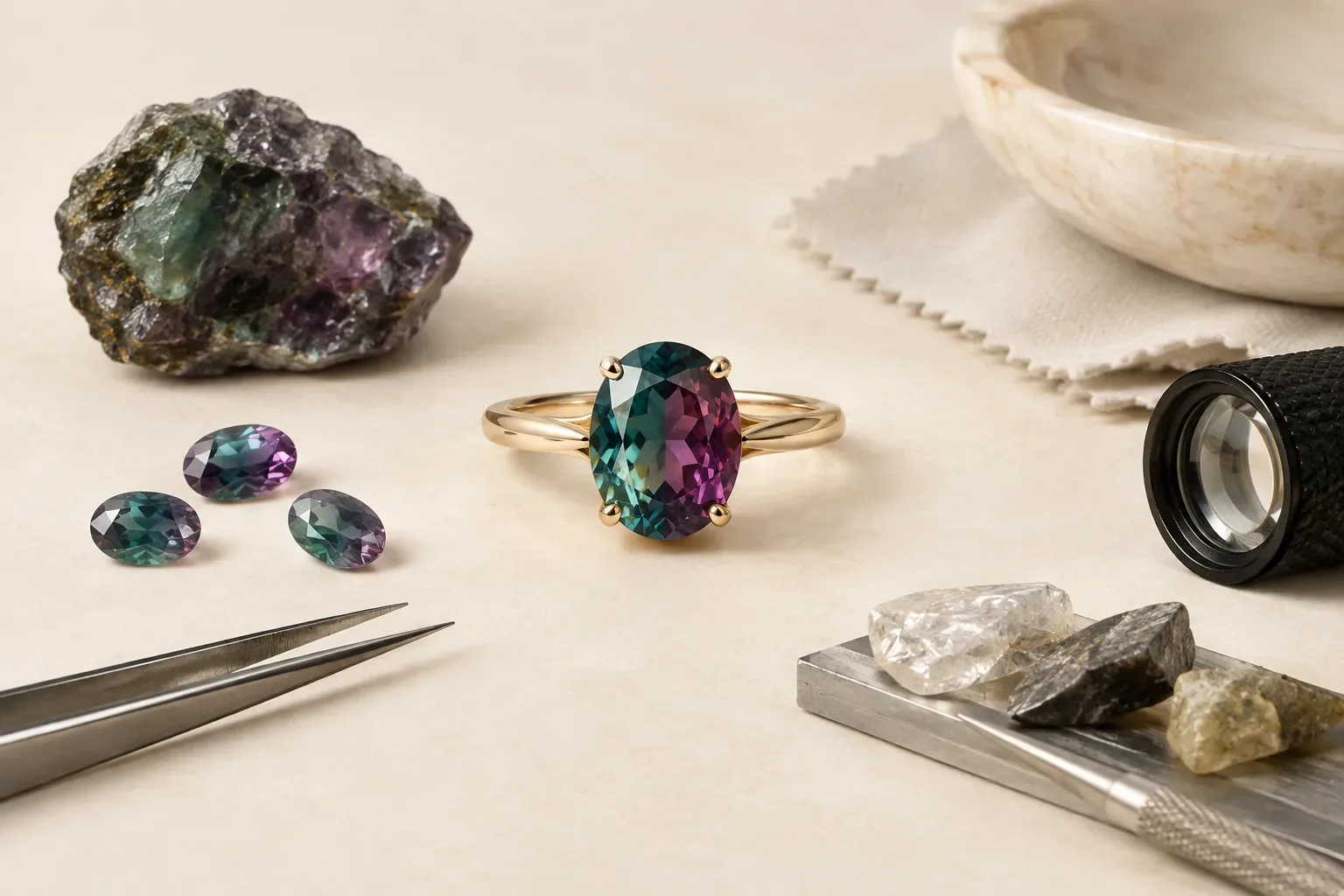
Meaning at a glance
This guide explains hardness and toughness definitions, practical trade-offs for daily wear, safe care steps drawn from gem trade guidance, and what shoppers can verify only with a qualified jeweler or gemological laboratory.
Direct answer — what 'alexandrite durability guide' should give you
The practical answer to someone searching for an "alexandrite durability guide" is not a single number but a decision framework: know the stone's hardness and toughness characteristics, confirm whether it is natural, treated or lab-grown through seller disclosures or a laboratory report, choose settings that protect exposed edges for daily wear, and follow conservative cleaning and care practices until a jeweler or lab confirms specific treatment stability. This article provides clear decision criteria, trade-offs for daily wear, safe-care guidance based on gem-trade principles, and the limits of what you can reasonably verify without a qualified jeweler or a gemological laboratory.
Understanding hardness, toughness, and stability (what those words mean for wear)
Hardness, toughness and stability are distinct properties that determine how a gemstone performs in jewelry. Hardness describes resistance to scratching; toughness describes resistance to breakage from impact or cleavage; and stability describes how a material responds to heat, chemicals and light. These are separate concepts: a stone can be hard yet brittle, or tough but relatively soft, and each quality affects daily-wear decisions differently.
The Gemological Institute of America (GIA) emphasizes that treatments, disclosure, detectability and special care are part of consumer durability questions. That means when assessing a specific alexandrite, you should ask about any treatments that might change its apparent hardness or stability and whether any special cleaning or handling is required.
Documented history and cultural meanings — what the evidence shows
Readers often expect a concise cultural history for a named gemstone. The approved sources for this article do not supply a historical or cultural timeline specific to alexandrite. Because the available evidence in this brief includes trade and consumer-protection guidance rather than primary historical documentation, this guide separates documented history from modern interpretation and does not attribute any historical origins or symbolic meanings to particular cultures without supporting source citation.
Separating documented history from modern personal interpretation is important. When historical evidence is available it should be attributed to primary historians, museums or dedicated gemological references. In the absence of such material in the current evidence set, any cultural or historical claims about alexandrite in this guide are intentionally limited to noting that modern jewelers and buyers often attach personal meanings to gemstones independent of documented history.
How alexandrite and similar gemstones appear in contemporary jewelry
Trade reporting shows current consumer interest in gemstone rings, birthstone necklaces and sculptural jewelry forms. Professional Jeweller and related industry analyses identify growth in gemstone rings and birthstone necklaces as notable trends, and Imaginaire Digital reports continuing strong demand for engagement rings, bracelets, earrings and necklaces in the UK market. These trend signals explain why alexandrite is commonly offered in rings and pendants today: jewelers follow consumer interest in colored gemstones and sculptural settings.
Because industry trends favor visible, faceted stones and designs that highlight color shift or rarity, alexandrite—when available—tends to be set in shapes that maximize color appearance, such as oval or round faceted cuts, and often appears in rings, pendants and stud or drop earrings. Designers may choose protective settings such as bezels or halos if the design aims for frequent wear, while open prong settings are often used when the priority is maximum light exposure and color display.
Decision criteria and practical trade-offs for daily wear
A shopper deciding whether to wear an alexandrite piece daily should weigh several practical trade-offs. If daily wear and low maintenance are top priorities, prefer settings that protect the stone's girdle and pavilion and select styles that minimize exposure to hard knocks. If maximum color display and light performance are more important, a more open mounting can be chosen, with the understanding that it may require more careful daily handling.
Ask the seller for written disclosures about whether the stone is natural, treated or lab-created, and whether any treatments affect durability. The Federal Trade Commission advises that consumers need clear distinctions among natural, lab-created, treated and imitation materials and written seller disclosures. If a stone has been treated in ways that affect how it responds to heat, chemicals or ultrasonic cleaning, those details are essential for your selection and care plan.
When evaluating value and rarity trade-offs, consider that higher-value pieces often use more open settings to show off the stone and that protective settings typically lower the risk of accidental damage but may slightly reduce visual drama. Balance your aesthetic priorities with a realistic assessment of how often you will subject the piece to everyday activities, cleaning or travel.
Selection, gifting, and verification guidance
For purchasing or gifting, request written documentation from the seller. The FTC's consumer guidance stresses the importance of written disclosures, and the GIA reminds buyers that treatments and detectability matter to durability. A reputable seller should disclose whether the alexandrite is natural, lab-grown, treated, or an imitation and should be able to explain any stability concerns and recommended care.
If you need an independent verification, ask for a report from a recognized gemological laboratory or a qualified appraiser. Without a laboratory report or a qualified jeweler's assessment, you cannot reliably confirm certain properties such as the precise hardness, the presence of specific treatments, or whether the color-change effect is natural or simulated. Expect to pay for independent testing when provenance, treatment status or insurance valuation depends on definitive identification.
When gifting, include care instructions and recommend setting choices aligned with the recipient's lifestyle. If the recipient lives an active life with frequent hand use, favor a protective setting and include a suggestion to remove the piece during strenuous chores or sports. If the recipient prioritizes display and wears jewelry mainly for special occasions, an open setting may be appropriate with a note to avoid rough wear.
Cleaning, handling and safe-care recommendations
Follow conservative cleaning practices until a gemological lab or experienced jeweler confirms that the stone and any treatments are stable under stronger cleaning methods. The GIA's guidance acknowledges that treatments and durability concerns create distinct consumer questions and that special care may be needed depending on the treatment.
As a practical baseline, avoid steam cleaning and ultrasonic cleaning unless you have confirmation from the seller or a gemological laboratory that those methods are safe for the specific stone and any treatments. Use a soft, lint-free cloth and mild soapy water for routine cleaning and dry the piece thoroughly. Store gemstone jewelry separately to prevent harder stones or metal components from scratching it.
When to consult a qualified jeweler or laboratory
Consult a qualified jeweler or a gemological laboratory when you need definitive answers that affect purchase, insurance or long-term care. Typical situations include when a seller cannot provide clear written disclosure about natural versus lab-grown origin, when you need to know whether treatments are stable to heat or chemicals, or when a piece has visible damage and you require a repair plan.
Only a gemological laboratory can issue an authoritative identification report and often the only way to confirm treatment types or origin claims. Use that report as the basis for insurance valuations or for high-value gifting decisions. A qualified jeweler can advise on the safest setting for daily wear and whether existing damage is a surface scratch or a structural concern requiring professional repair.
Final takeaways
The proper way to approach an alexandrite purchase for daily wear is evidence-led: understand the distinct concepts of hardness, toughness and stability; require written seller disclosures about origin and treatments; choose protective settings if daily wear is intended; follow conservative cleaning until lab confirmation; and use a qualified jeweler or laboratory when definitive identification matters. Industry and consumer-protection guidance emphasize disclosure and testing as the only reliable routes to remove uncertainty.
Frequently asked questions
How do hardness and toughness affect whether I can wear alexandrite every day?
Hardness affects resistance to scratches and toughness affects resistance to chips or breaks; both matter for daily wear. Ask the seller or a qualified jeweler for the stone's hardness and toughness characteristics and request written disclosure about any treatments that affect durability. If you cannot obtain that information, choose a protective setting or reserve the piece for occasional wear.
Can I verify if an alexandrite is natural or treated without a lab report?
No. The Federal Trade Commission recommends clear written seller disclosures for natural, lab-created, treated and imitation materials, but verifying origin or specific treatments definitively usually requires a report from a recognized gemological laboratory or a qualified independent appraiser.
Are there cleaning methods I should avoid until I know a stone's treatment status?
Yes. Until a laboratory or the seller confirms stability, avoid steam and ultrasonic cleaners and strong chemicals. Use mild soapy water and a soft cloth for routine cleaning and follow any additional care instructions provided by the seller, in line with guidance from the Gemological Institute of America about special-care concerns for treated gems.
What setting types are best for regular wear?
Protective settings such as bezels or partial bezels reduce the risk of knocks to the stone's edges and girdle and are generally better for regular wear. Open prong settings show more of the stone but expose it to impact and require more careful handling. Consult a qualified jeweler for a setting recommendation that matches your lifestyle.
Should I get an independent lab report for insurance?
If the piece has significant value or if you need an authoritative basis for insurance or resale, obtain a report from a recognized gemological laboratory. Lab reports are often required by insurers to confirm identity, treatments and value, and they remove uncertainty that can affect coverage decisions.
What questions should I ask a seller before buying an alexandrite piece?
Ask whether the stone is natural, lab-grown, treated or an imitation and request written confirmation. Ask whether any treatments affect care, whether the stone has been stabilized or enhanced, what setting type is recommended for daily wear, and whether the seller can provide or arrange an independent laboratory report if you need definitive identification.
Sources and further reading
- Imaginaire Digital — Imaginaire Digital
- Professional Jeweller / PRYA Jewellery Search Insights — Professional Jeweller / PRYA Jewellery Search Insights
- Gemological Institute of America — Gemological Institute of America
- Federal Trade Commission — Federal Trade Commission