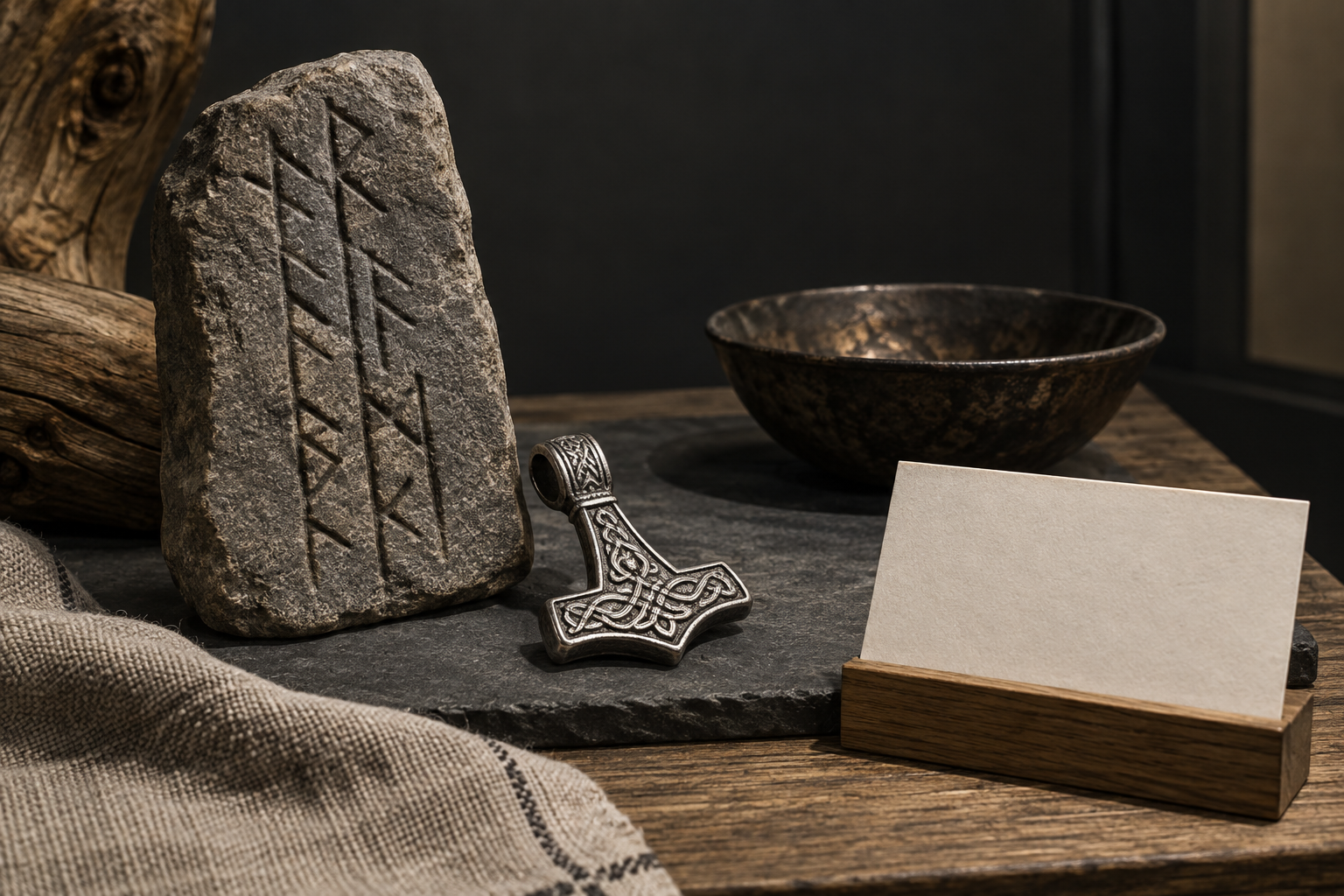
Meaning at a glance
Ancient Norse and runic symbols are not inherently hateful, although some have been appropriated by extremist movements; responsible interpretation depends on the complete design, accompanying signs, stated intent, and social context.
What the historical evidence actually shows
Our best surviving evidence for runes, inscriptions, and much Viking-age material culture comes from archaeological finds and museum research. The Swedish History Museum explains the role of runes largely as a writing system found on stones, metalwork, and other artifacts, and presents the material sources scholars use to study Norse culture and symbolism. These primary and secondary objects—inscribed stones, personal items, and reliquary-style jewelry—provide the direct evidence we have for how people in different Norse and Scandinavian contexts used motifs and signs.
It is important to keep cultures and periods distinct. When researchers and museums describe runic writing and iconography they are usually referring to material from the Viking Age and related Norse contexts conserved in Scandinavia and beyond. The Swedish History Museum’s overviews make clear that runes were part of everyday and commemorative practice on specific artifacts; they are evidence of lettered inscription, naming, and commemoration rather than of a single monolithic symbolic system.
Modern scholarly summaries and museum displays—such as the Swedish History Museum’s pages on runes and on the material sources for Viking studies—are the appropriate places to find what the archaeological record supports. These sources do not present runes and motifs as carrying a single, unchanging ideological message across time and place; rather, meanings are attached to particular objects and contexts by their makers and users.
Documented historical meanings versus modern personal interpretations
Documented historical meanings come directly from inscriptions and the archaeological context in which objects were used. For example, runic inscriptions often record names, ownership, memorial formulae, or short messages; this is the type of reading supported by museum research into rune-stones and inscribed objects, as summarized by the Swedish History Museum. Those are concrete, evidence-based readings tied to the artifact itself.
Modern personal interpretations—how people today might use a rune or Norse motif to express identity, spirituality, or fashion—are different in kind. Contemporary wearers may choose a symbol for reasons unrelated to its original use: family heritage, an interest in Norse mythology, aesthetic taste, or modern spiritual practice. These individual meanings are valid as personal statements, but they are not the same as historically documented functions of the symbol.
A further layer to note is appropriation: some modern extremist and hate groups have adopted certain runes and other Norse motifs as identifiers. The Anti-Defamation League documents at least one such example with the Tyr rune, noting that a symbol rooted in historical practice has been repurposed by some hate groups in modern contexts. That documented appropriation changes how some viewers interpret the mark today, which is why context and provenance matter when wearing or gifting such symbols.
How Viking motifs and runes appear in jewelry today
Contemporary jewelry makers draw on archaeological finds and stylistic traditions when producing pieces inspired by Norse material culture. On the basis of museum collections and scholarship, runes appear as inscribed letters on rings, bracelets, and pendants; stylized animal interlace and motif panels inspired by Viking art show up as cast or carved surfaces; and reproductions of small metal amulets based on finds are common in both historically informed reproductions and modern reinterpretations. The Swedish History Museum’s object pages catalog examples of the kinds of items—metalwork, brooches, and inscribed pieces—that survive from the Norse past and that inspire modern jewelry.
Designers use a range of techniques: casting small reproductions of archaeological forms, engraving runic sequences onto modern metals, and combining ancient-style motifs with contemporary gemstones and settings. Jewelry that references runes can range from single-letter pendants to full band inscriptions; how those pieces are made and presented affects how they will be read in public and by those familiar with extremist appropriations.
Assessing risk: when a symbol may be read as hateful
A historically grounded symbol can become ambiguous when it is combined with other signs, used in specific political settings, or adopted by groups with exclusionary ideologies. The Anti-Defamation League’s profile of the Tyr rune provides a clear, recent example of how an otherwise historical character has been appropriated and used as a hate-group emblem. When a symbol has a documented history of modern extremist use, that use becomes part of its contemporary meaning landscape and may influence how the object is perceived.
Because meaning is partly created by context, the same pendant may be interpreted very differently at a family gathering, a museum tour, or a political rally. The maker’s stated intent, any accompanying literature, and the visual language of a larger outfit or display all influence reception. Responsible wear therefore requires attention to these surrounding cues rather than a simple assumption that a mark is harmless because it is ancient.
Practical and respectful guidance for choosing or gifting Viking-inspired jewelry
First, check provenance and explanation. If you buy from a museum shop, an established historical-replica maker, or a reputable artisan who provides clear notes about the design’s inspiration, you reduce the risk of unknowingly selecting an item associated with extremist groups. The Swedish History Museum’s object descriptions are a good model for the level of contextual information that helps consumers understand what they are buying.
Second, look for explicit labeling or educational materials from the seller. A responsible vendor will describe whether a design is a documented replica, a modern reinterpretation, or a design inspired by multiple sources. If you cannot find a straightforward explanation, ask the seller about the design’s sources and whether they are aware of any contemporary appropriations.
Third, avoid combinations known to have extremist use. Where a particular rune or mark has been singled out by an advocacy organization as used by hate groups, heed that warning and consider alternative symbols or designs. The Anti-Defamation League’s material on the Tyr rune is one example of the kind of documentation that should inform such decisions.
Fourth, consider your recipient’s background and the public contexts where the piece will be worn. A pendant that feels meaningful to one person may feel threatening to someone else with a different history; gifting practices should take potential audience and setting into account. If in doubt, choose pieces with clear, benign explanations—such as historically described reproductions accompanied by an interpretive card—or select designs that explicitly communicate inclusive intent.
Finally, make openness part of the gift. Include a short note explaining why you chose the piece, what historical sources inspired it, and the inclusive intent behind the gift. Clear communication reduces the risk of misunderstanding and demonstrates respect for the broader social meanings attached to certain symbols.
When to consult experts or decline to wear a piece
If you encounter a symbol or combination of symbols that you suspect may have been appropriated by extremist groups, consult reliable institutional sources or advocacy organizations before wearing it in public. The Anti-Defamation League and museum resource pages are appropriate starting points for determining whether a specific rune or design has contemporary problematic use.
If you feel unsure about how a symbol might be read in a given social or political environment, it is reasonable to choose an alternative design for that setting. Avoiding ambiguity is a practical, nonconfrontational way to respect others’ safety and comfort while still engaging with historical aesthetics in private or in contexts where you can explain your intent.
Final note on responsibility and respect
Viking-age imagery and runes can be powerful ways to connect with history, ancestry, or aesthetic preference. At the same time, modern appropriation by extremist groups has altered how some marks are received in public. Using museum resources and advocacy documentation to evaluate designs, asking straightforward questions of sellers and makers, and choosing transparent, historically grounded pieces for public display are practical steps that balance personal meaning with communal respect.
Frequently asked questions
Are Viking symbols hate symbols?
No—Viking-era runes and Norse motifs are not inherently hate symbols. However, a small number of these symbols have been appropriated by extremist groups in modern times, which affects how they may be perceived today. Responsible wear depends on the specific symbol, its presentation, and the social context; consult museum resources and advocacy documentation for particular cases.
Is the Tyr rune a hate symbol?
The Tyr rune is historically a runic character, but the Anti-Defamation League notes that it has been used by some extremist groups in the modern era. That documented appropriation means the rune can carry different contemporary meanings depending on context and usage.
Can I wear a Mjölnir or runic pendant safely?
Many people wear Mjölnir and runic pendants as expressions of historical interest or personal identity; these uses are common and not inherently hateful. To minimize risk of misunderstanding, choose pieces from reputable sellers that provide clear context, avoid combinations known to be used by extremist groups, and be mindful of the public settings in which you wear the item.
How can I check if a design has been appropriated by hate groups?
Begin with credible institutional sources and advocacy organizations that document modern extremist use of symbols. The Anti-Defamation League provides profiles of symbols with known contemporary misuse, and museum object pages and descriptions can show whether a piece is a historically documented artifact or a modern reinterpretation.
What should I say when gifting Viking-inspired jewelry?
Include a brief note describing the piece’s provenance, why you chose it, and your inclusive intent. If the item is a historical reproduction, mention the source or maker and, when possible, a museum reference so the recipient understands the artifact’s documented background.
Sources and further reading
- Tyr Rune — Anti-Defamation League
- Runes — Swedish History Museum
- The sources for what we know — Swedish History Museum