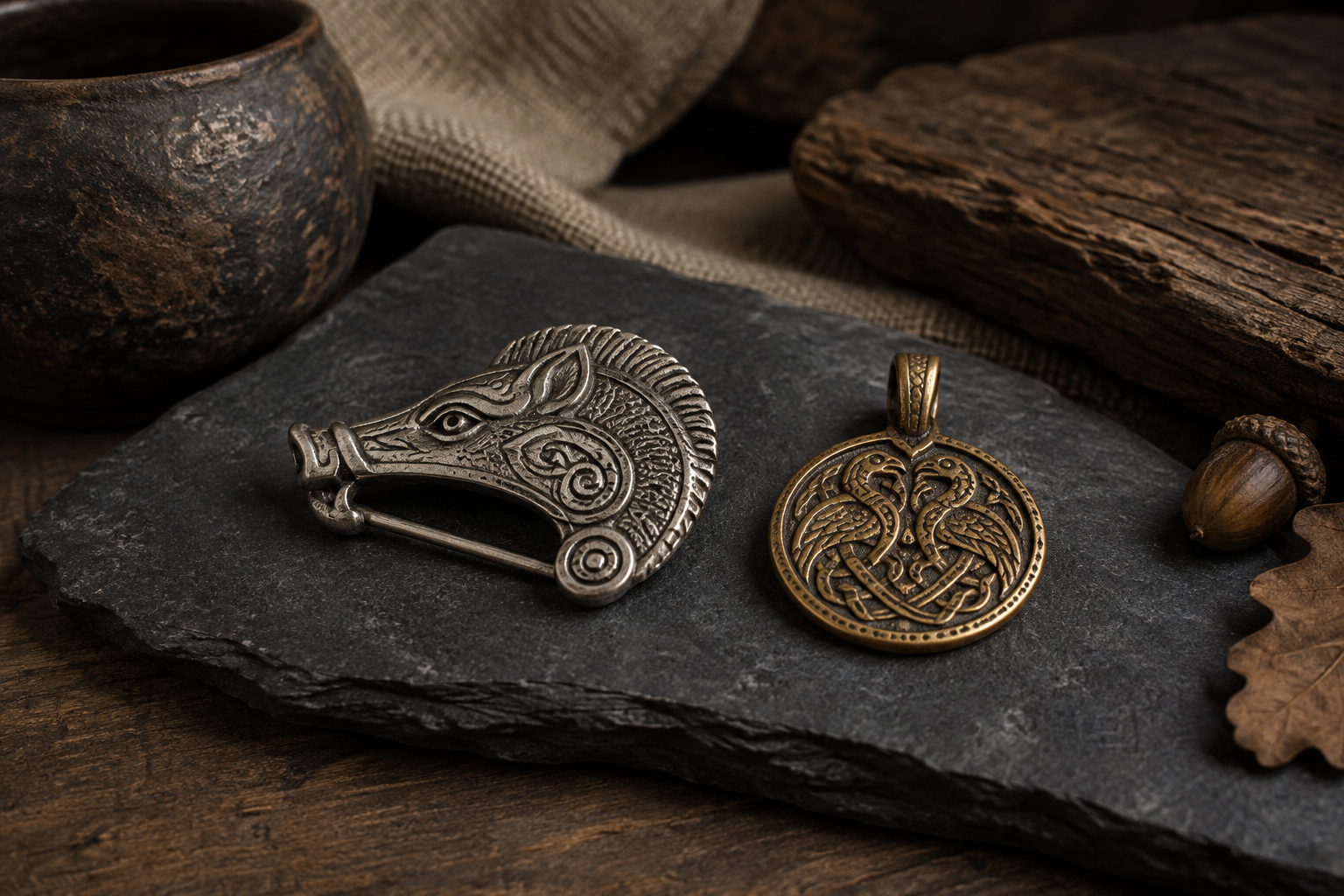
Meaning at a glance
Freyr and the boar are linked in Old Norse literature and boar motifs appear across northern European art, but a boar ornament should not automatically be read as Freyr or given a single ancient meaning.
Historical evidence and chronology — what the sources say
The main literary link between Freyr and a boar is preserved in Old Norse material. Manuscripts collected and edited under the aegis of the Viking Society for Northern Research include the Uppsala Edda and other Old Norse poetic and prose traditions that associate Freyr, a fertility and prosperity deity in the Norse pantheon, with a boar. These texts are the principal medieval literary attestations for that specific association and reflect the beliefs or storytelling of medieval Icelandic and Scandinavian culture as preserved in those manuscripts.
Archaeological and art-historical evidence shows that boar imagery appears in northern European metalwork and decorative art across several related periods. The Metropolitan Museum of Art’s study of Migration Art (A.D. 300–800) documents animal motifs—including boarlike forms—on brooches, fittings, and other objects produced in Germanic and early medieval contexts. That body of material pre-dates, overlaps with, and feeds into the later Viking Age visual vocabulary, so scholars use it to trace how animal motifs were stylized and circulated in Northern Europe.
Museum overviews of Viking religious practice and iconography, such as those published by the National Museum of Denmark, place Freyr within a broader Norse religious framework while cautioning that textual, archaeological, and iconographic evidence must be correlated carefully. The National Museum emphasizes that gods appear in a mix of sources and that identifying a single motif on an artifact with a named deity is often uncertain without clear contextual evidence.
Where the historical record is clear — and where it is not
Documented: Old Norse textual tradition preserved in the Uppsala Edda and related collections explicitly connects Freyr with a boar. These are medieval Icelandic compilations of earlier Scandinavian myths that give us narrative evidence tying the deity to a swine as an attribute or companion.
Documented: Archaeological and stylistic surveys such as the Metropolitan Museum’s Migration Art catalogue show that boar and boarlike animal motifs appear repeatedly in northern European metalwork from the Migration period through the Viking Age. These motifs were part of an established animal style used in jewelry and fittings.
Not documented (or not provable): A single boar-shaped ornament discovered in isolation cannot be taken as proof that its maker intended to depict Freyr, invoke that specific god, or express the precise religious meaning found in later texts. The function and interpretation of animal images varied by region, period, and social context, and museum scholarship cautions against straightforward one-to-one identifications without supporting archaeological context.
Historical meanings versus modern interpretations
Historical meanings that we can substantiate are narrative and iconographic: Old Norse mythic texts link Freyr to a boar, and northern European decorative art used boar motifs in a variety of ornamental contexts. Those are the two strands of evidence that underlie the modern association between Freyr and boar imagery.
Modern personal interpretations are broader and more varied. Contemporary wearers and designers often assign meanings such as fertility, strength, prosperity, or protection to boar jewelry and may label pieces explicitly “Freyr” as a devotional, symbolic, or aesthetic choice. Those modern attributions can be meaningful to the wearer but are not identical to a single, fixed ancient belief supported directly by the medieval textual record or by every archaeological example.
For responsible presentation, sellers, interpreters, and wearers should distinguish between what the medieval sources say and what a modern person chooses to mean by the motif. As the National Museum of Denmark and the Viking Society for Northern Research note, labeling and provenance matter for accuracy.
How the motif and tradition appear in jewelry (historically and today)
Historically, boar imagery appears in metalwork—on brooches, harness fittings, pins, and decorative mounts—documented in Migration period and later early medieval finds. The Metropolitan Museum’s work on Migration Art catalogs these forms and traces stylistic continuities into the Viking Age. Such pieces are often stylized rather than naturalistic, using the period’s animal-interlace and ribbon-style motifs to render heads and bodies.
In modern jewelry, makers draw on those historical forms in several ways. Some reproduce or reference archaeological styles, creating brooches, pendants, or rings that echo the stylized boar heads and bodies seen in museum catalogs. Others create more literal or contemporary representations of boars, sometimes combined with stones, enamels, or modern finishing techniques. Modern materials range from historically common metals like bronze and silver to gold, stainless steel, and newer alloys; gemstones are chosen for aesthetic or symbolic reasons by the designer rather than by any documented ancient convention.
Whether historical or contemporary, presentation and labeling matter. Museum and academic sources recommend clear statements about whether a piece is a modern design inspired by historical motifs, a direct reproduction of a known artifact, or an ancient artifact with archaeological provenance.
Practical and respectful selection or gifting guidance
If you are selecting Freyr- or boar-themed jewelry for yourself or as a gift, begin by deciding whether your interest is historical, spiritual, aesthetic, or a combination. If historical accuracy matters to you or the recipient, ask the maker or seller about source inspiration, whether the design is a reproduction, and, for antiques, for verifiable provenance and documentation.
For religious or spiritual use, be explicit and respectful. Not everyone who wears Norse-inspired motifs intends them as religious symbols, and not every wearer understands the historical complexities. If you give boar jewelry as a devotional gift, consider whether the recipient identifies with modern Heathen or reconstructionist beliefs and whether they would appreciate a piece labeled and sourced thoughtfully.
When buying from a commercial seller, check materials, maker reputation, and return policy. For archaeological pieces or museum-quality reproductions, request documentation and resist claims that a generic boar pendant is automatically an authentic Viking 'Freyr amulet' unless supported by provenance. If you want a tangible link to scholarship, look for descriptions that reference specific finds or texts and cite museum or academic sources.
Finally, consider context and occasion. A boar motif can be a bold personal statement, a historical conversation piece, or an elegant decorative element. Match the style to the wearer’s wardrobe and daily life, and respect cultural contexts by avoiding sensationalized or inaccurate marketing language.
Conclusion
The connection between Freyr and the boar is real in Old Norse literature, and boar imagery is a recurring visual element in northern European art. Those two facts together explain why modern jewelers and wearers often link boar motifs to Freyr. At the same time, careful reading of both the textual and material evidence—following the guidance of the Viking Society for Northern Research, The Metropolitan Museum of Art, and the National Museum of Denmark—shows that a boar ornament does not automatically equal Freyr or carry one fixed ancient meaning. Treat historical claims with nuance, label modern pieces accurately, and choose or gift boar jewelry with attention to provenance, context, and the recipient’s perspective.
Frequently asked questions
Is every boar pendant a symbol of Freyr?
No. While Freyr is associated with a boar in Old Norse literature, museum and academic sources caution that a boar motif on an ornament is not automatically evidence of Freyr worship. Context, provenance, and accompanying iconography are necessary to support a specific religious identification.
Can wearing boar jewelry be a modern religious act?
Yes. Modern practitioners of Heathenry or related paths may wear boar-themed pieces as devotional symbols. That is a contemporary spiritual choice and distinct from claims about a given artifact’s ancient function; clear labeling helps distinguish modern devotional use from historical attribution.
How can I tell if a boar-themed piece is historically accurate or a modern design?
Ask the seller or maker for information. Historically inspired reproductions often cite specific finds or stylistic periods; authentic artifacts come with provenance and documentation. If a listing simply calls an item “Viking” without evidence, treat the historical claim skeptically.
Are certain materials or gemstones traditional for boar or Freyr symbolism?
No single gemstone or modern material is historically documented as 'Freyr’s stone.' Metals like bronze and silver appear in archaeological metalwork, but choices of gemstones and modern alloys reflect contemporary design preferences rather than a documented ancient convention.
Is it culturally insensitive to wear or gift boar jewelry?
Not inherently. Sensitivity comes from accuracy and respect. Avoid promoting sensationalized or false claims about artifacts, and if the recipient practices a living tradition, consider their views. Transparency about whether a piece is a modern design or an ancient reproduction helps keep the exchange respectful.
Where can I read more about the archaeological and textual background?
Begin with the medieval Old Norse texts collected by the Viking Society for Northern Research, the Metropolitan Museum’s Migration Art catalogue for material culture, and museum overviews such as those from the National Museum of Denmark for context on Viking religion and iconography.
Sources and further reading
- The Uppsala Edda: DG 11 4to — Viking Society for Northern Research
- Migration Art A.D. 300–800 — The Metropolitan Museum of Art
- The Viking gods — National Museum of Denmark