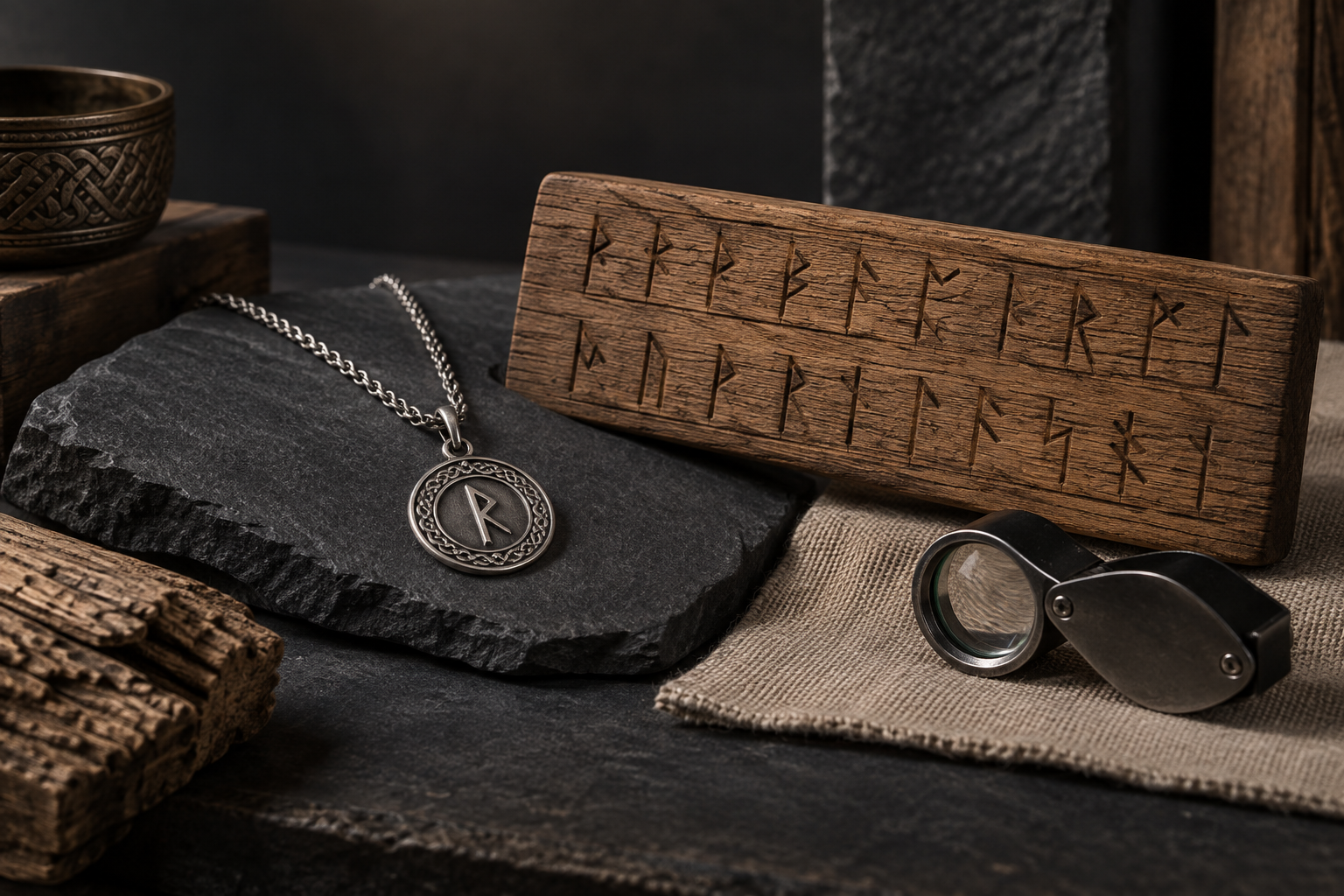
Meaning at a glance
A Viking rune necklace is most accurate when its inscription uses an appropriate rune row and transparent transliteration, because Viking Age runes recorded language and names rather than forming a universal catalogue of modern spiritual keywords.
What the historical evidence actually shows
Our best archaeological and museum evidence comes from objects, stones and inscriptions documented and interpreted by institutions such as the Swedish History Museum. The Swedish History Museum presents runes as writing systems used across different Scandinavian periods; the museum’s materials explain that runic inscriptions were used to record names, ownership, memorials and short messages rather than a fixed set of abstract spiritual keywords.
The tools and standards used to read and present runes today are built on transcription and transliteration work. The Swedish National Heritage Board summarizes principles for transliteration and consistent presentation of runes, showing that runic inscriptions are linguistic records and that modern readings require careful, standardized conversion from runic characters into Latin letters. These principles help avoid arbitrary or misleading interpretations when runes are reproduced on jewelry.
Which rune rows relate to Viking Age necklaces — be specific about cultures and periods
Runic alphabets changed over time and place. For objects made or inspired by the Viking Age (broadly the later first millennium in Scandinavia), the younger runic inventory known as the Younger Futhark is the primary historical system used in inscriptions from that era. When a necklace claims to reproduce a Viking inscription, the Younger Futhark is the historically appropriate rune row for Viking Age Scandinavian inscriptions, while the Elder Futhark belongs to an earlier period and other regional variants appear in other times and places. Institutions such as the Swedish History Museum contextualize runic material culture by connecting inscriptions to the eras and regions that produced them.
Because historical usage varied, a modern maker reproducing runes should state which rune row they used and why. That distinction matters: a name transliterated into Elder Futhark will look and map differently than one set into Younger Futhark, and those choices change how an inscription reads to a trained eye.
Historical meanings versus modern personal interpretations
Documented historical meanings are typically linguistic: names, ownership marks, memorial formulas and short messages. Curators and researchers at the Swedish History Museum and related collections present runes as records of language rather than as a fixed lexicon of metaphysical or universally applicable modern keywords.
Modern interpretations—such as assigning single-word 'meanings' like protection, love or prosperity to individual runes—are contemporary practices. These modern attributions can be meaningful to a wearer, but they are cultural reinterpretations, not statements of Viking Age practice. When buying or wearing runic jewelry, treat those contemporary attributions as personal or modern spiritual choices rather than as evidence of a historical, universally shared rune-based system of magic.
How bindrunes and name inscriptions differ
Bindrunes are modern and historic in different ways. Historically, some runic inscriptions show ligature-like forms or decorative clustering, but the systematic creation of personal bindrunes as compact symbols combining several runic characters into a single motif is largely a later, often modern popular practice. Craftspeople and designers combine runes today to create stylized, compact marks that read as names or symbolic composites to modern wearers.
A name inscription, as produced historically, tends to be a linear sequence of runic signs transliterated into letters. If you want a historically grounded name necklace, ask for a clear, linear transliteration using the appropriate rune row and a readable carving or engraving. If you prefer a bindrune for aesthetic or personal reasons, request a labeled explanation that presents the bindrune as a modern design derived from runic characters and include the transliteration separately so the inscription remains transparent.
How motifs, gemstones and traditions show up in Viking rune jewelry
Motifs and materials in modern Viking-inspired jewelry draw from archaeology but are not one-to-one reproductions. Museums display pendants, amulets and metalwork that inspire contemporary makers; the Swedish History Museum’s exhibits and object descriptions are common points of reference for designers who want authentic-looking elements. Typical motif sources are runic bands, simple linear inscriptions, and occasionally iconography like hammer shapes based on archaeological finds.
Gemstones and modern materials are largely contemporary choices. In the Viking Age, jewelry makers used available materials—metals, glass beads, amber and carved bone—depending on region and status. Today’s makers often use sterling silver, gold plating, lab-created gems or bezel-set stones to achieve particular aesthetics. If a gemstone is marketed with a supposed runic significance, that connection is usually modern and should be communicated as a current symbolic choice rather than as a documented Viking practice.
Practical and respectful selection or gifting guidance
When choosing a Viking rune necklace, ask the maker what rune row they used and request a transliteration into Latin letters that you can read. If the inscription is a personal name, verify the spelling that you want. If the maker proposes a bindrune, ask for both the combined motif and a linear transliteration. Sellers who provide clear transliteration and context are practicing historical responsibility and make better gifts for people who care about accuracy.
Label any modern or spiritual meanings explicitly. If you give a rune necklace as a gift, include a note that separates historical facts (for example, which rune row was used) from contemporary interpretations (for example, what a giver or recipient feels the runes represent today). This approach shows respect for the historical record and for recipients’ cultural sensitivities.
Be mindful of cultural context and appropriation. A piece inspired by Viking material culture can be meaningful and respectful if presented honestly. Avoid marketing language that claims universal, ancient powers or definitive historical uses that are unsupported by museum documentation. If the recipient has Scandinavian heritage and that heritage matters to them, consider discussing the choice so the gift aligns with their perspective.
Finally, consider materials and wearability. Choose metal and finish appropriate to the recipient’s skin sensitivity and lifestyle, and pick chain length and pendant size for comfortable daily wear or for occasional display. High-quality craftsmanship—secure settings for gemstones, clear engraving, and durable metalwork—will preserve both the visual appeal and the legibility of any inscription.
How to commission or check an inscription
If you commission a rune necklace, provide the name or word in the modern language you want transliterated, and ask the maker to show the runic transliteration before production. Use the Swedish National Heritage Board’s transliteration principles as a reference for how runes are conventionally converted to Latin letters and ask makers to follow similar standards for clarity. Request a photo of a mock-up and a line-by-line transliteration so the final object can be read and understood.
If you buy a ready-made necklace, look for pieces labeled with the rune row used and a clear transliteration. Avoid pieces that present a runic motif as an opaque 'symbol of power' without any readable inscription or documentation, because that opacity is precisely what separates historically grounded reproductions from purely modern invention.
Final note on authenticity and respect
Runes are best appreciated as writing: they connected people to names, messages and memory. Museums and national heritage boards, including those cited here, frame runes as linguistic artifacts and provide standards for responsible display and transliteration. A thoughtful Viking rune necklace can honor that history while also serving as a meaningful modern personal object—so long as makers and buyers keep historical evidence and modern interpretation clearly distinct.
Frequently asked questions
What rune row should I use for a historically accurate Viking rune necklace?
For Viking Age inscriptions the Younger Futhark is the historically appropriate rune row; ask the maker to state which rune row they used and to provide a transliteration into Latin letters.
Are individual runes historically guaranteed to mean things like 'protection' or 'love'?
No. Historical runic inscriptions most often record names, ownership or short messages. Single-word modern attributions like 'protection' are contemporary interpretations rather than documented Viking Age meanings.
What is a bindrune and is it authentic?
A bindrune is a combined motif built from two or more runic characters. While ligature-like forms appear historically, most compact personal bindrunes as used in jewelry are modern creations and should be presented as contemporary designs with a clear transliteration.
How can I avoid cultural appropriation when buying Viking-inspired jewelry?
Choose pieces that provide clear context: which rune row was used, a readable transliteration, and honest labeling of any modern meanings. Respectful presentation and provenance are better than claims of ancient or universal power.
What should I ask a maker before commissioning a rune necklace?
Ask which rune row they will use, request a written transliteration and mock-up, clarify the intended spelling of any names, and ask how they will label modern interpretations so historical and contemporary meanings are not conflated.
Sources and further reading
- Runes — Swedish History Museum
- Begrepp och principer for translitterering — Swedish National Heritage Board
- The sources for what we know — Swedish History Museum