Meaning at a glance
Several designs marketed as Viking, including familiar forms of Vegvisir, the Helm of Awe, and many modern bindrunes, belong to later Icelandic or contemporary traditions, while Elder Futhark also predates the Viking Age; accurate jewelry descriptions should label chronology clearly.
Quick, direct answer
Several designs commonly sold as "Viking"—notably the familiar Vegvísir sun-compass, the radial Helm of Awe (Aegishjalmur) image that appears in modern carvings, and many contemporary bindrunes—are not documented as inscribed or worn motifs from the Viking Age. The Vegvísir and the radial-stave Helm of Awe are attested in later Icelandic sources rather than in contemporary Viking-Age archeological contexts, while the runic alphabet known as Elder Futhark predates the Viking Age. Jewelry descriptions that want to be historically accurate should identify whether a motif is Viking-Age attested, later medieval/Icelandic, or a modern revival or invention.
What the historical evidence actually shows
The clearest starting point is the written and material record. Archaeological finds and museum research establish that the earliest runic alphabet, called Elder Futhark, was in use before the Viking Age; the Swedish History Museum describes the first runes as predating the Viking period, so not every runic-style inscription on modern jewelry is 'Viking' in the narrow archaeological sense.
Other well-known symbols commonly labeled "Viking" appear primarily in later sources. Scholarship on Icelandic magical staves shows that the iconic Vegvísir and the particular radial-form Helm of Awe are documented in Icelandic manuscripts and magical collections that postdate the Viking Age. Academic treatment of these symbols emphasizes that their appearance in post-medieval Icelandic material places them in a later tradition rather than in contemporaneous Viking-Age practice, so labeling must reflect that chronology. These distinctions are made in detailed studies of galdramyndir (Icelandic magical symbols) and related manuscript material.
Finally, the modern reconstruction and revival of Norse religion and imagery is a living cultural movement with many creative interpretations. The National Museum of Denmark cautions that modern Norse revival is not a direct continuation of historic religion and that contemporary uses often combine historical motifs with new meanings or aesthetics. That means a runic-looking pendant or a stylized 'Helm' symbol on a necklace may be meaningful to a wearer today but should not automatically be presented as a historically attested Viking object.
Each motif: origins and the culture or period involved
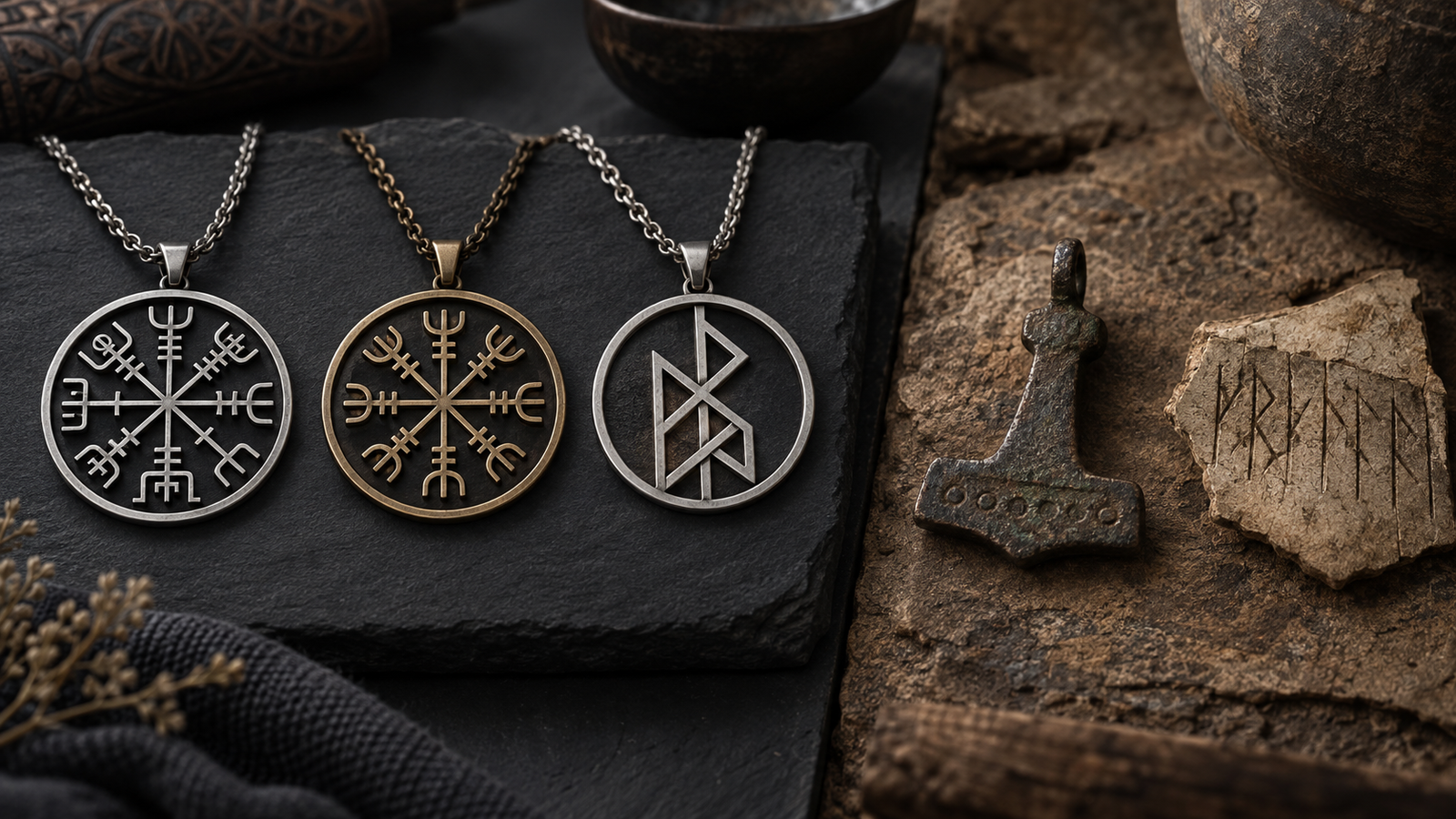
Vegvísir: The Vegvísir is documented in Icelandic manuscript contexts that are later than the Viking Age. Scholarship treating Icelandic magical staves identifies it as part of post-medieval Icelandic magical tradition rather than an object widely recorded in Viking-Age archaeological assemblages. Presenting a Vegvísir pendant as a medieval Icelandic talisman is accurate; presenting it as an artifact worn by Vikings requires qualification. This distinction follows the research tracing the symbol in Icelandic manuscripts.
Helm of Awe (Aegishjalmur): A radial-stave motif associated in modern sources with protection and fear has been popularized as the "Helm of Awe." The particular radial graphic that appears on much jewelry and in popular culture is tied to later Icelandic manuscript traditions and later folk magical material rather than to a securely attested Viking-Age insignia. Academic analyses that catalogue galdramyndir note that the emblem as commonly pictured is documented in later Icelandic sources.
Elder Futhark and runic alphabets: The runes themselves have a long, complex history. The Elder Futhark is an earlier runic system that predates the Viking Age; the Swedish History Museum summarises how the earliest runes appeared well before the Viking period. During the Viking Age, variants such as the Younger Futhark were in regional use. Jewelry makers sometimes mix rune forms and create hybrid inscriptions—those modern creations should be described as modern interpretations unless they replicate a single historically attested inscription exactly.
Bindrunes and modern inventions: Many bindrunes—composites of runic characters or symbol elements—seen on contemporary jewelry are modern creations or modern reconstructions combining motifs from different periods. While bindrunes have a basis in historical practice (people did combine runes), the specific designs used for commercial jewelry are frequently contemporary and should be presented as such rather than labeled "authentic Viking."
Documented historical meanings vs modern personal interpretation
Documented historical meaning relies on contemporary evidence: inscriptions, archaeological contexts, and manuscript glosses. Where such evidence exists, it is appropriate to summarize the historical interpretation and cite the originating context. For example, runic inscriptions that survive on stones or metal objects can often be linked to specific places, funerary contexts, or ownership marks, and museums such as the Swedish History Museum provide that kind of contextual interpretation.
Modern personal interpretation is a legitimate and valuable layer of meaning, but it is different from an historical claim. Modern wearers or makers commonly ascribe protective, guiding, or spiritual meanings to Vegvísir, the Helm of Awe, or bindrunes. These contemporary meanings reflect personal spirituality, cultural revival, or aesthetic preference and do not by themselves prove antiquity. The National Museum of Denmark points out that modern revival practices are not direct continuations of the old religion, so contemporary meanings should be labeled as modern or revivalist when they are presented alongside historical claims.
How these motifs appear in jewelry today
Motifs marketed as "Viking" come in many forms: engraved pendants, cast silver or bronze replicas, stamped rings, and laser-cut charms. The Vegvísir is often stylized into a circular pendant framed as a compass; the Helm of Awe is reproduced as a radial symbol on medallions and stamped into rings. Rune-like alphabets are commonly stamped into bands or charms, sometimes using Elder Futhark letter shapes and sometimes mixing alphabets for visual effect.
Gemstones and settings are typically modern choices selected for aesthetics. On a Vegvísir pendant you are more likely to find a decorative cabochon or a bezel-set gem added for contrast rather than any historical precedent for that stone. Jewelers combine historical motifs with contemporary metals, fastenings, and finish techniques, so an item that looks "old" may be newly cast and finished using modern alloys or patination.
Practical, respectful selection and gifting guidance
If historical accuracy matters to you or the recipient, check product descriptions for precise labeling: does the seller say "inspired by Viking-Age sources," "Icelandic manuscript motif," or "modern design"? Prefer items that include provenance or specify whether a rune inscription copies a known artifact and cite the source of the transcription.
When giving a symbol-laden piece as a gift, consider the recipient’s background and how they will interpret the symbol. If the item is intended as a meaningful cultural or spiritual token, note that modern meanings are valid but distinct from historical continuity. If the recipient values historical authenticity, select pieces that are explicit about their period: Viking-Age-attested runic inscriptions, medieval Icelandic motifs, or contemporary designs labeled as modern.
Respect matters. Avoid presenting a later or modern symbol as an "original Viking talisman" if that claim cannot be supported. Sellers and givers can be both respectful and useful by stating provenance, making a clear distinction between documented history and personal meaning, and being open about creative adaptation.
For care and wear: treat these pieces like any jewelry made from silver, bronze, or mixed alloys. Ask the maker about metals, plating, and gemstone types. If you plan to wear a historically styled pendant for ritual or religious reasons, inquire about the maker's intent and avoid appropriating living traditions without understanding their context.
Final note
Symbols marketed as Viking attract attention because of their strong visual style and evocative associations. That appeal is fine, but clear labeling and a respectful distinction between attested historical use and contemporary interpretation benefit buyers, makers, and the cultures involved. Where possible, rely on museum and academic descriptions for chronology and provenance, and treat modern personal meanings as contemporary additions rather than proof of ancient practice.
Frequently asked questions
Is the Vegvísir a Viking symbol?
No. The Vegvísir is documented in later Icelandic manuscript contexts and is part of a post-Viking Icelandic magical tradition rather than being attested as a commonly worn Viking-Age emblem, according to scholarship on Icelandic magical staves.
Was the Helm of Awe used by Vikings?
The radial-stave image often called the Helm of Awe appears in later Icelandic sources; it is not clearly attested as a widespread Viking-Age insignia and should be described as later Icelandic in origin when accuracy matters.
Do runes always mean 'Viking'?
No. Runes were used in multiple periods and alphabets. The Elder Futhark predates the Viking Age, while Viking-Age inscriptions more commonly use Younger Futhark forms. Runic-looking jewelry can be historically accurate, medieval, or modern—check the source and alphabet type.
Are modern bindrunes historically authentic?
Many bindrunes in contemporary jewelry are modern compositions or stylized reconstructions. While historical examples of rune combination exist, specific decorative bindrunes sold today are often modern designs and should be presented as such.
How can I choose a respectful Viking-style gift?
Choose pieces with clear provenance, prefer descriptions that state whether a motif is Viking-Age attested, medieval Icelandic, or modern, and consider the recipient’s background. If the wearer values historical authenticity, look for items that reproduce a documented inscription or clearly reference reputable sources.
Sources and further reading
- Guidance from ancient symbols: Vegvisir, Aegishjalmur and other galdramyndir — De Gruyter
- The first runes — Swedish History Museum
- The old Nordic religion today — National Museum of Denmark