Meaning at a glance
This guide defines common enhancements used on Tahitian pearls, explains how those treatments affect appearance, durability, value and care, and summarizes the exact questions buyers should ask and the limits of unaided verification versus lab testing.
What counts as a treatment and why it matters
Gemological treatments are any deliberate modification intended to change the appearance, stability or durability of a gem. The Gemological Institute of America (GIA) explains that treatments, detectability, durability and special care create distinct consumer questions for gemstones; the same concerns apply to pearls. For Tahitian pearls, commonly referenced enhancements in gemological literature include color alteration, bleaching, dyeing and surface coatings. Sellers may also alter the appearance by applying luster coatings or by polishing and drilling in ways that change how light reflects from the surface.
Why this matters to a buyer depends on your priorities. Untreated, high-quality cultured pearls tend to command higher prices among collectors because their color and luster are natural and stable. Treated pearls can offer exceptionally consistent color, fewer visible surface flaws, or stronger contrast with accompanying stones, which appeals to many people shopping for jewelry with a particular aesthetic or budget. Treatments can affect long-term durability and the way you care for the pearl, and they can affect resale value—points emphasized by both gem trade references and consumer-protection guidance.
Historical evidence and periodized context
When discussing history, it is important to separate documented, cited evidence from broader cultural or modern interpretive claims. The sources approved for this article do not provide detailed ethnographic histories of pearl use across specific cultures, so this guide restricts historical claims to matters documented by the named authorities. Gemological literature such as that collected by the GIA documents how treatments and disclosure practices developed as gem testing matured. The Federal Trade Commission records the modern legal and consumer-protection framework that governs seller statements in the United States, while industry publishers report contemporary market demand and trends.
In short, the historical evidence relevant to treatments is found primarily in the technical and regulatory records of gemological institutions and consumer-protection agencies rather than in popular cultural histories. This article therefore distinguishes documented technical history and regulation from modern personal or symbolic interpretations of Tahitian pearls.
Documented meanings versus modern personal interpretations
Documented meanings are those recorded by institutions and historical sources: for example, records about how pearls are produced, how treatments are applied, and how sellers are required to disclose information. The GIA and the Federal Trade Commission are the kinds of organizations that document these practical, technical, and legal facts. Modern personal interpretations—such as the symbolic meanings individuals or cultures attach to Tahitian pearls—are subjective and vary by person and community. They are valid as personal or cultural expression but are not universal facts that affect a pearl’s technical grading, treatment status or legal disclosure.
When choosing a pearl for symbolic reasons, be explicit about whether you value natural origin and untreated beauty for symbolic authenticity, or whether an enhanced pearl’s color and durability align better with the meaning you want to convey. Both approaches are common today and both are acceptable; the distinction is a buyer preference rather than a universal rule.
How Tahitian pearls appear in jewelry
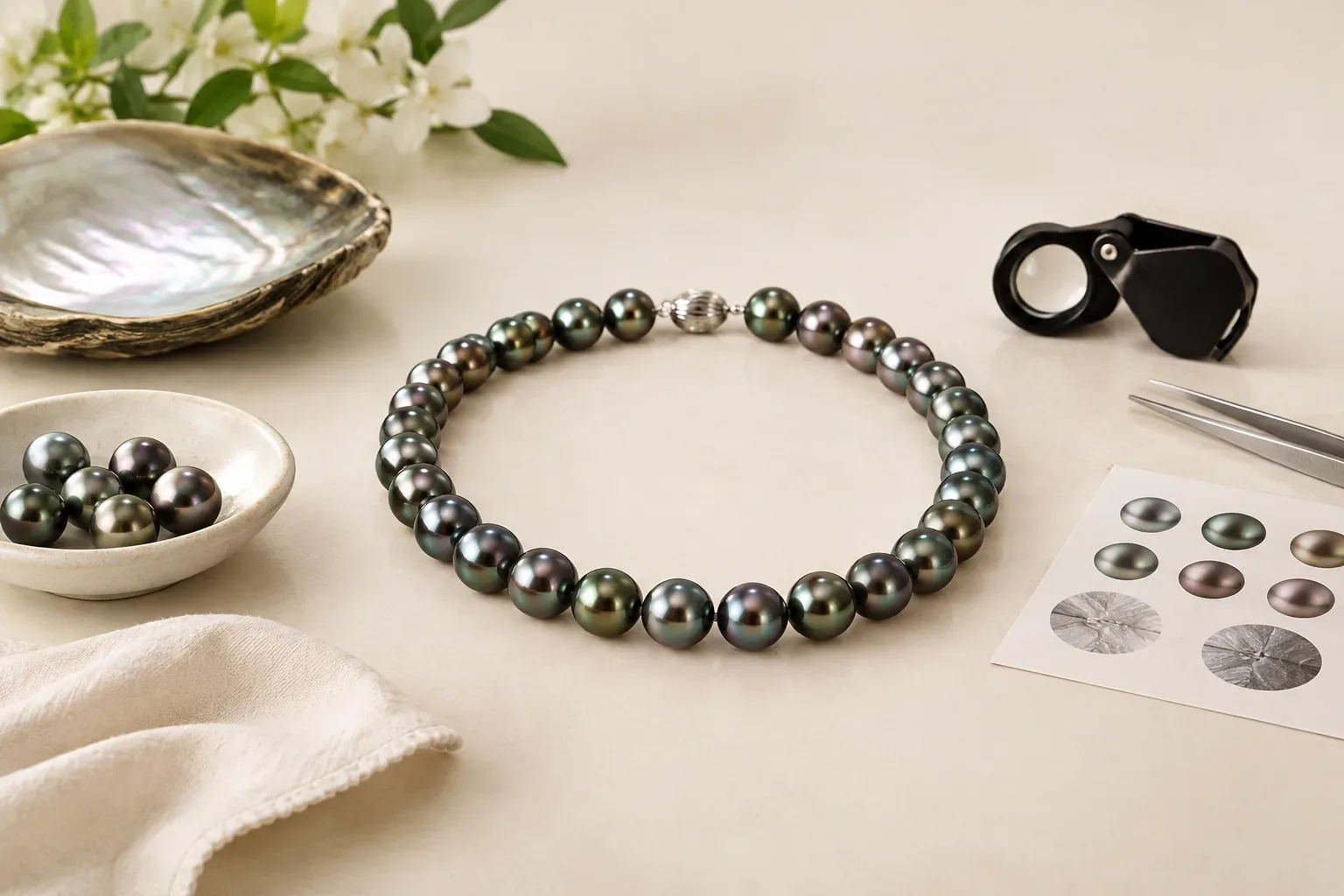
Tahitian pearls are commonly used as focal points in pendants, single-stone or multi-stone rings, stud and drop earrings, and strand necklaces where dark or peacock overtones are desired. Industry trend reporting from sources such as Imaginaire Digital and Professional Jeweller documents growing consumer interest in diverse gemstone settings and sculptural jewelry, which has influenced how pearls are set. Designers often pair Tahitian pearls with diamonds, colored gemstones and mixed metalwork to highlight the pearl’s color and to provide contrast.
Because pearls are organic and relatively soft compared with most gemstones, jewelers choose settings that protect the pearl from abrasion and impact. Settings that expose the pearl are popular for aesthetics, but they increase the risk of surface wear and require more careful daily handling and maintenance.
Practical selection and gifting guidance
Decide which attributes are most important to you: natural origin, color and overtone, luster, surface condition, matching (for strands or pairs), or price. If you prioritize authenticity and potential long-term value, seek pearls that are described as untreated and cultured from reputable sellers who provide clear documentation. If you prioritize a specific look or a lower price, treated pearls can be an excellent choice as long as you understand the nature and durability of the enhancement.
Ask the seller four concrete questions before purchase: Is the pearl natural, cultured, treated or an imitation? If treated, what specific treatment was used? Will you provide written disclosure? Can I see any available gemological lab reports or guarantees? The Federal Trade Commission advises consumers to request clear distinctions among natural, lab-created, treated, cultured and imitation materials and written seller disclosures. Retain receipts and any written statements for future appraisal or resale.
For gifting, consider the recipient’s likely priorities. If they are a collector or someone who values natural materials, an untreated or lab-verified cultured pearl is a safer choice. If the recipient prefers a particular color or modern styling, a treated pearl that offers striking color uniformity may be more appreciated. When in doubt, a reputable seller who will provide transparent answers and written disclosure is the best intermediary.
Trade-offs: appearance, cost, durability and resale
Treated pearls often offer immediate visual benefits: more even color, fewer visible blemishes and intensified overtones. These improvements can make a piece more wearable and attractive for everyday jewelry. However, treatments can reduce resale value compared with comparable untreated examples because collectors typically prize naturally occurring qualities.
Durability varies by treatment. Some surface coatings wear over time and may require professional renewal. Because pearl treatments and their stability can vary, the Gemological Institute of America recommends that consumers and jewelers consider both detectability and durability when evaluating treated gems. Ask how the seller suggests you care for a treated pearl and whether future maintenance will be needed.
Care guidance for treated and untreated Tahitian pearls
Pearls are delicate organic gems and require gentler care than hard gemstones. Avoid chemical exposure such as perfumes, hairsprays, chlorine, and household cleaners, and remove pearl jewelry before swimming or exercising. Clean pearls gently with a soft, damp cloth after wear to remove body oils and environmental residue. Store pearls separately to prevent abrasion and consider flat storage for strands to reduce stress on the string.
If a pearl has been treated with a surface coating, ask the seller about the coating’s expected lifespan and any recommended maintenance. Do not assume that treatments are permanent. For detailed, treatment-specific care instructions and the likely effects of cleaning on treated surfaces, consult a qualified jeweler or the literature of a recognized gemological laboratory such as the GIA.
What you can and cannot verify without a lab
You can make useful visual assessments at home or in-store: examine the surface for a natural nacre sheen versus plastic-like gloss, inspect drill holes for color concentration or layered coatings, and compare pearls in the same piece for matching and consistency. You can also ask to see statements of origin, treatment disclosure, and any available lab reports.
However, you cannot reliably measure nacre thickness, confirm the presence or absence of very thin surface coatings, or detect some internal treatments without instruments and expertise. The thesis that guides this article states clearly that some verification limits exist: only a qualified jeweler or a gemological laboratory can confirm certain attributes and detect some treatments with certainty. If the treatment status or structural attributes matter to price or symbolic intent, purchase only when a trusted lab report or jeweler’s certificate is available.
How to get a pearl independently tested
If you need independent verification, seek a reputable gemological laboratory or a qualified, independent jewelry appraiser. The GIA and similar institutions offer testing protocols that address treatment detection and durability assessment; ask what tests will be performed and request a written report. Expect a small fee and a defined turnaround time. A lab report is the most reliable basis for insurance, resale, or estate appraisal decisions.
Keep documentation and photographs of the piece as an additional record. If a seller objects to independent testing, treat that as a red flag and consider other sellers who are willing to support transparent verification.
Final practical checklist for buyers
Before buying, confirm type (natural, cultured, treated, imitation), request written disclosure, ask for any available lab reports, and test or inspect the pearl under good light and magnification. For gifts, choose according to the recipient’s likely priorities and retain documentation. When long-term value or authentication matters, obtain an independent lab report. These steps reflect consumer-protection guidance and gemological best practice and are meant to turn the common search intent behind 'Tahitian pearl treatment guide' into concrete steps you can follow.
Frequently asked questions
Are Tahitian pearls often treated?
Tahitian pearls can be treated, and gemological literature documents common enhancements for pearls such as color alteration, bleaching, dyeing and surface coatings. Whether a particular pearl has been treated should be disclosed by the seller and, if important to you, confirmed by a laboratory report.
What should I ask a seller about a Tahitian pearl?
Ask whether the pearl is natural, cultured, treated or an imitation, what specific treatment (if any) was used, whether written disclosure is available, and whether there are any lab reports or guarantees you can see. Keep those written statements with your purchase records.
Can I tell if a pearl is treated by looking at it?
You can make preliminary visual checks—look for surface coatings at drill holes, unusually uniform color, or a plasticky gloss—but many treatments are not reliably detectable without gemological equipment. For definitive identification, consult a qualified jeweler or a gemological laboratory.
Do treatments change how I care for a pearl?
Yes. Some surface coatings and color treatments can be less durable and may require gentler cleaning or periodic maintenance. Avoid chemicals, ultrasonic cleaners and prolonged water exposure, and follow any specific care instructions provided by the seller or lab.
Will a lab report affect the pearl’s resale value?
A lab report clarifying whether a pearl is treated or untreated can significantly affect resale value because buyers and collectors often pay premiums for documented untreated examples and may pay less for treated pieces. A report generally increases market transparency and helps with insurance and appraisal.
What consumer protections exist when buying pearls?
In the United States, the Federal Trade Commission recommends clear distinctions among natural, lab-created, treated, cultured and imitation materials and written seller disclosures. Always obtain written documentation and receipts, and consider independent testing if authenticity or treatment status is critical to your purchase.
Sources and further reading
- Imaginaire Digital — Imaginaire Digital
- Professional Jeweller / PRYA Jewellery Search Insights — Professional Jeweller / PRYA Jewellery Search Insights
- Gemological Institute of America — Gemological Institute of America
- Federal Trade Commission — Federal Trade Commission