Meaning at a glance
A practical Tahitian pearl buying guide: know the decision criteria (bodycolor and overtone, luster and surface quality, shape and matching, nacre thickness and treatments), understand trade-offs between size, perfection and price, request seller disclosures and lab reports when needed, and follow gentle care steps—while recognizing that some attributes require a qualified jeweler or gemological laboratory to verify.
What makes a pearl a Tahitian pearl?
The term used by sellers for 'Tahitian pearl' generally refers to saltwater cultured pearls produced in French Polynesia and nearby waters. For shoppers the most useful approach is to treat the label as a trade descriptor and to ask for the supporting documentation the seller can provide. Consumer-protection guidance from the Federal Trade Commission emphasizes clear distinctions among natural, lab-created, treated, cultured and imitation materials and requires sellers to make accurate written disclosures about origin and treatments.
Historical evidence and cultural context
Pearls have a long recorded place in jewelry and trade across many cultures; gemological literature and consumer guidance note the long histories that underpin modern markets. The Gemological Institute of America discusses how gem treatments, detectability and durability create consumer questions that persist with pearls and other gems. That said, authoritative primary-source scholarship about the precise emergence of cultured pearls in particular Pacific island communities is beyond the scope of the consumer and trade resources cited here, so this guide separates broadly documented facts from later cultural or personal interpretations.
Documented meanings versus modern personal interpretations
Documented historical meanings for pearls—such as their use in trade, ornament and social display—are part of broad gemological and historical literature and are best consulted in specific cultural studies or museum catalogues. Modern symbolic meanings attached to Tahitian pearls, such as associations with Polynesian identity, spiritual meanings, or personal narratives about 'power' or 'mystery', are contemporary and personal. This article treats historic documentation (as discussed in gemological reference material) separately from modern individual and marketing interpretations.
How Tahitian pearls appear in jewelry
In jewelry, pearls are used whole rather than 'cut' like faceted gems; designers set them in necklaces, pendants, earrings, rings and bracelets in single-stone styles or as matched strands. The way a pearl is mounted affects how observers perceive its color and luster: open settings and minimal metal around a pearl allow more light on the surface, while high-domed bezels can emphasize bodycolor. When pearls are strung as a matched necklace the seller’s matching practice (how well color, size and luster are graded and arranged) becomes a key part of value.
Key buying criteria
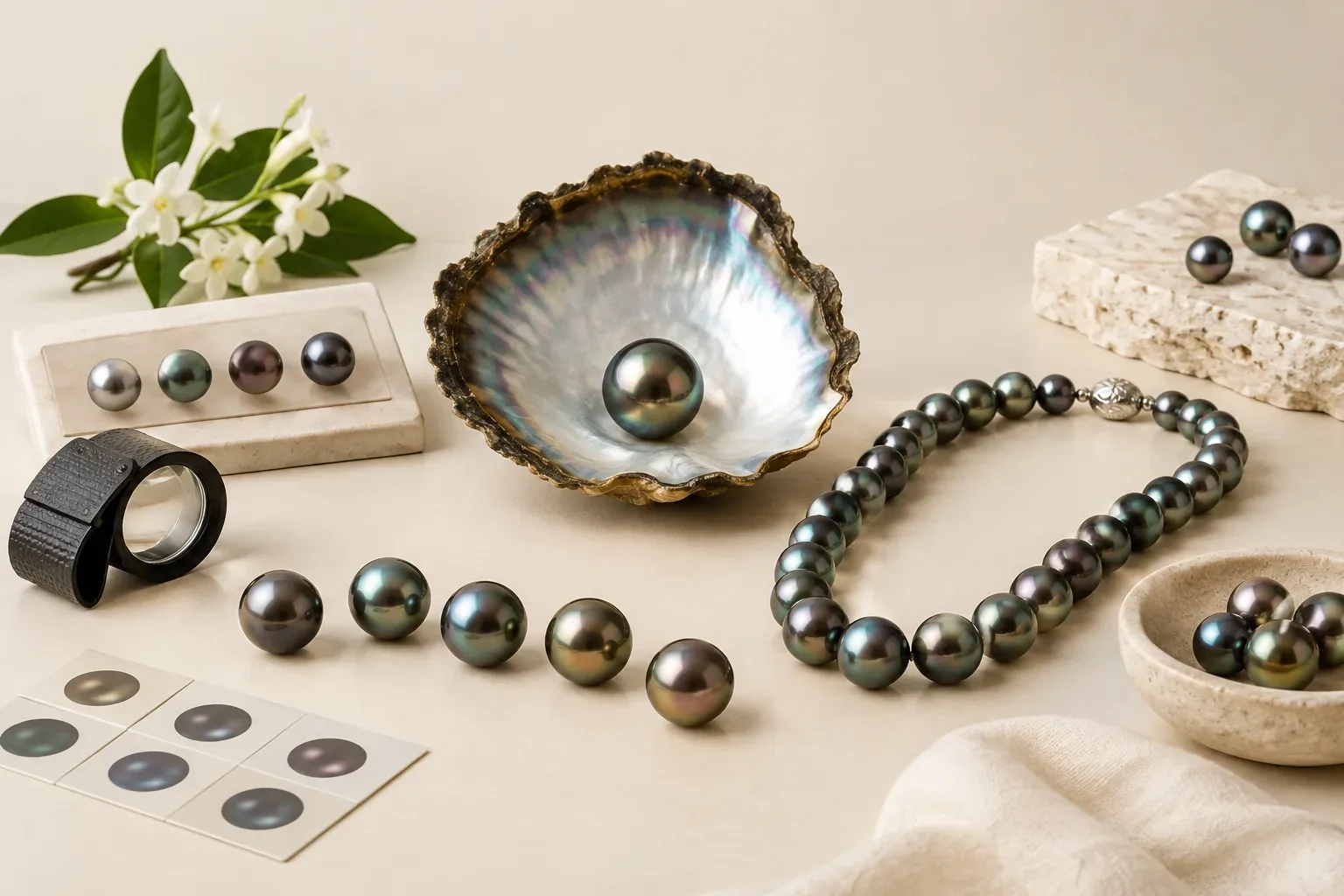
Color: Evaluate the bodycolor and any overtone or orient. Buyers often distinguish even, attractive bodycolor and appealing overtones from uneven or patchy coloration; these perceptions are subjective, so compare multiple examples under natural daylight when possible. Luster and surface quality: Luster describes how bright and sharp reflections appear on the surface, and surface quality (sometimes called 'clarity' in pearl trade) relates to bumps, spots or blemishes. Higher luster and cleaner surfaces usually command higher prices. Shape: Perfectly round pearls are generally priced higher than off-round or baroque shapes, but unusual shapes can be desirable in contemporary designs. Nacre and durability: Nacre thickness and overall durability are critical long-term factors; buyers should ask how the pearl was cultured and whether the seller can document nacre condition. Size and matching: Larger pearls tend to cost more, but evenness across a matched set or strand can be more important than a single size number.
Treatments, disclosure and what labs can verify
Treatments and their disclosure are central to an honest sale. The Gemological Institute of America explains that treatments, their detectability and their effects on durability and appearance create distinct consumer questions. The Federal Trade Commission requires that sellers clearly disclose whether gems have been treated, whether they are cultured or natural, and any other material facts. For important purchases insist on written disclosures and, for high-value items, independent laboratory reports. A qualified gemological laboratory can verify whether a pearl is natural versus cultured, detect certain treatments, and provide objective measurements such as nacre thickness or precise color notation—services a buyer cannot reliably perform at home.
Practical trade-offs and value decisions
Every buyer balances competing priorities: size versus luster, spotlessness versus character, perfect matching versus cost. For many shoppers, high luster and clean surfaces provide the most visual impact, so spending more to improve luster can be a better value than paying a premium for a slightly larger but duller pearl. If you prefer contemporary or one-of-a-kind pieces, baroque shapes may offer better value per dollar than classic round pearls. Always ask whether the price reflects documented origin, treatment disclosures and any lab report provided.
Selection and gifting guidance
When choosing a pearl for yourself or as a gift, begin by considering how the recipient wears jewelry: simple studs or a single pendant suit everyday wear while matched strands and rings are more formal. For gifts, choose pieces with timeless proportions and avoid overly trendy settings if you want long-term wear. Ask the seller about their return policy and request written disclosures. For a high-value purchase consider an independent appraisal and a laboratory report. Be respectful when attaching symbolic meanings to a gift: modern symbolic associations can be meaningful to the giver and recipient, but they are personal and should not be presented as historical fact without cultural sourcing.
Care and maintenance
Pearls are organic and require gentle care. The Gemological Institute of America notes that treatments and durability concerns inform how gems should be cared for. In practice, wipe pearls with a soft, dry cloth after wear, avoid exposure to cosmetics and perfumes, and store them separately to prevent scratching. For restrung necklaces, have the stringing checked periodically by a jeweler. Avoid ultrasonic cleaners and harsh chemicals; if a pearl requires cleaning beyond surface wiping, consult a professional jeweler or gemologist.
When to consult a professional
If you are buying a high-value item, a matched multi-pearl strand, or a piece with outstanding provenance, obtain a written report from a recognized gemological laboratory and a signed appraisal from a qualified appraiser. The Federal Trade Commission's consumer guidance underscores the importance of clear seller disclosures; the Gemological Institute of America emphasizes that some attributes and treatments require laboratory testing. Use these expert services for verification rather than relying on photographs or a seller’s label alone.
Final practical checklist
Compare pieces in natural light, evaluate luster and surface condition before prioritizing size, ask for written disclosures about origin and treatments, request a laboratory report for expensive purchases, and follow gentle care steps after purchase. These actions will help you balance aesthetics, durability and price when buying Tahitian pearls.
Frequently asked questions
How can I tell if a Tahitian pearl is cultured or natural?
Only a qualified gemological laboratory can reliably distinguish a natural pearl from a cultured pearl; the Federal Trade Commission requires sellers to disclose whether a pearl is cultured or natural, so ask for written disclosure and, for higher-value purchases, an independent lab report.
Do pearls get treated, and should I be told?
Yes, pearls can be treated to modify color or surface appearance; the Gemological Institute of America explains that treatments affect detectability and durability, and the Federal Trade Commission requires sellers to disclose such treatments in writing.
What should I ask the seller before buying?
Request written disclosures about origin and treatments, ask about matching and nacre condition, view the pearl in natural light, check return and warranty policies, and obtain an independent laboratory report for expensive or high-profile purchases.
How do I care for Tahitian pearls?
Follow gentle care: wipe pearls with a soft dry cloth after wear, avoid sprays and perfumes, store them separately to prevent scratches, and have strands restrung or inspected periodically by a jeweler rather than using harsh cleaners.
When is a lab report recommended?
Obtain a laboratory report for high-value purchases, unusual claims about provenance, or when a seller makes material claims about natural origin or absence of treatment; labs can perform tests and measurements buyers cannot do at home.
Sources and further reading
- Imaginaire Digital — Imaginaire Digital
- Professional Jeweller / PRYA Jewellery Search Insights — Professional Jeweller / PRYA Jewellery Search Insights
- Gemological Institute of America — Gemological Institute of America
- Federal Trade Commission — Federal Trade Commission