Meaning at a glance
This guide defines diamond cut grade reports, explains how to interpret the technical entries you will see, lays out practical trade-offs buyers make between light performance, size, and cost, offers safe care advice, and explains what you cannot verify without a qualified jeweler or a gemological laboratory.
Direct answer — what this guide delivers
A diamond cut grade report guide must give evidence-led definitions of the report elements, a clear set of decision criteria for shoppers, sensible trade-offs between appearance and price, straightforward care advice, and an explicit statement of limits — that you cannot independently confirm a lab grade without a qualified jeweler or a recognized gemological laboratory report. This article follows that thesis and points to authoritative consumer and laboratory guidance where relevant.
What a diamond cut grade report is, in plain terms
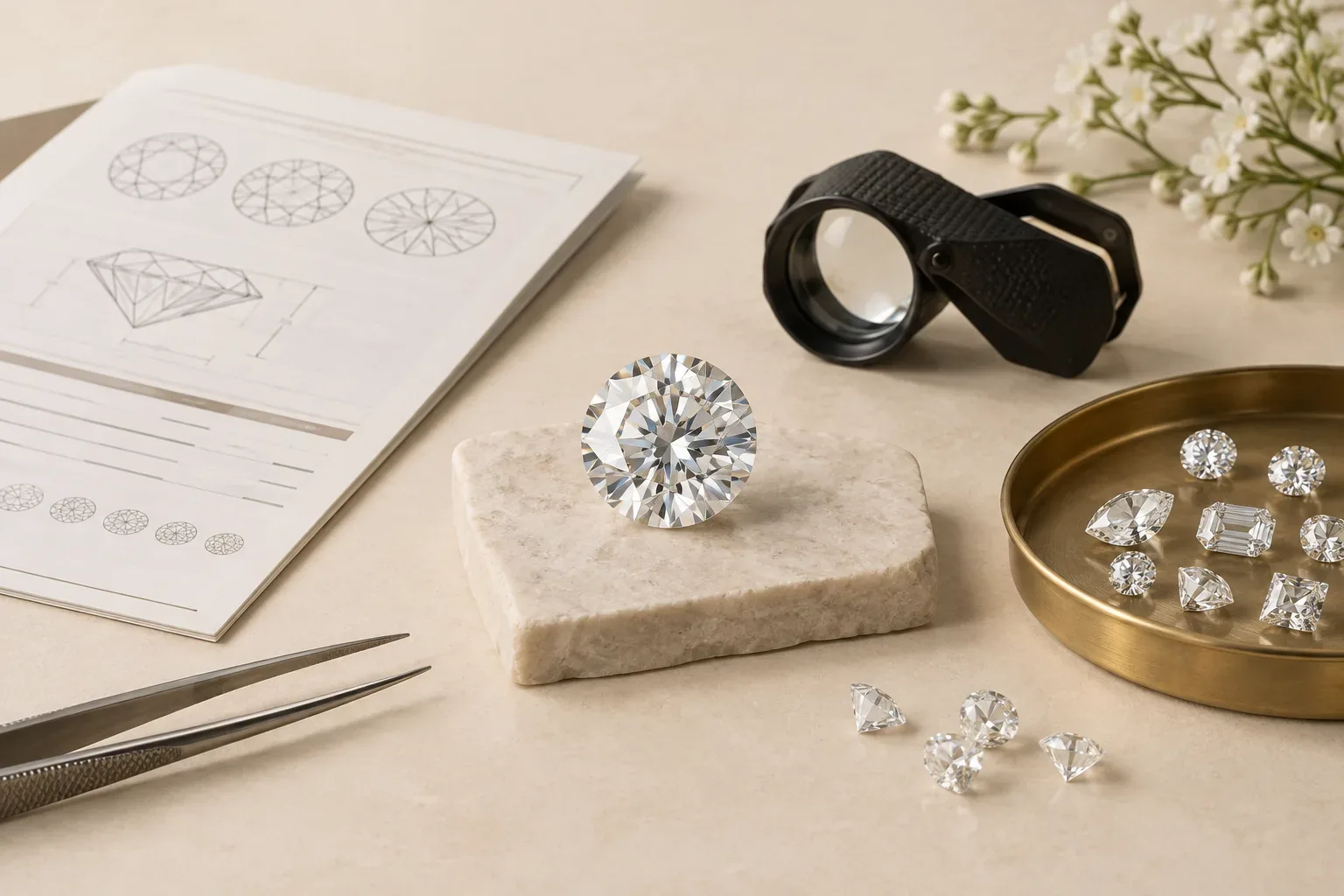
A cut grade report is a technical description issued by a gemological laboratory or a qualified grader that records how a diamond’s proportions and finish affect its light performance and overall appearance. Typical entries include a cut grade or assessment of light return, proportion measurements such as table and depth percentages, polish and symmetry ratings, and other observations such as fluorescence and a plot of inclusions. Laboratories may also include an overall grade for cut in addition to these component measurements.
Laboratory reports are different from sales certificates or advertising. A lab report describes physical and optical measurements made under controlled conditions by trained graders and instruments. Because these reports are technical documents, they are designed to help buyers and trade professionals make informed decisions rather than to serve as simple marketing claims.
Historical evidence and the development of cut grading
Documented, technical cut grading is a modern practice associated with gemological laboratories. The Gemological Institute of America (GIA) and other labs developed standardized measurement and grading protocols during the 20th century to make comparative assessments reproducible for trade and consumer protection. These laboratory standards are the primary historical evidence for how cut became a codified attribute for diamonds.
Before laboratory grading existed, diamond cutting and assessment were practiced by cutters and merchants in distinct cultural and historical settings. For example, diamonds were mined and traded in South Asia (India) in the pre-modern period, where they were admired for color and natural crystal form. In Renaissance and early modern Europe (roughly the 15th through 18th centuries), advances in cutting techniques and mounting styles changed how brilliance and fire were valued in jewelry. These cultural periods influenced taste and technique, but they did not produce the standardized, instrument-based reports you see today. For technical, laboratory-focused history and why modern grading matters to consumers, see the material from the Gemological Institute of America.
Documented historical meanings vs modern personal interpretations
Historical meanings of diamonds — how different cultures valued them — are distinct from the scientific statements a cut grade report makes. Museums and historians document that various societies prized diamonds for rarity, hardness, or symbolic reasons; these are cultural meanings reported by historians and collections. By contrast, modern cut grade reports do not assign symbolic meaning; they record measurable properties.
Modern personal interpretations — for example, equating a specific cut grade with romantic commitment or status — are contemporary social meanings that differ by buyer, culture, and marketing. A responsible shopper should keep these two layers separate: use the cut grade report for technical evidence about appearance and durability, and decide on symbolism and narrative according to personal or cultural preference.
How the cut grade report elements appear on jewelry
Cut grade and related measurements directly affect how a diamond looks once set. A stone with strong light return and balanced proportions tends to exhibit more brilliance and scintillation in ring, stud, or pendant settings. Polished facet edges and good symmetry reduce visible light leakage and produce cleaner sparkle, which is especially noticeable in open settings like solitaire rings and stud mounts.
Other report entries also affect choice of setting. Fluorescence can be visible in some lights and may alter perceived color; buyers often choose settings or metal colors that harmonize with the diamond’s visual effect. Inclusion plots show the location and size of internal features; a cutter will often place inclusions where a setting prong can conceal them or choose a setting that distracts the eye from an inclusion. In short, the cut grade report describes properties that jewelry designers and setters use to optimize appearance in different mountings.
Decision criteria: what to weigh when reading a cut grade report
Prioritize the cut grade or equivalent light-performance assessment first if visual brilliance is your top criterion. For many buyers the cut grade drives perceived beauty more than carat weight. After cut, consider proportion numbers, polish and symmetry, and the diamond’s shape, because different shapes have different ideal proportional ranges.
Balance your budget against size and visual performance. A slightly lower cut grade can sometimes allow you to buy a larger carat weight for the same price, but that may reduce sparkle. Conversely, paying more for an excellent cut grade can make a smaller diamond look brighter and visually larger in certain settings. Decide which visual qualities you value most and use the report to compare stones on comparable measurement criteria.
Practical trade-offs and examples
If you want a dramatic, very bright appearance, prioritize a top cut grade even if that reduces carat weight. If you want maximum face-up size for budget, accept a slightly lower cut grade but pay attention to proportion charts and find a stone that minimizes light leakage. For fancy shapes such as oval or emerald cuts, understand that face-up appearance depends as much on length-to-width ratio and pavilion design as on the cut grade number; compare stones visually and with their reports.
Also consider settings and metal color. A halo or bezel can increase perceived size and mask inclusions or less-than-perfect proportions. For everyday wear, think about durability: stones with deep pavilions and thin girdles can be more vulnerable to chipping at the girdle when struck, so consider how the ring will be worn and whether protective settings are appropriate.
Safe care guidance and treatment disclosure
Treatments, disclosure, detectability, and special-care needs are important consumer issues. The Gemological Institute of America (GIA) explains that treatments must be disclosed and that treatment type affects detectability, durability, and care. The Federal Trade Commission (FTC) requires clear written disclosure distinguishing natural, lab-created, treated, and imitation materials. Always ask the seller for written disclosure and read the laboratory report for any treatment notation.
For daily care, follow general jewelers’ guidance: clean diamonds in warm water with mild detergent and a soft brush, inspect settings periodically for loose prongs, and avoid exposure to harsh chemicals that can damage surrounding metals or settings. If a report notes unusual treatments, ask the issuing lab or a qualified jeweler about any special handling or cleaning precautions.
What you can and cannot verify without a lab or qualified jeweler
You can verify the presence of a laboratory report, its issuing laboratory name, and often a report number by checking the issuing laboratory’s database or contacting the lab directly. The FTC advises consumers to demand clear written disclosures about material origin and treatments. You can also perform basic visual checks: look at photos or the actual stone to assess face-up appearance, ask for a loupe image to see obvious inclusions, and compare multiple stones side by side.
You cannot, however, confirm a professional cut grade, detect some treatments, or authenticate a diamond’s origin reliably without a recognized gemological laboratory or a qualified gemologist. Only recognized labs have the instruments and trained graders to provide an authoritative cut grade and treatment detection. If independent verification is important, insist on a report from a reputable lab and, if needed, pay for a buyer-requested independent evaluation.
Practical, respectful selection and gifting guidance
When selecting or gifting a diamond, ask the seller for the full laboratory cut grade report, verify the laboratory name and report number, and compare the stone’s listed measurements rather than relying solely on images or marketing descriptors. Consider the recipient’s lifestyle and aesthetic: choose a protective setting for someone who wears jewelry daily, and favor a higher cut grade if brilliance is the primary preference.
Respect tastes and budgets. If the gift’s symbolism is more important than technical perfection, a well-documented mid-range stone with a clear report and honest seller disclosure is often a better choice than an expensive stone with an unclear provenance. Use the report to support a transparent conversation with the seller or with an independent jeweler when you need clarification.
Closing: use reports as evidence, not as the whole story
Treat a cut grade report as an evidence-based tool that helps you compare stones on objective measurements and to understand likely appearance and care needs. Keep cultural and personal meanings distinct from the laboratory evidence. When in doubt, follow FTC guidance about disclosure and rely on recognized gemological laboratories or qualified jewelers for verification you cannot perform yourself.
Frequently asked questions
What is a cut grade and why does it matter?
A cut grade is a laboratory assessment of how a diamond’s proportions, polish and symmetry affect its light performance and appearance. It matters because cut-related attributes often influence perceived brilliance more than carat weight. For technical context, consult a recognized laboratory report and the issuing lab’s descriptions.
Can I trust an online image instead of a report?
No. Images can be helpful for initial comparison, but they cannot replace a verified laboratory report. The FTC advises consumers to demand written disclosure about treatments and origin, and independent verification from a reputable lab or qualified jeweler is required to confirm grade and treatment claims.
Will the cut grade tell me whether a diamond was treated or lab-created?
Not always. Some reports include treatment and origin information, but detection of certain treatments or lab-grown origin requires specific laboratory testing. The Gemological Institute of America and the FTC recommend requesting clear, written disclosure and a formal lab report for such matters.
What can I verify myself before buying?
You can verify the presence of a report, the issuing laboratory name, and often the report number via the lab’s public database. You can visually compare face-up appearance and ask for loupe images. You cannot, however, perform authoritative grading or certain treatment detection without a recognized lab or qualified gemologist.
How should I care for a diamond ring based on the report?
Follow standard jewelry care: clean with warm water and mild soap and a soft brush, inspect settings periodically, and avoid harsh chemicals. If the laboratory report notes specific treatments, ask the lab or a qualified jeweler about any special cleaning or handling instructions.
Sources and further reading
- Imaginaire Digital — Imaginaire Digital
- Gemological Institute of America — Gemological Institute of America
- Federal Trade Commission — Federal Trade Commission