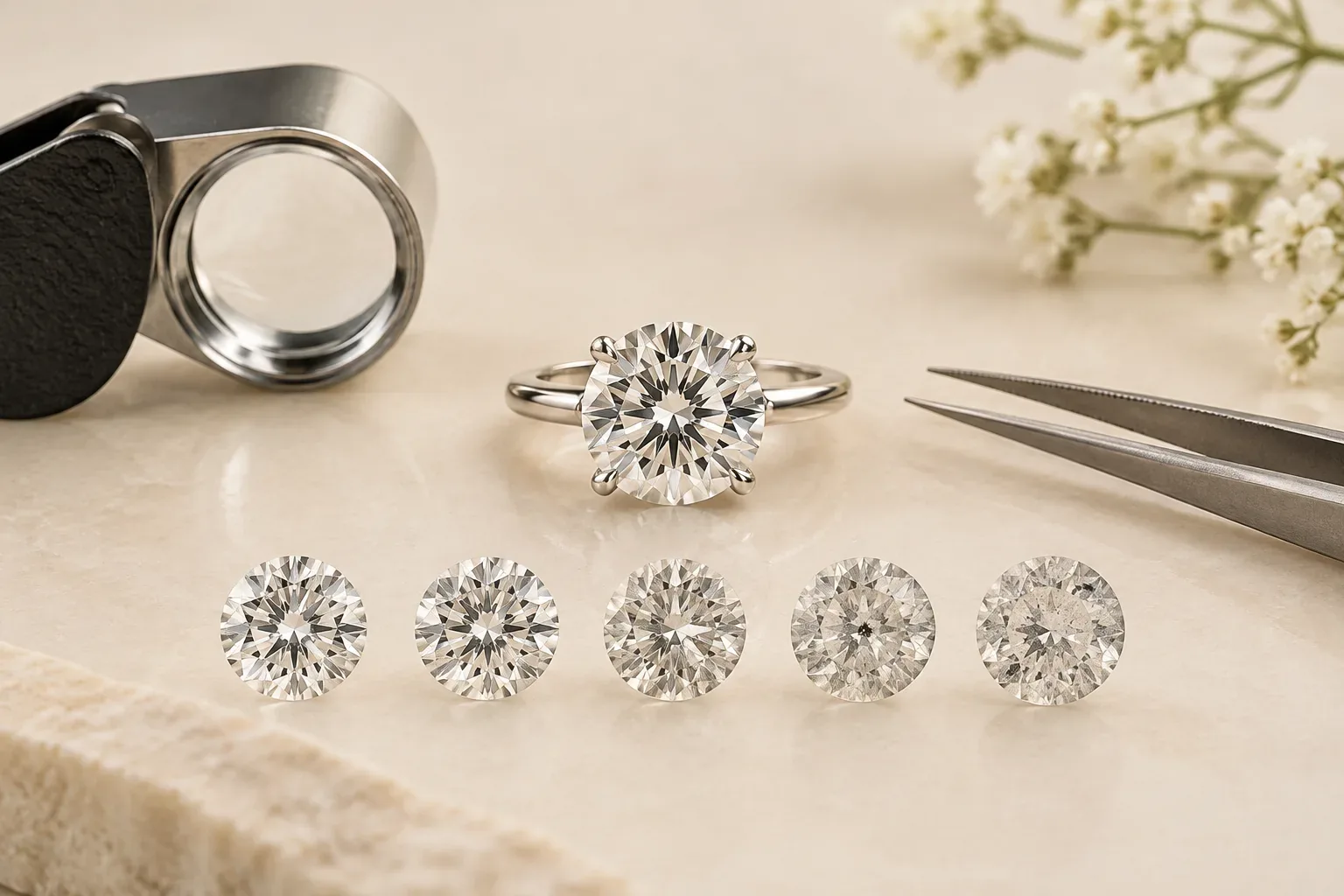
Meaning at a glance
“Eye-clean” describes a diamond whose inclusions are not visible to the unaided eye at a normal viewing distance; understanding it requires clear inspection, knowledge of trade-offs among clarity, cut and price, and awareness of what only a lab or qualified professional can confirm.
Direct answer — what 'diamond eye cleanliness' means
In trade usage, “eye-clean” (or “eye cleanliness”) means a diamond has no internal inclusions or surface blemishes that are visible to the unaided eye when viewed at a normal social distance under ordinary lighting. The designation is a visual, practical judgment rather than a formal laboratory grade. Shoppers use the term to decide whether a lower clarity grade still looks flawless in everyday wear and to compare value between stones.
How this concept developed (historical evidence and context)
The notion of judging a gemstone by whether imperfections are visible to the unaided eye is a product of modern gemological practice and retail behavior rather than an ancient symbolic system. The systematic clarity grading frameworks used by gemological laboratories evolved in the 20th century as the trade sought consistent ways to describe internal features and treatments; institutions such as the Gemological Institute of America (GIA) underpin that modern vocabulary and the consumer questions that follow. The sources approved for this article focus on those contemporary technical and consumer dimensions rather than on older cultural symbolism.
Documented historical meanings vs modern personal or cultural interpretations
Documented meanings recorded by modern gemological organizations and consumer regulators are primarily technical and commercial. The GIA documents treatments, detectability and disclosure obligations that shape how clarity and other quality factors are presented to buyers, and the Federal Trade Commission (FTC) sets expectations for accurate disclosure of whether a gem is natural, lab-created, treated or imitation. These are objectively documented roles that affect how “eye-clean” is used in sales and reporting.
Modern personal or cultural interpretations—such as attaching moral, spiritual or symbolic meanings to a stone’s apparent purity—are separate from the technical “eye-clean” judgment. Those interpretations vary widely by individual, culture and period, and they are not universal. This article keeps the technical, verifiable meaning of “eye-clean” distinct from any symbolic reading a wearer might prefer.
How the term and the diamond itself appear in jewelry listings and designs
Retail listings, appraisals and jeweler conversation commonly use “eye-clean” to describe a diamond that looks free of inclusions in practical use. You will see this term applied to center stones in engagement rings, solitaire studs, tennis bracelets, and other pieces where a clean visual appearance is a priority. Market demand data from 2026 shows strong consumer interest in engagement rings, studs, tennis bracelets and other classic diamond items, which is why clarity discussions—eye-clean or grade-based—are frequent in those categories, according to Imaginaire Digital.
Design-wise, jewelers sometimes set diamonds to emphasize their visual purity: bright, open settings and high-quality cuts increase perceived brilliance and can mask minor inclusions at the scale visible to the naked eye. Conversely, designs that sit close to the skin or use mixed metals can highlight or hide features differently, so a diamond that appears eye-clean in a showroom can read slightly different once set.
Decision criteria: what to check when someone says a diamond is 'eye-clean'
First, treat “eye-clean” as a visual claim about appearance, not an absolute statement about internal structure, treatment history, or origin. Ask to inspect the stone in person at arm’s length and in several lighting conditions, or request high-resolution, unretouched images and a video that shows the stone from multiple angles while it is mounted. Second, consider the interplay between clarity, cut and carat: a superior cut often improves perceived brightness and can make small inclusions less obvious in daily wear, so many buyers prioritize cut over a perfect clarity grade.
Third, confirm disclosures. The FTC requires clear seller disclosure about whether a gemstone is natural, lab-created, treated or an imitation. For treatments and detectability questions, consult the guidance of the Gemological Institute of America, which details how treatments affect appearance and durability, and why some treatments may be detectable only by a qualified laboratory.
Practical trade-offs shoppers face
Choosing an eye-clean stone typically lets buyers save on clarity while retaining a visually clean appearance. That is often an economical strategy: opting for the lowest clarity grade that remains eye-clean at the chosen carat and cut can preserve budget for a better cut or larger carat weight. The trade-off is that lower clarity grades have inclusions that, while not visible unaided, are present and can affect resale value or appraisal outcomes later.
High-value purchases or stones above certain sizes may warrant higher clarity grades or a formal laboratory report because inclusions become easier to spot as carat size increases. In addition, certain types of inclusions can affect durability; the GIA highlights that treatments and internal features can influence detectability and performance, so a professional assessment is sensible for higher-risk configurations.
What you can verify without a lab and what requires a qualified jeweler or laboratory
You can verify eye-cleanliness yourself by examining the diamond in person, requesting clear images and video, and testing it in multiple lights. You can also check seller disclosures and ask for any available grading reports. The FTC notes that sellers must provide honest information on the nature of the gem—whether it is natural, lab-created, treated, or imitation—so written disclosures are a key verification step.
What you cannot reliably determine without professional help includes whether microscopic treatments were applied, whether the diamond is natural or lab-grown in some cases, and the exact internal character and origin of inclusions. Detecting some treatments or confirming origin usually requires specialized instruments and testing in a gemological laboratory, as the GIA explains in its material on treatments and detectability.
Safe care guidance for diamonds described as eye-clean
Everyday care for a diamond labeled eye-clean follows the same best practices as for other diamonds: clean regularly with a mild soap and warm water and a soft brush, rinse thoroughly and dry with a soft cloth to maintain brilliance. Ultrasonic cleaners and steam cleaners are effective for many untreated, well-set diamonds, but the GIA warns that certain treatments and fragile settings may be adversely affected, so verify whether a stone has received treatments or has a delicate setting before using aggressive cleaning methods.
For mounted stones, check prongs and mount security regularly. Even a visually clean diamond can become damaged if its setting fails. If you receive a grading report, keep it with the jewelry for resale or insurance purposes; the documentation helps clarify quality and treatment disclosures long after purchase.
Selection and gifting guidance (practical and respectful)
When selecting or gifting a diamond described as eye-clean, match the choice to intended use, budget and the recipient’s priorities. For everyday wear like engagement rings or studs, prioritize cut and a visual inspection to ensure the stone looks clean in typical lighting. If the gift recipient values certificates, request a recent grading report from a recognized lab and ask the seller for all treatment/creation disclosures as recommended by the FTC.
Be respectful when making choices about clarity and price. If someone equates clarity with emotional significance, that is a valid personal interpretation; conversely, many buyers place more importance on sparkle, ethical sourcing, or budget. Communicate openly with the recipient when possible, and for surprise gifts consider a clear return or upgrade policy so the recipient can choose a different stone or setting if desired.
Summary and limits on verification
“Eye-clean” is a practical, sight-based designation: it means no imperfections are obvious to the naked eye at normal viewing distance. It is useful for budgeting and for everyday-wear decisions, but it is not a substitute for laboratory grading or disclosure about treatments and origin. Use seller disclosures required by the FTC, look for documentation and lab reports for higher-value purchases, and consult a qualified jeweler or a gemological laboratory for questions about treatments, origin or microscopic internal features as explained by the GIA.
Frequently asked questions
What exactly does 'eye-clean' mean for a diamond?
Eye-clean means no inclusions or blemishes are visible to the unaided eye at normal viewing distance under ordinary lighting; it is a visual assessment, not a formal lab grade.
Can I tell if a diamond is eye-clean from photos alone?
Photos and videos can help, but lighting, camera quality and retouching affect appearance; an in-person inspection or high-resolution, unedited video is more reliable.
Is an eye-clean diamond the same as flawless or internally flawless?
No. Flawless and internally flawless are formal laboratory clarity grades that indicate no internal or surface features at 10x magnification; eye-clean is a visual description at normal sight.
Will a diamond stay eye-clean forever?
Eye-clean refers to current visible appearance; durability can be affected by certain inclusions or treatments, and settings or damage can change how a stone looks, so regular care and inspection are important.
Do treatments or lab creation affect eye-clean appearance?
Treatments and lab-grown production can affect appearance and detectability; the GIA explains that some treatments change how a gem looks and how it must be disclosed, and the FTC requires accurate seller disclosure.
When should I ask for a laboratory report?
Ask for a reputable lab report for high-value purchases, stones above typical sizes where inclusions are easier to see, or when you need confirmation of treatments, origin or exact clarity and color grades.
How should I clean an eye-clean diamond?
Use mild soap and warm water with a soft brush for routine cleaning and inspect the setting regularly; check with the seller or a jeweler before using ultrasonic or steam cleaners if the stone has known treatments or a fragile setting.
Sources and further reading
- Imaginaire Digital — Imaginaire Digital
- Gemological Institute of America — Gemological Institute of America
- Federal Trade Commission — Federal Trade Commission