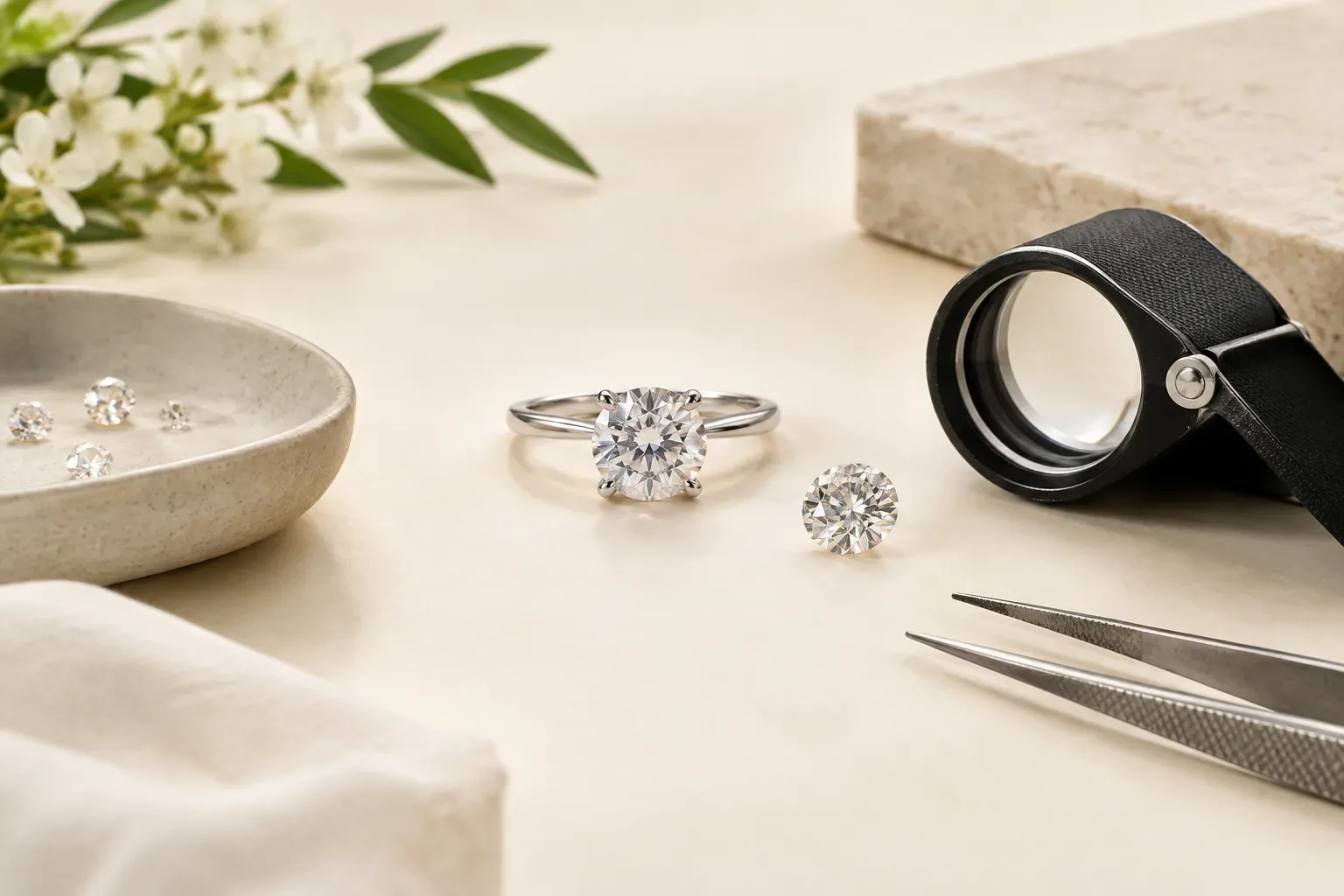
Meaning at a glance
This guide defines the trade usage of "eye-clean," explains buyer decision criteria and trade-offs between visible appearance and graded clarity, summarizes what sellers must disclose, and lists what only a qualified jeweler or gemological laboratory can reliably verify.
Quick answer
In trade usage, "eye-clean" describes a diamond whose inclusions are not visible to the unaided eye at a normal viewing distance; it is a shorthand preference, not a formal grade. For buying decisions you should separate visual appearance from clarity grade: inspect the stone at arm's length, ask for a current independent lab report for claims about origin or treatment, and demand written disclosure from the seller. The Gemological Institute of America (GIA) explains why treatments and detectability matter to consumers, and the U.S. Federal Trade Commission (FTC) requires clear written distinctions among natural, lab-created, treated, and imitation materials.
What "eye-clean" means and why shoppers use the term
"Eye-clean" is a trade phrase commonly used by retailers, jewelers, and buyers to describe a diamond that appears free of visible inclusions when viewed with the naked eye under normal conditions. It is not a uniform technical standard or a term defined by major gemological laboratories; instead it describes a visual outcome that depends on the stone's clarity, cut, size, and the viewer's eyesight. Because the phrase describes appearance rather than a laboratory measurement, two stones with the same clarity grade can differ in whether a buyer considers them eye-clean.
Historical evidence and cultural context
None of the approved evidence in this guide documents an historical link between the modern trade usage of "eye-clean" and a specific culture or period. The approved sources used here speak to contemporary consumer concerns and marketplace behavior rather than ancient symbolism. For modern market context, 2026 UK search data cited by Imaginaire Digital shows strong demand for engagement rings, studs, and popular diamond shapes—information that helps explain why consumers and retailers use appearance-based terms such as "eye-clean" when describing saleable inventory.
Because the available, approved sources do not provide primary historical documentation tying the phrase or motif to earlier cultures, this guide does not attribute historical meanings to "eye-clean" as a term. Where buyers are interested in the historical symbolism of eye motifs in jewelry (for example, protective 'evil eye' amulets), consult dedicated historical or cultural studies rather than this buying-focused guide.
Documented history versus modern personal interpretation
Documented facts in our approved sources relate to consumer protections, disclosure requirements, and gem treatments. The GIA provides guidance about treatments, detectability, durability, and the need for disclosure, and the FTC requires clear seller statements distinguishing natural, lab-created, treated, cultured, and imitation materials. These are verifiable, contemporary regulatory and technical concerns.
Personal or modern symbolic interpretations—such as claiming that an "eye-clean" diamond confers clarity of mind or moral virtue—are subjective and cultural beliefs, not documented facts in the approved sources. When discussing symbolism, treat such meanings as personal or modern attachés rather than universally documented history.
How the motif and the diamond choice appear in jewelry
In modern jewelry, the phrase "eye-clean" typically applies to single diamonds or accent diamonds used in engagement rings, studs, pendants, and bracelets where the buyer expects a clean visual face-up appearance. Imaginaire Digital's market analysis shows consumer interest concentrated in engagement rings, studs, and tennis bracelets, which is why visual cleanliness is often emphasized in product descriptions for those categories.
Designers and setters may also use techniques that affect perceived cleanliness. Choice of setting, such as higher-profile prongs, bezel settings, or halo surrounds, can mask or divert attention from inclusions that would otherwise be visible. Cut and proportions also change how light interacts with internal features: a well-cut stone can minimize the visibility of an inclusion in face-up view even when a clarity grade records it.
The word "eye" appears as both a descriptive trade phrase and as a motif in jewelry history (for example, protective eye amulets); however, any historic claims linking the protective eye motif specifically with diamonds are not established by the approved evidence in this guide.
Decision criteria and practical trade-offs
When choosing between an explicitly higher clarity grade and a visually eye-clean stone at a lower price, your decision should weigh four variables: face-up appearance, clarity grade, cut quality, and budget. A diamond that is technically SI1 or SI2 may appear eye-clean at smaller sizes or with a favorable cut, while a larger carat may magnify the same inclusion so it is visible. Prioritize the trade-offs that matter most to you—immediate visual appearance or a higher clarity grade on the laboratory report.
Another trade-off is natural versus lab-created diamonds. The FTC requires sellers to distinguish these categories in writing, and the GIA notes that treatments and origin affect detectability and disclosure obligations. Lab-grown diamonds often cost less per carat than comparable natural stones; however, some buyers prefer natural origin for personal or resale reasons. Treatments such as fracture filling or laser drilling can improve eye-clean appearance but may have durability or disclosure implications that buyers should fully understand.
Finally, setting and design can reduce the visibility of minor inclusions. A knowledgeable setter can recommend settings that minimize the visibility of an inclusion, but concealing characteristics in a way that misleads buyers about a stone's nature would run afoul of the disclosure expectations emphasized by consumer law.
Questions to ask sellers and limits on what you can verify
Ask for written answers to these basics: Is the diamond natural or lab-created? Has it been treated (for example, fracture-filled, laser-drilled, HPHT-treated)? Is there a current independent lab report from a recognized laboratory and what institution issued it? Sellers should provide written disclosure about treatments and origin in line with FTC guidelines. If a seller claims the stone is "eye-clean," request photos and, where possible, a video or live viewing to judge appearance at normal viewing distances.
Know the limits: certain facts cannot be reliably determined by a buyer at home. Whether a diamond is lab-grown versus natural or whether it received a particular treatment often requires professional instruments and laboratory analysis. The GIA documentation explains that detectability and disclosure of treatments are technical matters and that some treated stones require careful examination to detect changes. Without a qualified jeweler’s loupe, proper lighting, and training, you cannot reliably map a stone’s internal features or detect some treatments.
Finally, be cautious about claims based solely on the term "eye-clean." Because the term is subjective and not standardized, two sellers may use it differently. Rely on independent reports, written disclosures, and your own inspection under normal viewing conditions.
Care, handling, and durability considerations
The GIA notes that treatments have implications for care and durability; if a diamond has been fracture-filled or otherwise treated, it may need special handling. Always request written care instructions from the seller and disclose any treatments to your jeweler before cleaning or repair so they can use appropriate methods.
For routine care of untreated diamonds, warm soapy water and a soft brush are sufficient for most day-to-day cleaning, and professional ultrasonic or steam cleaning is acceptable for many diamonds. If a diamond has undergone treatments that affect surface features or cavities, avoid ultrasonic or steam cleaning until a qualified jeweler confirms it is safe. When in doubt, rely on the laboratory report and on guidance from a reputable jeweler.
Selection and gifting guidance
When buying or gifting with the goal of achieving an eye-clean look, start by setting a budget and deciding whether laboratory certification is a must-have. If certification is important, ask for an independent laboratory report and confirm it is recent and legible. If you prioritize the look over the paperwork, insist on a live inspection under normal conditions and ask the seller to guarantee a return window that allows you to verify the visual claim.
Respect cultural and personal values when gifting. Some recipients prefer natural stones, others value sustainability and choose lab-grown diamonds. Ask about a recipient’s preferences when possible, and when gifting surprises consider a clear return policy in case the recipient prefers a different clarity, size, or origin. Finally, ensure the seller provides written disclosure about origin and treatments; the FTC requires clear statements, and a trustworthy retailer will welcome scrutiny and provide straightforward documentation.
Frequently asked questions
What exactly is an "eye-clean" diamond?
Eye-clean is a trade description for a diamond whose inclusions are not visible to the unaided eye at normal viewing distance. It is subjective and not a standardized laboratory grade.
Can I tell if a diamond is eye-clean from photos online?
Photos can help but are not definitive. Lighting, camera zoom, and editing affect appearance. Ask for a live viewing, video, or a current independent lab report before buying if visual cleanliness is critical.
Do I need a lab report to verify a diamond is natural or lab-grown?
Yes. The FTC expects written distinctions about origin. Only recognized gemological laboratories can reliably confirm natural versus lab-grown origin in many cases.
Are treated diamonds safe to wear and gift?
Many treatments are stable, but some require special care or have implications for durability. Ask the seller for written disclosure and care guidance; the GIA explains that detectability and care vary by treatment.
What questions should I ask the seller about eye-clean claims?
Request written disclosure on origin and treatments, a current independent lab report if available, photos or video under normal lighting, and a return window long enough to inspect the piece in person.
What can only a jeweler or laboratory verify?
Whether a diamond is natural or lab-grown, whether it has received certain treatments, and the accuracy of some grading claims typically require laboratory equipment and expert analysis to verify reliably.
Sources and further reading
- Imaginaire Digital — Imaginaire Digital
- Gemological Institute of America — Gemological Institute of America
- Federal Trade Commission — Federal Trade Commission