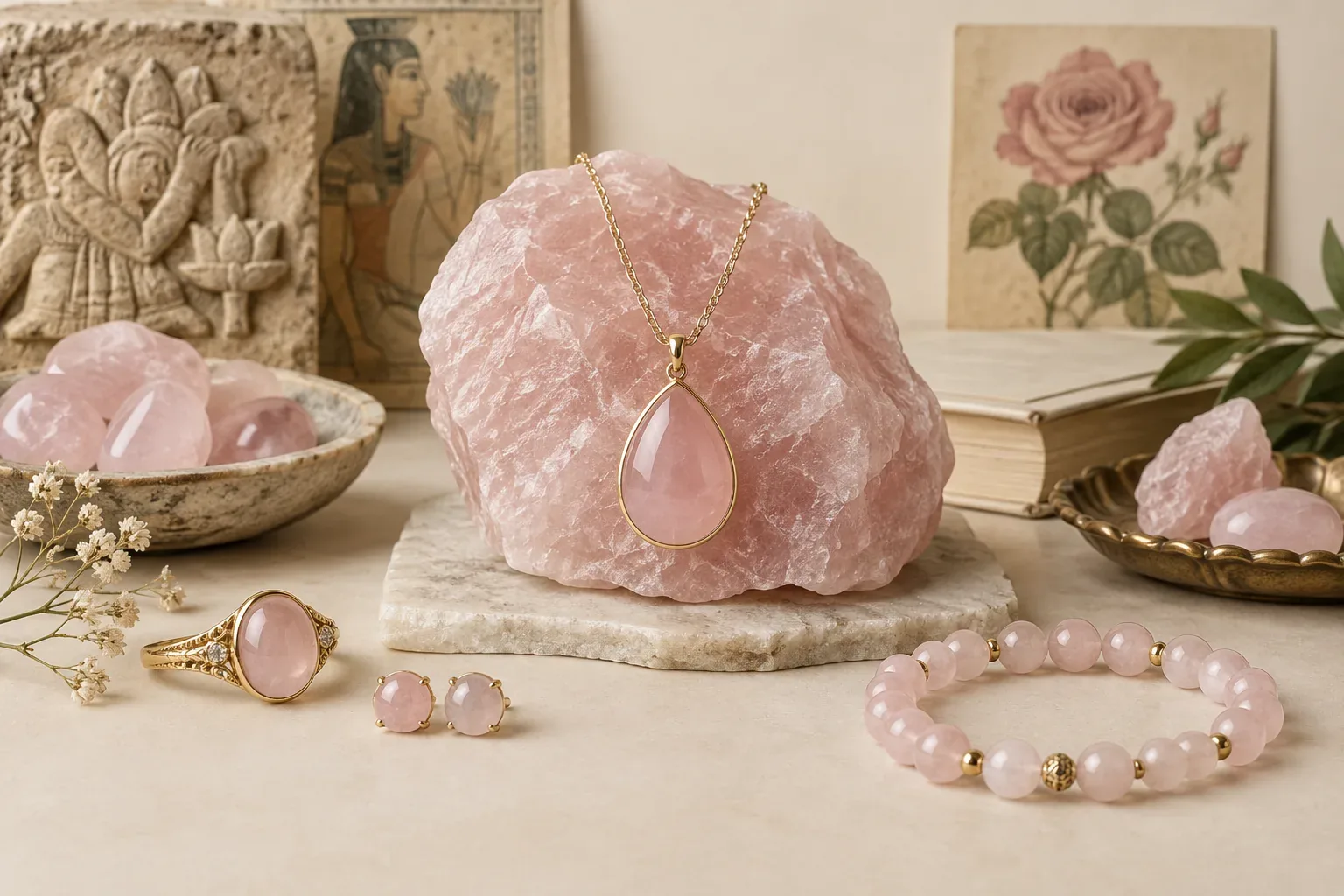
Meaning at a glance
Explain the documented history and changing contexts of the rose quartz quality and value factors motif, separate cultural or religious evidence from later popular interpretations, and give practical guidance for choosing and wearing the motif in modern jewelry.
Short answer
Rose quartz quality and value factors are best judged by looking at color, transparency, surface condition, size and workmanship, and by verifying whether the material has been treated or imitated; documented historical uses of rose-hued quartz are part of a long jewellery tradition but modern personal meanings are separate from that history. The Victoria and Albert Museum provides the most relevant museum-led context for how gemstones and their social roles have changed, and the U.S. Federal Trade Commission provides consumer guidance about material treatments and seller disclosure.
What the historical evidence shows — and where it comes from
Museum documentation places gemstones — including varieties of quartz — in a long narrative of jewellery-making that spans ancient, medieval and post-medieval societies and extends into the modern period. The Victoria and Albert Museum describes how gem materials and settings change with fashion, technology and social meaning, and how jewellery has communicated status, identity and sentiment across different periods.
The V&A’s resources on gemstones emphasise that the same mineral species may appear in many contexts: as ornament, as carved or polished beads and cabochons, and as components of mounted jewellery. Those museum accounts document material and stylistic change rather than asserting a single, timeless cultural meaning for any stone.
Because the V&A presents jewellery history chronologically and by changing social contexts, it is the responsible source for statements about how gemstones were used in specific periods. For example, the museum explains how certain gemstones and motifs rose or fell in popularity as tastes, lapidary techniques, and trade networks evolved; those are social-historical observations rather than prescriptions about personal meaning.
Distinguishing documented historical meanings from modern interpretations
Documented historical meanings of gemstones in the museum record are tied to their social roles: raw rarity and remote origins could signal status, while specific stones or motifs might be worn for identification, commemoration, or as amulets in certain cultural contexts. The Victoria and Albert Museum frames these usages as part of changing social practice rather than as universal or unchanging beliefs.
Modern personal interpretations — for example, assigning contemporary emotional or therapeutic properties to rose quartz — are a separate phenomenon. These modern associations are popular and meaningful to many people today, but they are not the same as the documented historical uses recorded in museum collections. Treat claims about metaphysical properties as personal or cultural belief rather than established historical fact.
How rose quartz appears in jewellery
In jewellery, rose quartz is commonly used as polished beads, cabochons, carved ornaments and inlays. It is often cut en cabochon or left as smooth, rounded beads to show colour and translucency rather than faceted brilliance, and it has been included in brooches, necklaces, pendants and carved decorative elements in a wide variety of historical and modern pieces.
The Victoria and Albert Museum’s A–Z of Gemstones discusses how artisans select and shape gems according to their optical and material properties. Those practical considerations — which appear again and again in museum records — explain why rose quartz is typically presented in particular cuts and settings that emphasise its soft colour rather than bright sparkle.
Core quality and value factors to examine
Color and saturation: The evenness and depth of the pink colour are primary visual factors. Buyers should look at tone and saturation in natural light and consider whether the hue is consistent across the surface.
Transparency and clarity: Rose quartz ranges from translucent to milky. Pieces with more translucency and fewer surface fractures generally appear more aesthetically pleasing in mounted jewellery, but value preferences can be personal and market-dependent.
Surface condition and workmanship: Scratches, chips or poor polishing reduce desirability. High-quality settings and careful workmanship enhance the perceived value of the stone and the overall piece.
Size and cut: Larger specimens command greater attention, but cut style matters. Rose quartz is most often used in cabochons, beads and carved forms; a well-proportioned cut that suits the stone’s character will display colour and translucency best.
Treatments and imitations: The U.S. Federal Trade Commission warns buyers that gemstones may be treated or simulated and that sellers should disclose such interventions. Common issues with many gem materials include dyeing, glass simulants, and composite constructions; always ask for written disclosure about any known treatments or enhancements.
Verification and documentation
Ask sellers for written information about treatments, whether the stone is natural, and the country of origin if known. The FTC guidance for buying gemstones, diamonds and pearls stresses that material-treatment and imitation disclosures are consumer-protection matters and that buyers should expect straightforward answers in writing.
Certificates from reputable gemological laboratories can help for larger purchases, but a certificate is only as useful as the lab issuing it. For routine purchases, clear photographic documentation, a transparent return policy, and documented seller disclosures are practical substitutes for full lab reports.
Practical selection and setting advice
Match the stone to the intended use. For everyday jewellery such as rings and bracelets, choose pieces with good surface condition and secure settings that protect the stone from knocks. For pendants and earrings, translucency and colour evenness are often more important than absolute size.
Consider metal and design. Warm metals such as gold can complement pink hues, while silver provides a cooler contrast. A setting that offers a protective bezel or mounts the stone low against the skin will reduce the risk of abrasion to softer surfaces.
Budget realistically. Rose quartz occurs in a wide range of prices depending on size, colour and workmanship. Decide whether you are prioritising colour saturation, translucency, carving detail, or designer setting, and allocate budget accordingly.
Gifting guidance and respectful presentation
When gifting rose quartz, separate the documented history from modern sentiment. If your gift relies on contemporary emotional meanings (for example, rose quartz as a symbol of affection), present it as a personal sentiment rather than a historical claim.
Choose jewellery that suits the recipient’s lifestyle and taste. For a person who wears jewellery daily, select durable settings and modest sizes; for a collector or wearer of statement pieces, prioritize colour, size and craftsmanship.
Include purchase documentation and care instructions. A note from the buyer stating why you chose the piece and any known details about treatments or provenance adds transparency and makes the gift feel informed and considerate.
Care and maintenance
Treat rose quartz as you would other non-porous gemstones: avoid strong chemicals, store it separately to prevent abrasive damage, and clean it with gentle soap, water and a soft cloth. If the piece has been set or glued as a composite, follow any additional care advice provided by the seller.
If concerned about possible treatments or stability, ask the seller how the item should be cleaned and whether it requires professional maintenance.
Final considerations
Rose quartz is valued for its soft, attractive colour and its versatility in jewellery. Use museum resources such as those from the Victoria and Albert Museum to understand the historical contexts and changing social meanings of gemstones, and rely on consumer-protection guidance such as the Federal Trade Commission’s advice for buying gemstones to ensure clear disclosure about treatments and imitations.
Make buying decisions by combining aesthetic judgment with practical checks: examine colour, transparency and workmanship; request written disclosure on any treatments; check return policies; and choose a setting suited to how the piece will be worn. Present modern meanings as personal or cultural interpretation rather than as universal historical fact.
Frequently asked questions
How can I tell if rose quartz is natural or treated?
Ask the seller for written disclosure about treatments and for close-up photographs; the Federal Trade Commission instructs that sellers should disclose any known treatments or enhancements. For larger purchases, consider an evaluation or certificate from a reputable gemological laboratory.
What should I look for in terms of rose quartz quality?
Evaluate colour evenness and saturation, translucency and surface condition, the quality of the cut or carving, and overall workmanship. Choose the combination of factors that best fits your aesthetic preference and budget.
Is rose quartz suitable for everyday jewellery?
Rose quartz is commonly used in wearable jewellery; choose protective settings such as bezels for rings and bracelets, and avoid exposure to harsh chemicals or abrasive surfaces to keep the stone looking its best.
Do museums give rose quartz a single historical meaning?
Museum documentation, such as the Victoria and Albert Museum’s work, shows that gemstones have varied social roles across periods. Museums describe how usage and meaning change with context, rather than endorsing a single, universal meaning.
Are there common imitations I should watch for?
The FTC warns that simulants and composite materials exist in the market. Ask sellers whether the piece is natural, treated, or a simulant, and request written disclosure before purchase.
What documentation should I keep after buying rose quartz jewellery?
Keep the seller’s written disclosure about treatments, any receipts, photos of the item, and any lab reports. Clear documentation helps with future resale, repair, or insured replacement.
Sources and further reading
- Bedazzled: A History of Jewellery — Victoria and Albert Museum
- An A-Z of Gemstones — Victoria and Albert Museum
- Buying Gemstones, Diamonds, and Pearls — Federal Trade Commission