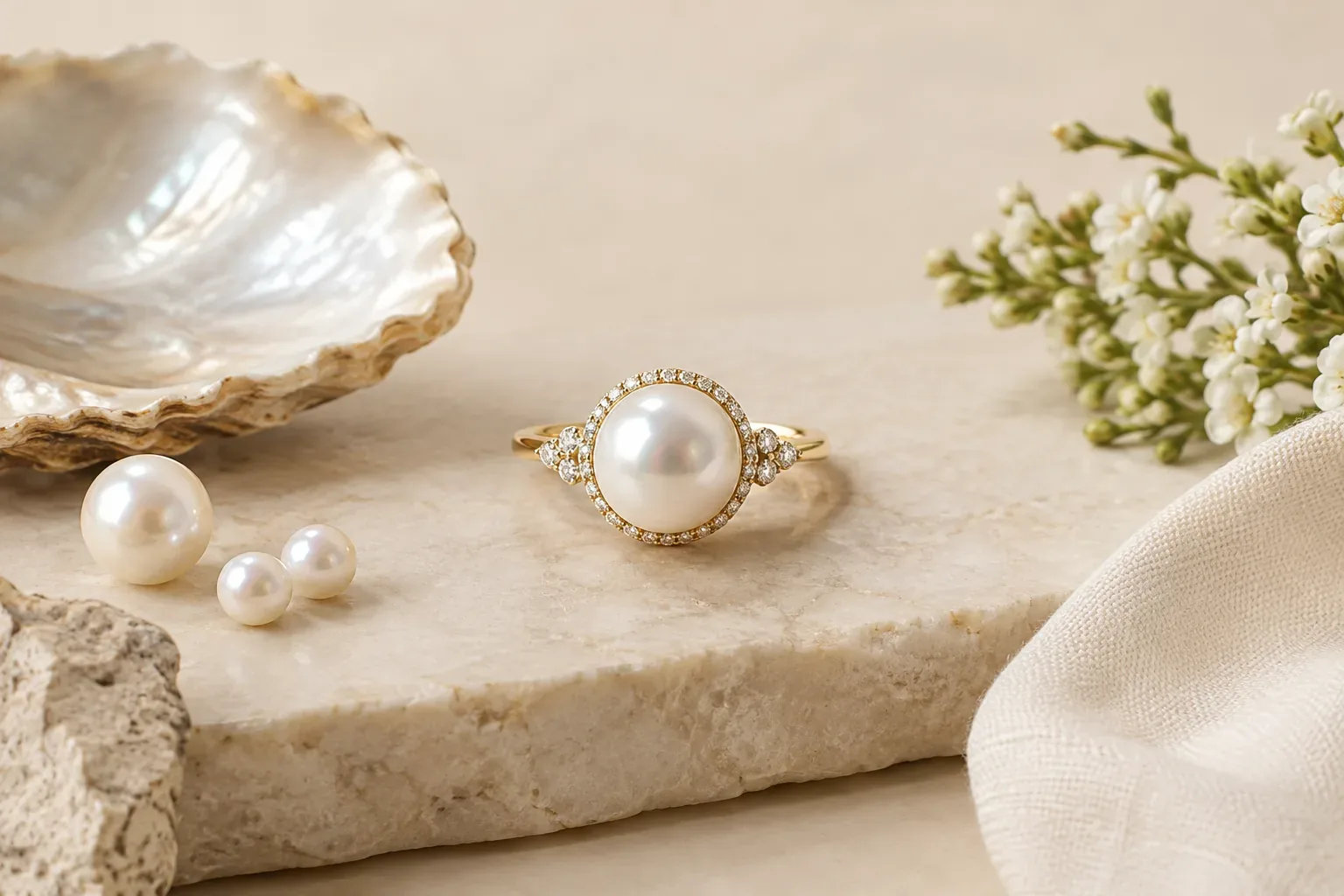
Meaning at a glance
A pearl engagement ring can be a beautiful and meaningful choice for some buyers, but its softer nature and the variety of natural, cultured and imitation materials require careful setting selection, clear seller disclosure, and gentle care; verification of origin or treatment requires a qualified jeweler or gemological laboratory.
Quick answer
A pearl engagement ring can be an elegant, symbolic alternative to a diamond ring when the wearer prefers the look or meaning of pearls and is willing to accept trade-offs in durability and routine care. This guide gives evidence-led decision criteria, recommended settings that protect pearls, practical gifting advice, safe cleaning and maintenance tips, and clear limits on what you can verify without a qualified jeweler or a gemological laboratory.
What the documented evidence covers — and what it does not
The approved, evidence-backed sources used for this guide document modern consumer questions about gems, seller disclosure requirements, treatments and detectability, and current jewelry trends. The Gemological Institute of America (GIA) explains that treatments, disclosure, detectability, durability and special care create distinct consumer questions for gemstones. The U.S. Federal Trade Commission (FTC) requires sellers to make clear distinctions among natural, lab-created, treated, cultured and imitation materials and to provide written disclosures to consumers. Industry trend reports from Professional Jeweller identify renewed interest in historical styles such as Art Deco and sculptural jewelry, while Imaginaire Digital reports recent search demand for engagement rings and other categories in the UK market.
Those sources do not provide a complete catalogue of primary historical evidence about pearl symbolism across ancient cultures. Because primary historical research and museum citations are outside the approved evidence set for this article, any precise claims about how individual historic cultures used or understood pearls should be confirmed with specialist historical sources. In this guide I separate the modern, documented trade- and care-related evidence from commonly repeated historical or symbolic interpretations, and I label modern interpretations where appropriate.
Documented history versus modern interpretations
Documented history in the approved sources focuses on contemporary market behavior, labeling and consumer protection rather than ancient symbolism. The FTC and GIA address how pearls and other gems are categorized and disclosed, not the full sweep of cultural stories attached to pearls.
Modern interpretations—such as describing pearls as symbols of purity, tears, or marital fidelity—are widespread in popular writing and contemporary gift language, but those attributions are interpretive rather than uniformly documented across cultures in the approved literature. Treat such symbolic meanings as personal or culturally specific choices rather than universal facts. If you want historically precise symbolism for a specific culture or period, consult specialist historical or museum sources before claiming that meaning as a fact.
How pearls and their motifs appear in engagement jewelry today
Pearls in modern engagement rings appear in a few consistent ways: as a single center pearl set alone, as a pearl set with accent diamonds or gemstones, as part of a cluster or charm-style ring, or as inlaid mother-of-pearl elements integrated into a sculptural band. Trend reporting from Professional Jeweller highlights interest in sculptural and historically inspired styles such as Art Deco revival, which can include pearls alongside diamonds and colored gems.
There are differences in the materials that bear the name 'pearl'. The FTC distinguishes between natural pearls, cultured pearls, and imitation pearls, and requires sellers to disclose which type they are selling. In practical terms, most pearl jewelry sold today uses cultured pearls because fully natural pearls are rare and costly. Imitation pearls may be used for costume or fashion rings and should be clearly disclosed.
Suitability: who should consider a pearl engagement ring?
A pearl engagement ring suits someone who prioritizes the look and personal meaning of a pearl and who either wears rings carefully or chooses a protective setting. Pearls are generally softer and more vulnerable to abrasion, acids and chemicals than hard gemstones, so they are better suited to wearers who do not expect to subject the ring to daily heavy-duty wear without protection. The GIA highlights that durability and special care are important consumer questions for gemstones, which applies to pearls as well.
Think about lifestyle, routine, and priorities. If the wearer spends a lot of time with hands in water, in labs, doing gardening, or in other physically demanding work, a traditional diamond solitaire might be a lower-maintenance choice. If the wearer values uniqueness or vintage-inspired style and is comfortable with gentle daily care and occasional professional maintenance, a pearl engagement ring can be entirely appropriate.
Settings and design choices that protect pearls
Choose settings that physically protect the pearl from knocks and abrasion. Bezel-style settings and partial bezels that wrap the lower portion of the pearl offer good edge protection. Low-profile settings that avoid high points are less likely to be struck during everyday activities. Where you want sparkle, a halo of small diamonds or a cluster design can visually complement the pearl while keeping it slightly recessed and protected.
Consider metal choice and band design that allow for a comfortable fit and that can be resized or repaired. If you plan a wedding band to sit with the engagement ring, try ring-stacking mockups before purchase to ensure a flush fit. For more sculptural or historical styles referenced in trend reporting, work with a designer to ensure the pearl is secured and that the overall design balances aesthetics with protection.
Trade-offs and decision criteria
Trade-offs include appearance versus durability, and cost versus authenticity. Pearls have a unique luster and surface quality that many people prefer to diamonds, but that same surface is more susceptible to scratches, cosmetics and chemicals. Expect to accept periodic maintenance such as professional cleaning, rechecking of settings, and possibly re-stringing if your design uses beading or strung elements.
Cost trade-offs depend on whether the pearl is natural, cultured or imitation and on quality factors including size, luster and surface condition. Because the FTC requires clear disclosure, ask the seller for written confirmation of the pearl type and any treatments before purchase. For many consumers, the decision criteria are: wearer preference for look and symbolism; willingness to follow care guidance; and the presence of clear seller disclosure and a reasonable return or repair policy.
Care and maintenance — practical, safe steps
Treat pearls gently. Wipe your pearl ring with a soft, damp cloth after wear to remove body oils, perfumes and lotions. Avoid exposing pearls to household cleaners, chlorine, acidic substances, and cosmetics. The GIA emphasizes that special care and durability concerns are key for certain gems, and pearls fall into that practical category.
Avoid ultrasonic or steam cleaning for pearls and do not subject them to harsh chemical cleaners that can damage the nacre. Have your ring inspected periodically by a qualified jeweler who can check settings and the pearl’s surface, and who can recommend professional cleaning methods if needed. For verification of origin or treatment, only a qualified jeweler or a recognized gemological laboratory can provide conclusive analysis.
Verification, disclosure, and what requires a lab or qualified jeweler
The FTC requires sellers to disclose whether a pearl is natural, cultured, or an imitation. Ask for that disclosure in writing and for any available provenance or grading information. Visual inspection by a consumer can tell you certain things about surface condition and symmetry, but it cannot reliably determine whether a pearl is natural versus cultured or whether a treatment has been applied.
For conclusive identification of origin, treatments, or value grading, only a gemological laboratory or a qualified jeweler with appropriate equipment can provide definitive answers. The GIA and similar labs can test and report on many gem treatments and classifications; if origin or authenticity is important to you, budget for laboratory testing before finalizing a high-value purchase.
Practical gifting guidance and respectful approach
When gifting a pearl engagement ring, respect the wearer’s style and lifestyle. Ask discreet questions about their preferences for metal, ring profile and whether they prefer low- or high-maintenance jewelry. If the proposal is a surprise and you are uncertain, consider a loaner ring for the proposal and involve the recipient in the final selection to ensure fit and long-term satisfaction.
Insist on full written disclosure from the seller about the pearl type and any treatments, a clear return policy, and options for sizing and future maintenance. If the ring is a customized or period-inspired design, document the design choices and any warranties or service agreements so the recipient will have the information needed for future care or resale.
Summary: an evidence-led decision
A pearl engagement ring is an excellent, intentional choice when the wearer values the aesthetic and symbolic resonance of pearls and understands the need for protective settings and careful maintenance. Use seller disclosure and lab testing where authenticity or origin matters, select protective settings for everyday wear, and follow conservative cleaning and inspection routines recommended by qualified jewelers.
For trend context about styles and consumer interest, consult Professional Jeweller for coverage of sculptural and historical influences, and Imaginaire Digital for recent search demand data. For questions about treatment detectability and care, consult the GIA, and for legal seller disclosure requirements consult the FTC. When in doubt about authenticity or value, engage a qualified jeweler or gemological laboratory for testing and documentation.
Related articles
For broader context on gemstones and symbolic meanings, see our Gemstones category. If you are comparing pearl alternatives or similarly luminous gems, you may find the Amethyst, Onyx, and Moonstone guides useful starting points for color, history and care differences.
Frequently asked questions
Are pearl engagement rings durable enough for everyday wear?
Pearls are more delicate than many faceted gemstones and require protective settings and gentle care. The Gemological Institute of America highlights that durability and special care are important considerations for gemstones; if you expect heavy everyday wear, choose a low-profile protective setting and accept the need for periodic maintenance.
How can I tell if a pearl is natural, cultured, or imitation?
The FTC requires sellers to disclose whether a pearl is natural, cultured, or imitation. Visual inspection can reveal surface condition and symmetry, but conclusive identification of origin or treatment requires testing by a qualified jeweler or a gemological laboratory.
What settings best protect a pearl in an engagement ring?
Bezel and partial-bezel settings, recessed mounts, and lower-profile designs that avoid high points are among the best choices to protect a pearl. Designs that pair pearls with accent stones in a halo or cluster can also provide physical protection while adding sparkle.
How should I clean and care for a pearl engagement ring?
Wipe pearls gently with a soft damp cloth after wearing to remove oils and cosmetics, avoid harsh chemical cleaners and ultrasonic or steam cleaning, and have the ring inspected by a qualified jeweler periodically for security and professional cleaning recommendations.
Do I need a lab report to buy a pearl engagement ring?
A lab report is not mandatory for every pearl purchase, but it is advisable for higher-value pieces or when origin and treatment affect value. The GIA can test many gem treatments and classifications, and the FTC requires sellers to provide clear written disclosure about the type of pearl being sold.
Sources and further reading
- Imaginaire Digital — Imaginaire Digital
- Professional Jeweller / PRYA Jewellery Search Insights — Professional Jeweller / PRYA Jewellery Search Insights
- Gemological Institute of America — Gemological Institute of America
- Federal Trade Commission — Federal Trade Commission