Meaning at a glance
Documented museum and consumer-protection guidance shows spinel has long been valued in jewelry and sometimes confused with other gems; modern buyers should treat reports of treatments or imitations as material facts, ask specific disclosure questions, and base gifting choices on the recipient's preferences and context rather than assumed universal meanings.
What the historical evidence shows
Museum research places spinel within the long arc of jewellery history as a gemstone that has been admired and used in high-status pieces, and which for long periods was sometimes confused with rubies and other red gems. The Victoria and Albert Museum discusses how gemstones and their social meanings change through time and how jewellers and collectors have valued particular stones according to fashion, technology, and trade.
That documented museum perspective is focused on objects, craft, and shifting contexts rather than on single, fixed 'meanings.' The V&A's work on gemstones highlights identification, cutting styles, and collecting histories, showing that what jewellers and owners believed about a stone has often depended on the knowledge available at the time and on local classification systems.
Separating documented history from later interpretation
The museum record documents how spinel has appeared in fine jewellery and how it was identified or misidentified in different periods; this is not the same as claiming a universal symbolic meaning across cultures or centuries. Documentary sources like those at the Victoria and Albert Museum provide evidence about how stones were used and described in particular settings, but later popular interpretations and personal meanings are separate and often modern.
For example, an antique crown jewel may historically contain spinel that a craftsman or owner referred to as a ruby; museum documentation records that provenance and the object's social role. Contemporary buyers and wearers who assign personal symbolism to 'ruby' or 'spinel' are participating in a modern practice of personal meaning-making that is meaningful, but it should not be conflated with the historical record unless a source explicitly links the stone to a cultural belief.
How treatments and imitations fit into the historical picture
Historical jewellery practice has always included techniques to improve appearance and to make materials more affordable. The V&A's scholarship on jewellery emphasizes changing technologies and fashions, which helps explain why historical pieces might show evidence of enhancement or substitution according to available methods and market pressures.
In the modern market, the Federal Trade Commission sets clear expectations that sellers disclose treatments and imitations so consumers can make informed choices. That regulatory frame reflects a continuity with the past—techniques and substitutes have existed for a long time—but now buyers have stronger legal protections and standardized testing to identify whether a stone is natural, treated, synthetic, or an imitation.
How spinel appears in jewellery today
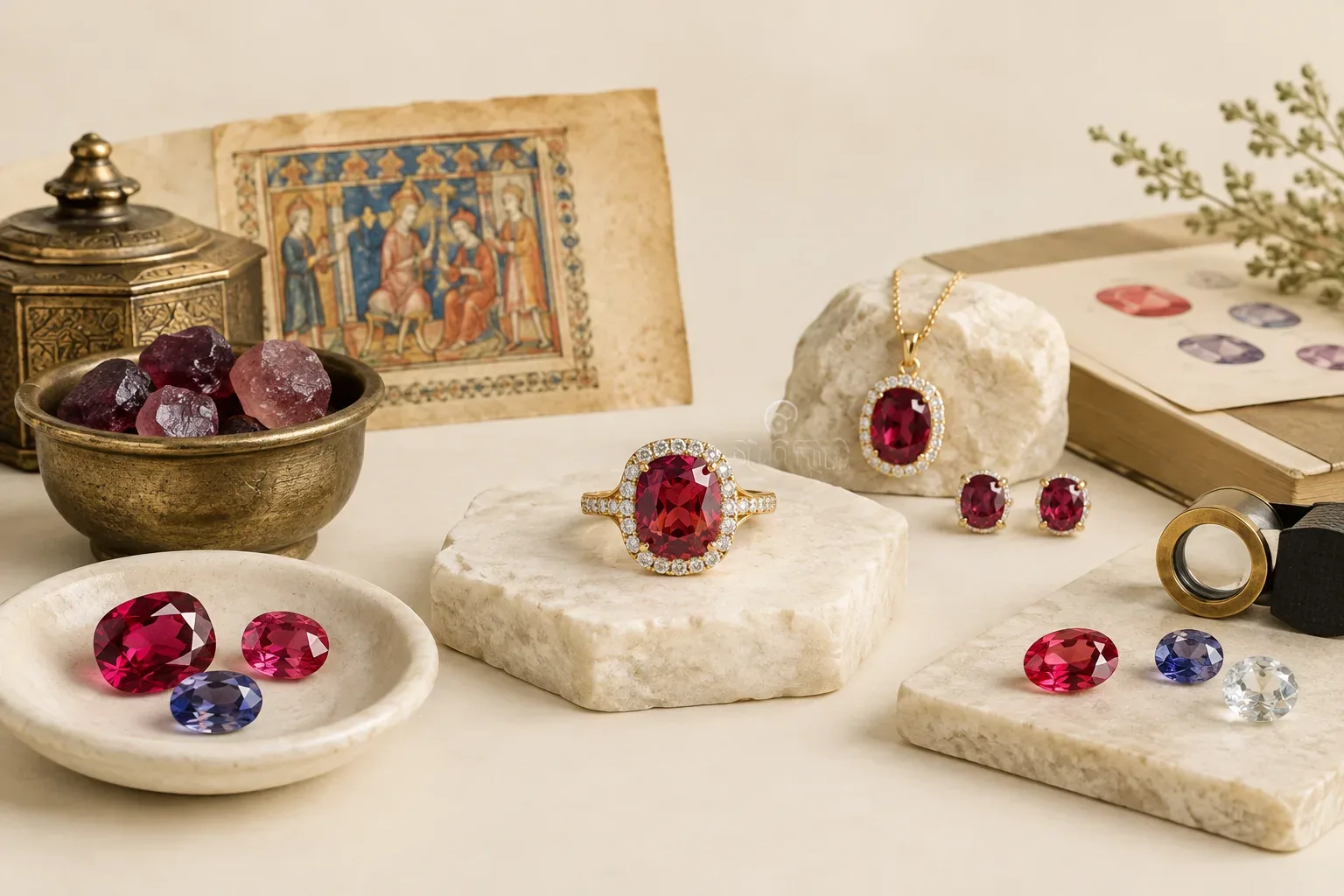
Spinel is used in a wide range of jewellery forms, from rings and earrings to brooches and necklaces. It appears in historic settings documented by museums and in contemporary designs where its bright colours and clarity are prized. Museums such as the Victoria and Albert Museum discuss spinel and other gemstones in the context of object collections, illustrating how stones were cut and set in specific historical styles.
In modern pieces you will see spinel set as centre stones in solitaires, grouped in cluster settings, or used as accent stones. The same physical qualities that make spinel attractive—colour and brilliance—also make it a target for treatments intended to enhance appearance and for imitation materials intended to replicate that look at lower cost.
Practical questions to ask sellers
Ask directly whether the spinel is natural or synthetic. If it is natural, ask whether it has been treated or enhanced and what type of treatment was used. If the stone is described as an imitation or as 'lab-created' or 'synthetic', ask for a clear explanation of the material and how it differs from natural spinel.
For higher-value purchases, request independent laboratory documentation that identifies the stone and any treatments. The Federal Trade Commission advises that sellers should disclose material treatments and imitations; requesting written disclosure or a gemological report makes the condition of the sale explicit and helps prevent misunderstandings.
Also check the return policy and any warranty, and ask about care recommendations for the specific treatment or material. Different enhancements can affect cleaning and wear, so documentation on care is a legitimate part of the purchase conversation.
Questions to ask yourself when selecting or gifting spinel
Consider the recipient's values and priorities. Do they prefer natural, untreated stones? Do they value sustainability, affordability, or visual impact? Some buyers prioritize the story of a natural, historically sourced gemstone, while others prefer the consistency and lower cost of synthetics or treated stones. Your choice should respect the recipient's preferences and the cultural context in which they will wear the piece.
If symbolism matters to the recipient, be transparent about what the stone actually is and whether it has been treated. Presenting a treated or synthetic spinel as if it were a natural, untreated stone is likely to undermine the sentiment you intend to convey. Clear, respectful disclosure preserves both the gift's meaning and the relationship.
Evaluating price and documentation
Price is often the clearest practical indicator that a stone is treated or imitated, but it is not definitive. Very low prices for a stone described as high-quality natural spinel should prompt questions and, if appropriate, a request for independent verification. The Victoria and Albert Museum's work on gems and jewellery helps explain why provenance, craft, and rarity affect value historically and today.
For significant purchases, seek a gemological report from a recognised laboratory. A report that states whether a stone is natural, treated, synthetic, or an imitation gives you objective information you can rely on, and the Federal Trade Commission supports this approach by emphasising the need for truthful disclosure about material treatments and imitations.
Respectful selection and gifting guidance
Be honest and specific about what you are buying and why. If you choose a treated or synthetic spinel for budgetary or aesthetic reasons, explain your choice: many people appreciate transparency and the thought behind selecting a beautiful stone that suits their lifestyle or budget. If the gift is meant to reference a historical object or a specific jewellery tradition, consider including a note that explains the connection and whether the stone is a close visual match or the actual material used historically.
Avoid assuming that historical uses recorded by museums imply present-day cultural or religious authority. Use documented museum sources to explain provenance or design inspiration, and clarify where you are offering a modern personal interpretation or sentiment. This keeps the gift respectful of cultural history and honest about contemporary meaning.
Final considerations
Spinel has a documented place in jewellery history and continues to be a popular gem in modern design. The key practical steps for buyers are straightforward: ask whether the stone is natural or synthetic, ask about treatments or enhancements, request written disclosure or a lab report for costly pieces, and be transparent when gifting.
Use museum scholarship such as that from the Victoria and Albert Museum to understand historical contexts and use the Federal Trade Commission's consumer guidance to protect yourself in the marketplace. Treat history and personal meaning as distinct: history documents how objects were made and used, while modern wearers assign the meanings that matter most to them.
Frequently asked questions
What simple questions should I ask when a seller offers a spinel?
Ask whether the spinel is natural or synthetic, whether it has been treated or enhanced and what treatment was used, whether the piece contains any imitations or assembled materials, and whether there is lab documentation for higher-value items. Also confirm the return policy and care recommendations for the stone.
Does museum history tell me whether spinel has symbolic meaning?
Museum documentation, such as research from the Victoria and Albert Museum, records how spinel was used and valued in specific historical contexts but does not establish a single universal symbolic meaning; personal and cultural interpretations vary and are often modern additions.
Is a treated spinel a 'fake'?
No. A treated spinel is still a real gemstone if the material is natural; a treatment modifies appearance or durability. Whether that is acceptable depends on buyer preferences and should be disclosed by the seller in line with consumer-protection guidance.
When should I ask for a gemological report?
Request an independent laboratory report for higher-value purchases, for stones whose identification affects price significantly, or when you need documented confirmation of natural origin and disclosure of treatments or synthetics.
What if the price seems too low for a claimed natural spinel?
Treat an unusually low price as a prompt to ask more questions. Request disclosure on treatments or imitations and consider asking for independent verification, since price alone is not definitive evidence but can indicate the need for further investigation.
Sources and further reading
- Bedazzled: A History of Jewellery — Victoria and Albert Museum
- An A-Z of Gemstones — Victoria and Albert Museum
- Buying Gemstones, Diamonds, and Pearls — Federal Trade Commission