Meaning at a glance
This guide defines the decision criteria for choosing a tanzanite engagement ring, explains what verified information you can and cannot get without a gem lab or qualified jeweler, describes suitable settings and trade-offs, and gives practical, respectful selection and care advice grounded in consumer-protection and gemological guidance.
Direct answer — is a tanzanite engagement ring right for you?
A tanzanite engagement ring can be a beautiful, modern choice for someone who values color and distinctive gemstones, provided you accept trade-offs: you should expect to ask the seller for written disclosures about treatments and origin, choose a protective setting if you plan daily wear, and arrange for insurance and periodic professional inspections. The decision rests on personal priorities about color, durability, maintenance and resale expectations rather than a single universal rule.
What the historical record shows (and does not show)
Among the approved reference material used for this guide there is no evidence of tanzanite in ancient or classical jewellery traditions. Contemporary trade and consumer resources treat it as a modern gemstone used in present-day jewellery rather than a material with deep archaeological or medieval use. Industry trend reporting shows growing consumer interest in gemstone rings and sculptural, non-traditional engagement styles in recent years, which is the context in which tanzanite appears in the market (Professional Jeweller; Imaginaire Digital).
Documented historical meanings versus modern personal interpretation
Because the sources for this guide present tanzanite as a modern trade gemstone rather than an artifact of earlier cultures, there are no documented ancient symbolic meanings for it in these materials. Modern symbolic meanings attached to colorful gemstones are primarily personal or marketing-driven: people may choose a tanzanite ring for its color, birthstone association, or because it feels distinctive. These contemporary, personal meanings are valid for the giver and wearer but are not the same as historically documented cultural symbolism.
How tanzanite typically appears in jewelry
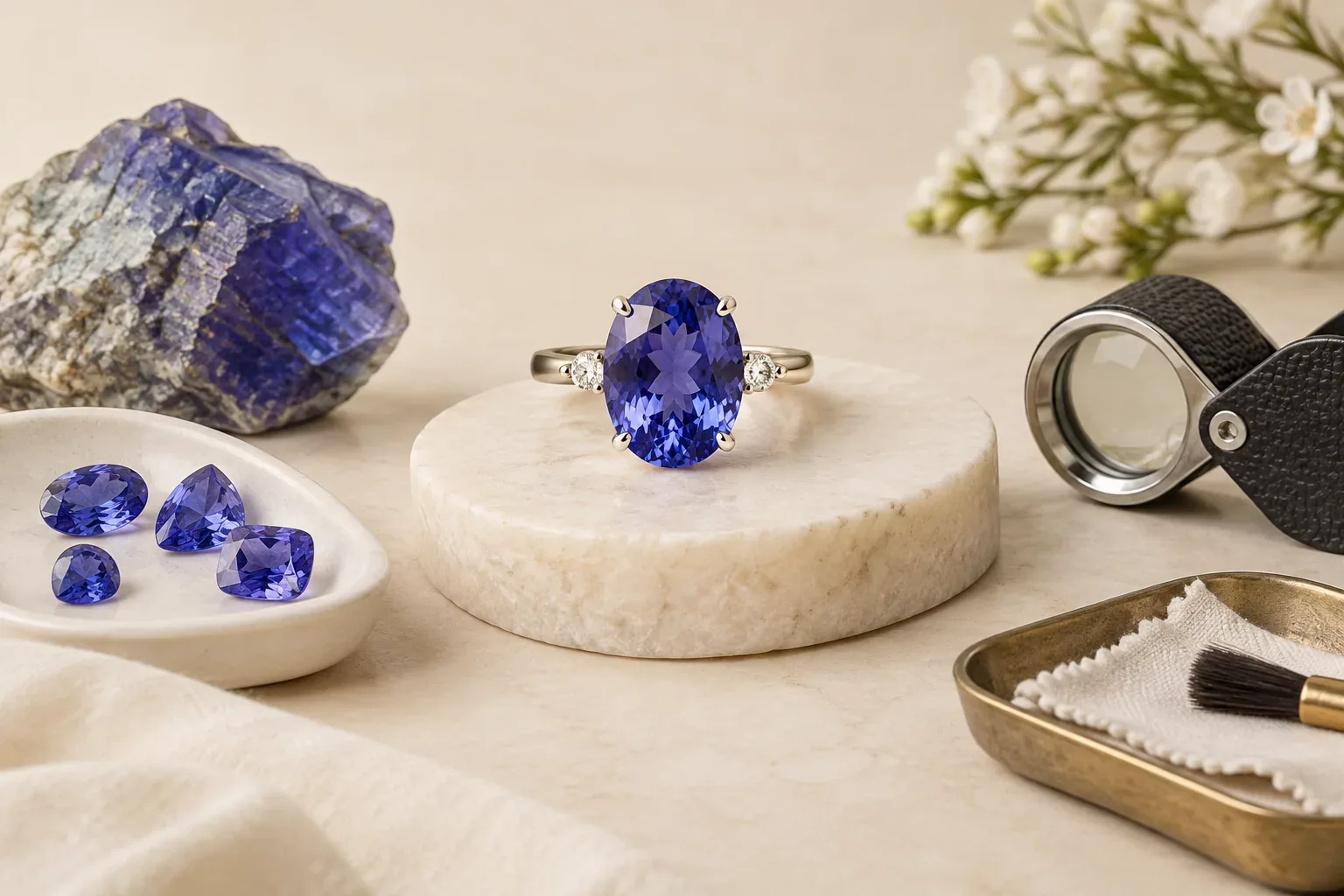
In current jewellery practice, tanzanite is offered in faceted cuts and frequently set as a central gemstone in rings, pendants and earrings. Trade reporting identifies an increased interest in gemstone rings and sculptural, Art Deco–inspired and clustered designs, trends that often use colorful stones as focal points (Professional Jeweller; Imaginaire Digital). Retailers commonly present tanzanite in single-stone solitaires, halo settings that surround the central color with smaller stones, and in cluster or three-stone layouts that balance color and sparkle.
Selection and gifting guidance: practical, respectful steps
Begin by clarifying priorities: how often the ring will be worn, whether the wearer prefers low-maintenance jewellery, and how important resale or heirloom considerations are. If the ring is intended for every-day wear, prioritize protective settings and confirm durability and care expectations with the seller.
Always request written disclosure from the seller about whether the stone is natural, lab-created, treated or an imitation. The Federal Trade Commission requires clear distinctions among these categories and written seller disclosures help you compare offers responsibly (Federal Trade Commission).
Ask whether the stone has undergone any treatments, how durable those treatments are, and whether treatments are detectable without advanced testing. The Gemological Institute of America emphasizes that treatments, disclosure, detectability and special care are key consumer questions for gemstones (Gemological Institute of America).
Obtain a written appraisal or invoice that clearly states the stone identification, treatment status (if any), and mounting metal. If origin or treatment resistance is an important factor for you, plan to order a report from a qualified gemological laboratory; without a lab report you cannot independently verify origin or many treatments.
Best settings and the trade-offs to consider
Choose a setting that reflects how the ring will be used. Settings that offer more protection—such as bezel or low-profile designs—help shield the stone from knocks and abrasion but change the visible surface area and can alter how the color reads. Prong settings maximize light and color but leave the stone more exposed to impact and snagging.
Design elements like a halo of small accent stones can visually enlarge the center gem and add protection around the girdle, while three-stone or cluster settings balance color with durable structural support. These choices are stylistic as well as functional; trade publications note a continued consumer appetite for sculptural and gemstone-forward engagement rings, so retailers often offer these design variants (Professional Jeweller; Imaginaire Digital).
Remember the trade-off: a setting that prioritizes protection can reduce the apparent size or brilliance of the center stone, whereas settings that maximize visibility can increase the risk of damage during everyday wear. If in doubt, choose a moderately protective setting and plan for routine checks by a jeweler.
Care, maintenance, and conservative handling advice
Gemological authorities highlight that treatments and the physical properties of gemstones influence care recommendations; ask your seller and, if possible, the laboratory report exactly which treatments (if any) apply and whether specific cleaning methods are advised (Gemological Institute of America).
In practice, adopt conservative habits: remove the ring for heavy work or activities that risk knocks, avoid exposure to harsh household chemicals, and store the ring separately from harder stones to prevent scratching. Regularly inspect the mounting for loose prongs or wear and have a trusted jeweler perform tightening, cleaning and professional checks as recommended.
For insurance and long-term preservation, document the purchase with photographs, keep invoices and any lab reports, and consider a tailor-made insurance or rider policy that covers gemstone jewelry.
What you can verify yourself and what requires a professional lab
You can verify certain seller commitments at purchase: whether the seller labels the stone natural or lab-created, whether any treatments are disclosed in writing, the metal type of the mounting, and the presence of a return policy or written guarantee. The Federal Trade Commission stresses the consumer need for clear written disclosures on these points (Federal Trade Commission).
However, many technical questions—such as a gemstone's geographic origin, the presence of specific subtle treatments, or detection of some lab-grown processes—require testing by a qualified gemological laboratory. The Gemological Institute of America notes that detectability and the limits of disclosure are frequent consumer issues in the gemstone market (Gemological Institute of America). If origin or treatment status is central to your purchase decision, budget for a laboratory report or buy from a seller who provides one.
Final considerations
Choose a tanzanite engagement ring because its color, style and care profile fit the wearer's lifestyle and values, not because of any assumed universal symbolism. Use the seller disclosures, laboratory reports when needed, and careful setting choice to manage durability and maintenance trade-offs. For contemporary shoppers, industry reporting shows strong interest in gemstone engagement styles and sculptural ring designs, so you will likely find many tasteful options that match your priorities (Professional Jeweller; Imaginaire Digital).
Frequently asked questions
Is a tanzanite engagement ring suitable for everyday wear?
It can be, but suitability depends on how the ring will be worn and whether you accept more careful handling. Gemological resources note that treatments and durability are key consumer issues; choose a protective setting and plan for regular inspections if you want everyday wear (Gemological Institute of America).
How can I be sure a tanzanite is natural or untreateD?
Ask the seller for written disclosure and any available laboratory reports. The Federal Trade Commission requires clear distinctions between natural, lab-created and treated gems; for definitive answers about origin or subtle treatments you will need a qualified gemological laboratory.
Which ring settings protect the stone best?
Settings that offer more coverage at the stone’s edge—such as bezels or low-profile designs—provide more protection from knocks, while prong settings expose more surface for light and color. Choose a setting that balances daily durability with the desired look.
What routine care should I plan for?
Follow conservative care: remove the ring for heavy work or exposure to chemicals, store it separately to avoid scratches, have the mounting inspected periodically, and follow any cleaning guidance linked to known treatments documented by a laboratory or seller (Gemological Institute of America).
Can I verify treatments or origin at the point of sale?
You can verify what the seller is willing to disclose in writing, but many technical verifications—especially origin and some treatments—require testing by a qualified gem lab. The FTC and gemological authorities recommend obtaining written disclosures and laboratory reports for critical purchase criteria.
Sources and further reading
- Imaginaire Digital — Imaginaire Digital
- Professional Jeweller / PRYA Jewellery Search Insights — Professional Jeweller / PRYA Jewellery Search Insights
- Gemological Institute of America — Gemological Institute of America
- Federal Trade Commission — Federal Trade Commission