Meaning at a glance
This guide defines natural, lab-created, treated, and imitation spessartine garnets; explains what buyers can reasonably verify themselves and what requires a qualified jeweler or gemological laboratory; outlines practical trade-offs and safe care; and gives clear selection and gifting advice grounded in consumer and gemological guidance.
Direct answer — concise and practical
In short: an "authentic" spessartine garnet usually means a natural (mined) spessartine that has not been misrepresented; lab-created spessartine must be disclosed as synthetic; treated stones must be disclosed with the type of treatment; and imitations intentionally copy the look without being garnet. Follow Federal Trade Commission guidance and ask for written disclosure and a gem report to confirm a seller’s claims; some treatments and origin questions may only be resolved by a qualified gemologist or a recognized laboratory report, as the Gemological Institute of America explains.
What 'authentic' means for spessartine garnet
For consumers, authenticity combines material identity (is the stone chemically and structurally a spessartine garnet?), source category (natural or lab-created), and accurate disclosure about any treatments or enhancements. The Federal Trade Commission sets the expectation that sellers provide clear distinctions among natural, lab-created, treated, and imitation materials and that those distinctions be disclosed in writing.
The Gemological Institute of America frames treatments, detectability, durability, and special care as separate but related issues. A stone can be a true spessartine mineral yet be treated in ways that materially affect appearance or durability; truthful disclosure about those changes is part of what most people mean by authenticity.
Historical evidence and cultural context
Authoritative sources included for this article do not provide detailed historical records for spessartine garnet’s use in specific cultures or periods. Where historical or cultural meanings of garnets are invoked in popular accounts, those claims are not documented in the sources cited here and should be treated cautiously.
What the available evidence does show is how modern markets and consumer interest shape the presence of colored gemstones in jewelry. Industry research reported by Professional Jeweller and PRYA Jewellery Search Insights documents renewed interest in sculptural jewelry, gem rings, and birthstone pieces, which is where spessartine typically appears in contemporary designs. Imaginaire Digital’s 2026 search insights similarly indicate strong consumer demand for a range of gemstone-set styles in the UK market.
Documented historical meanings vs modern personal interpretations
Because the approved sources for this guide do not supply specific, dated cultural meanings for spessartine, any firm claims about ancient symbolic uses of spessartine would go beyond the evidence here. That absence does not mean garnets in general lack history, but it does mean shoppers should treat sweeping historical or mystical claims about spessartine as modern narratives unless supported by primary historical scholarship.
Modern personal interpretations—what a buyer or giver believes a spessartine represents—are valid as individual meaning but are different in kind from documented historical meanings. The consumer-focused guidance from the FTC and the gem-treatment focus from GIA together imply that sellers should differentiate factual statements (origin, treatment, composition) from marketing language about symbolism or emotional meaning.
How spessartine garnet appears in jewelry today
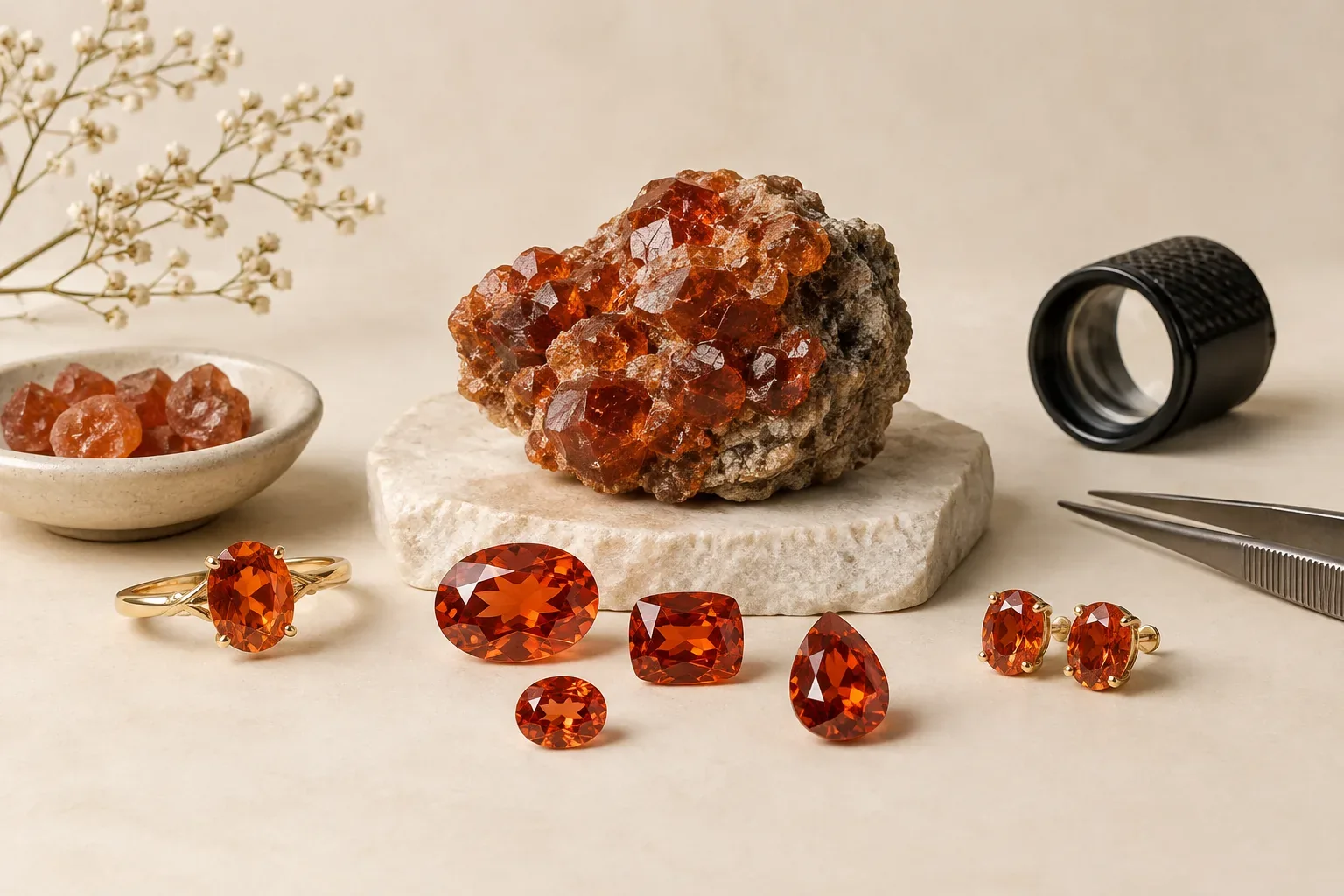
In contemporary jewelry markets, spessartine garnet is prized for its warm orange, orange-red, and brownish-orange colors and is commonly set in rings, pendants, earrings, and cluster pieces where its color contrasts against white or yellow metals. Trade reporting shows growth in gemstone rings, sculptural settings, and birthstone necklaces, which are the kinds of pieces where spessartine will appear most often.
Designers also use spessartine in mixed-gem compositions—cluster rings or multi-stone necklaces—where vivid color saturation is the priority. Because market interest fluctuates, imagery and styling choices are frequently shaped by current trends identified in industry research rather than by long-standing cultural rules.
How to decide: natural, lab-created, treated, or imitation
Define your priority first: are you buying for rarity and natural origin, for visual uniformity and lower cost, or for a purely aesthetic color? Natural spessartine (mined) will often command higher prices and can show characteristic inclusions and variation. Lab-created spessartine is produced to the same chemical composition as the natural mineral and should be labeled as synthetic; it can offer more consistent color and fewer inclusions.
Treated stones are natural material that have undergone processes to improve color or clarity. The GIA explains that treatments, their detectability, their effect on durability, and proper disclosure are important consumer considerations. Some treatments are easily detectable by a trained gemologist, while others require advanced instrumentation and experienced interpretation.
Imitations are different minerals or glasses made to look like spessartine. The FTC requires sellers to disclose when a gemstone is an imitation. Imitations may look convincing in photos, so written disclosure and seller reputation are critical.
What you can verify yourself, and what requires a professional
You can reasonably verify several practical items without a laboratory: ask for and read written disclosure about whether the stone is natural, lab-created, treated, or an imitation; request a clear return policy and a recent close-up photograph or video of the stone; and seek a named, reputable seller with customer reviews and transparent policies. The FTC specifically advises consumers to seek clear distinctions and written disclosures when buying gemstones.
However, some important attributes—such as whether an apparent natural spessartine has been subject to certain subtle treatments, whether it is heat-treated versus diffusion-treated, or its precise geographic origin—often cannot be confirmed conclusively without examination by a qualified gemological laboratory. The GIA notes that detectability varies by treatment and that laboratories provide the most reliable determination of treatment and origin. If the answer to origin or treatment will materially affect your purchase decision, plan to obtain a laboratory report from a recognized provider.
Practical trade-offs and purchasing criteria
Expect trade-offs among cost, rarity, durability, and visual characteristics. A natural, untreated spessartine may be rarer and hold more collectible value, but it can show inclusions or color variation. Lab-created options may offer brighter, more consistent color at lower cost but lack the 'natural' provenance some buyers value. Treated stones can provide attractive color at a lower price than top-quality naturals but may require more careful wear and disclosure.
Assess the seller’s transparency as part of the value equation. Written disclosure about treatments, an independent laboratory report for high-value stones, and a clear return policy reduce risk and help you make an informed trade-off between price and assurance.
Care and safe handling
Treatments can change how you should care for a spessartine. The GIA emphasizes that treatments, detectability, and durability inform special care recommendations. When in doubt, follow conservative care: avoid high heat, harsh chemicals, and sudden temperature changes; remove gemstone jewelry during heavy manual work and household chores; and clean gently with mild soap, lukewarm water, and a soft brush.
If a stone is confirmed to have surface-reaching fractures or a treatment that reduces stability, a qualified jeweler or gemologist can advise on whether setting choices (protective bezels, lower-profile settings) or wearing habits should be adjusted to reduce risk.
Selection and gifting guidance
When selecting or gifting a spessartine, ask the seller to provide written disclosure about whether the stone is natural, lab-created, treated, or an imitation, and request any existing laboratory reports. For higher-value stones, seek a report from a recognized gemological laboratory; the GIA and similar bodies provide guidance about what reports can and cannot determine.
Consider the recipient’s preferences: if provenance and natural origin matter, prioritize documented natural stones with full disclosure. If the recipient values color or consistency and cost-efficiency, a lab-created stone can be a thoughtful choice if clearly labeled. Regardless of choice, ensure there is a reasonable return or exchange policy and preserve any paperwork and receipts for future resale or insurance.
Concluding guidance
The phrase "spessartine garnet authenticity guide" implies several consumer needs: clear definitions, practical verification steps, and realistic limits on what can be confirmed outside a lab. Follow FTC guidance to demand written disclosure; use the GIA’s framework to understand why treatments and detectability matter; and use market-awareness from trade reporting to choose styles and settings that meet your aesthetic and budget priorities. If treatment or precise origin matters to you, plan to pay for a qualified laboratory report as part of the purchase process.
Frequently asked questions
How can I tell if a spessartine garnet is natural or lab-created?
Ask the seller for written disclosure and any laboratory report. Visible clues like natural inclusions can suggest a mined stone, but only a recognized gemological laboratory or an experienced gemologist can definitively distinguish some lab-created stones from natural ones in all cases, as explained by the GIA.
Are treatments common in spessartine garnet and should I be concerned?
Treatments can occur in many colored gemstones to improve color or clarity. The GIA emphasizes that the presence, type, and detectability of treatments matter for durability and care. Always request disclosure of any treatments and a description of how the treatment affects care and longevity.
What paperwork should I get when buying spessartine?
Obtain written disclosure about whether the stone is natural, lab-created, treated, or an imitation; a named seller’s return policy; and, for higher-value purchases, a current report from a recognized gemological laboratory. The FTC advises consumers to demand clear, written distinctions among material categories.
Can I rely on photos alone to confirm authenticity?
No. Photos can be useful for evaluating color and cut but cannot confirm origin, treatment, or whether the stone is an imitation. For those factors, ask for documentation and, when necessary, an independent laboratory report.
How should I care for a spessartine garnet?
Follow conservative care: avoid harsh chemicals, extreme heat, and sudden temperature changes; remove gemstone jewelry during heavy physical tasks; and clean gently with mild soap and lukewarm water. If a stone is treated or fragile, a jeweler or the laboratory report should provide specific care recommendations as suggested by GIA guidance on treatments and durability.
Sources and further reading
- Imaginaire Digital — Imaginaire Digital
- Professional Jeweller / PRYA Jewellery Search Insights — Professional Jeweller / PRYA Jewellery Search Insights
- Gemological Institute of America — Gemological Institute of America
- Federal Trade Commission — Federal Trade Commission