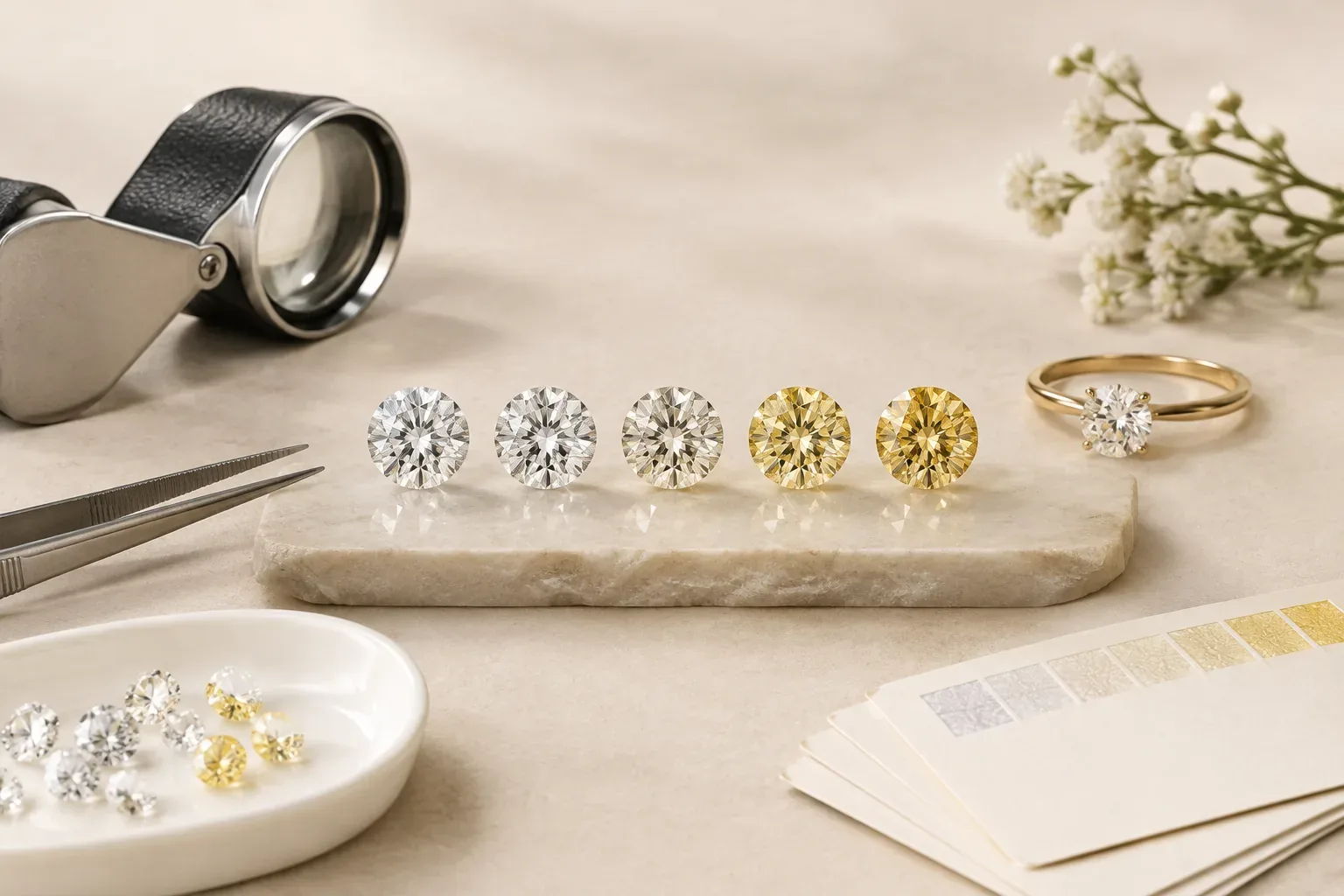
Meaning at a glance
Diamond color treatment buying guide answers what treatments are, why disclosure and lab testing matter, the practical trade-offs between appearance, price, permanence and resale, how treated diamonds appear in jewelry, safe care points, and the clear limits on what a shopper can verify without a qualified jeweler or a gemological laboratory.
Quick answer
A diamond color treatment buying guide should give you clear definitions of treated versus natural color, set out decision criteria (appearance, permanence, price and resale), explain what questions to ask a seller, and make explicit that only a qualified jeweler or a gemological laboratory can reliably verify many treatments. This article follows that evidence-led approach, emphasizing disclosure rules and detectability as documented by the Gemological Institute of America and the U.S. Federal Trade Commission.
What people mean by "diamond color treatment" and why it matters
In consumer use, a diamond color treatment usually refers to any deliberate human process applied to a diamond to change or enhance its color. Buyers commonly encounter treated stones when they prefer a vivid colored center, want to improve a near-colorless stone's appearance, or see a color-treated option offered at a lower price than an untreated stone with similar look.
The distinction matters because treatments can affect a diamond's permanence, durability, market value and required care. The Gemological Institute of America (GIA) highlights that treatments raise distinct consumer questions about disclosure, detectability and durability, while the U.S. Federal Trade Commission (FTC) emphasizes that consumers need clear differences among natural, lab-created, treated and imitation materials and that sellers should provide written disclosure.
Historical evidence and why precise cultural or period claims are limited
Treating gemstones is an old human practice, but published consumer guidance sources used here do not provide detailed, culture-by-culture histories for diamond color treatments. Institutional overviews such as the GIA describe the development of gem treatments as a documented phenomenon in gemology, but they focus primarily on modern processes, disclosure and detection rather than ancient cultural practices or symbolic meanings tied to specific societies.
Because the authoritative sources for consumer guidance prioritize modern detectability, treatment methods and disclosure rules, it is not responsible to invent precise historical timelines or attribute specific color‑altering techniques for diamonds to particular cultures or centuries without specialist historical references. If you need a culturally specific history of diamonds or colored gems, seek academic or museum-published sources that specialize in gem history and archaeology.
Documented technical and modern-interpretive meanings — keep them distinct
Documented, technical meanings about treatments are about process, permanence and market effect. The GIA's consumer-facing material explains that treatments exist, that some are detectable with laboratory testing, and that treated gems may have different care needs and resale expectations. The FTC's consumer guidance frames the legal and practical need for honest, written disclosure by sellers.
Modern personal and symbolic interpretations — why someone prefers a particular color or a treated stone for an anniversary ring — are subjective and vary by culture, relationship and fashion trends. Those personal meanings are legitimate for the giver and receiver, but they are not the same as the gemological facts about treatment and durability. Keep symbolic preferences separate from factual claims about a stone's origin or condition.
How color-treated diamonds appear in jewelry
Color-treated diamonds are used across jewelry types: as single-stone center diamonds in engagement rings, as accent diamonds in halo or three-stone settings, as melee in fashion pieces, and as colored studs or pendants. Retailers may describe them as enhanced, treated, or otherwise colored, and the visual effect is often similar to naturally colored stones when viewed in normal retail lighting.
Because treated diamonds can offer vivid colors or better appearance for a given budget, you'll commonly see them presented alongside untreated and lab-created options. Consumer interest in engagement rings and diamond jewelry remains strong, which is why retailers continue to offer a range of treated and untreated choices to meet varying priorities of appearance, price and perceived value, as shown in market visibility data published by Imaginaire Digital.
Decision criteria and practical trade-offs
Start by clarifying your priority: is it visual impact, long-term resale value, permanence, or price? If your primary goal is an immediately striking color at a lower price, treated diamonds can be an effective choice. If preserving resale value or ensuring documented permanence is the priority, untreated natural stones with laboratory grading will commonly perform better in the secondary market.
Expect trade-offs. Treated stones can deliver color and savings but may have limits on permanence or require special care; untreated natural diamonds typically command higher prices and clearer resale expectations. The GIA highlights that treatments differ in detectability and durability, so a treatment that is stable under normal wear will be a different choice than one that needs shielding from heat or chemicals. The FTC requires sellers to make these distinctions clear to consumers in writing, which is why disclosure should be a deciding factor in any purchase.
What a shopper can verify without a lab — and what they cannot
A buyer can verify a seller's written disclosures, the presence of a reputable grading or treatment report, return policies and warranties, and the reputation of the retailer or jeweler. The FTC specifically advises consumers to look for clear, written information that distinguishes natural, lab-created, treated and imitation materials.
What you cannot reliably verify by eye, with a loupe, or with typical retailer testing equipment is whether a particular color was produced by a specific process, or whether a subtle treatment will remain stable over decades. For many treatments, only a qualified gemological laboratory or a trained, independent gemologist using specialized instruments can detect the treatment and provide a definitive report. If you require laboratory confirmation, insist on a report from an accredited lab and be prepared that such tests may add time and cost to the purchase.
Questions to ask sellers and labs
Before you buy, ask the seller to state in writing whether the diamond has been treated, the exact nature of the treatment, and whether any laboratory grading report accompanies the stone. If a lab report is provided, verify the lab's name and whether the report explicitly describes treatment. The GIA and the FTC both emphasize the importance of disclosure and of distinguishing among natural, lab‑created and treated stones in writing.
Respectfully request details about care, warranty, and the seller's return policy for treated stones. If you need a lab verification, ask which accredited laboratory will do the testing and how long it will take. Be aware that independent testing is the only reliable route to resolving ambiguous claims about treatment for many stones, and that reputable sellers should accept that request or offer their own documented lab-backed disclosure.
Care, durability, and long-term considerations
Because treatments differ, general care guidance is necessarily cautious. The GIA advises that treatments can affect durability and special-care needs, so you should get the seller's recommended care instructions for the specific treatment and stone. Avoid exposing treated diamonds to high heat, harsh chemicals, or re-cutting and re-polishing unless a qualified professional confirms it is safe.
Consider long-term plans. If you plan to pass the stone to heirs or resell it later, document all disclosures and lab reports and keep them with the stone. The documented provenance and clear lab-backed descriptions will matter more in the secondary market than subjective testimony about when or why the stone was purchased.
Selection and respectful gifting guidance
Match the choice to the recipient's values. If the recipient values tradition or resale, prioritize un-treated natural stones with clear lab grading. If the recipient values color, fashion flexibility, or sustainability arguments for alternative processes, a disclosed treated or lab-created stone can be an entirely appropriate and often appreciated gift. Frame the gift respectfully: when the stone's origin or treatment is relevant to its meaning for the recipient, share the disclosure and any lab report as part of the gift.
When buying for someone unknown to you, err on the side of transparency with the recipient or the recipient's family. Ask the seller for clear written disclosure to include with the gift, and consider including the lab report or warranty in the presentation so that the recipient has the information they need for future decisions and care.
Final checklist before purchase
Before you finalize a purchase, confirm in writing whether the diamond has been treated, obtain any available lab report, understand the treatment's care requirements, review the return policy and get a clear statement about warranty or trade-in options, and understand that for many treatments only a qualified lab can provide definitive verification. Sellers operating under U.S. consumer-protection expectations should provide these disclosures, as highlighted by the FTC, and reputable gemological institutions such as the GIA are the standard reference for treatment detection and consumer guidance.
A practical diamond color treatment buying guide reduces surprise: prioritize written disclosure, credible lab reports when verification matters, and care advice specific to the treatment. Those steps will help you balance looks, cost and long‑term expectations without conflating symbolic preferences with gemological facts.
Conclusion
A buyer focused on appearance and budget may find color-treated diamonds an excellent value, provided the seller gives clear written disclosure and care instructions. Buyers who prioritize resale and documented permanence should favor untreated natural diamonds with recognized laboratory grading. In all cases, the critical companion to good choices is transparent documentation from the seller and, when needed, independent laboratory testing.
Frequently asked questions
What exactly is a diamond color treatment?
A diamond color treatment is any deliberate human process applied to a diamond to change or enhance its color. Treatments differ in method, permanence and detectability. The Gemological Institute of America advises that treatments raise specific consumer questions about disclosure, detectability and care.
Will I be able to tell a treated diamond by looking at it?
No. Many treatments are not visually obvious. Only a qualified gemologist or an accredited gemological laboratory using specialized instruments can reliably detect many treatments. The FTC advises consumers to rely on written disclosure and lab reports rather than visual inspection alone.
Do treated diamonds cost less than untreated diamonds?
Often they do, because treatment can produce a desirable visual effect at lower cost than a comparable naturally colored or higher-grade untreated diamond. However, price differences depend on the treatment, the stone's size and quality, and market conditions.
Are treated diamonds less durable?
Some treatments can affect how a diamond responds to heat, chemicals or re-cutting. The GIA notes that detectability and durability vary by treatment, so ask for the seller's care recommendations and any lab documentation about the treatment.
What should I ask the seller before buying a treated diamond?
Request written disclosure of any treatments, ask for the full lab report name and number if available, ask about care instructions, warranty and return policy, and ask whether independent laboratory testing is available or recommended. The FTC recommends clear written distinctions among natural, lab-created, treated and imitation materials.
Can a lab verify treatment for me?
Yes. Accredited gemological laboratories can often detect and identify many treatments and will issue a report. Be prepared for additional cost and time if you require independent laboratory verification.
Sources and further reading
- Imaginaire Digital — Imaginaire Digital
- Gemological Institute of America — Gemological Institute of America
- Federal Trade Commission — Federal Trade Commission