Meaning at a glance
This article explains the documented history and changing contexts of topaz quality and value factors, separates historical meanings from modern interpretations, describes how topaz appears in jewelry, and offers practical selection and gifting guidance grounded in museum and consumer-protection sources.
Quick answer
Topaz quality and value factors center on color, clarity, cut, carat weight, and treatment history, and these factors have been interpreted differently across times and cultures; choose a topaz by prioritizing honest disclosure of treatments and matching the stone’s visual and practical qualities to the wearer’s needs and budget. This article documents historical evidence and changing contexts from museum sources and uses consumer-protection guidance for practical purchasing steps.
What the historical record reports about topaz
Museums and reference collections provide the clearest documentary evidence for how gemstones, including topaz, were used and thought about in different places and periods. The Victoria and Albert Museum places gemstones in social and decorative contexts, showing that gem use and fashion have changed over time and that meanings attached to stones are historically situated rather than universal. Use of colored stones for personal ornament, status, and symbolic purposes appears in many cultures and periods, but the way a particular gem like topaz was named, valued, and described varies by language and era.
The museum’s A–Z of gemstones emphasizes identification and historical context rather than broad cultural claims. That resource helps distinguish the physical properties that make one specimen visually desirable from the changing fashions and symbolic associations created later. In short, the historical record on gemstones emphasizes changing social context and material characteristics rather than uninterrupted, identical meanings across cultures.
Separating documented historical meanings from modern interpretations
Documented historical meanings are the beliefs, uses, and descriptions recorded in primary objects, inventories, and museum labels. The Victoria and Albert Museum’s work models how researchers describe those facts: they identify when a gem appears in an object, the object’s date and provenance, and how contemporaries used it. Those documented details may show that a gem was used for status, amulet purposes, or simply decoration in a particular time and place.
Modern personal interpretations—what a buyer, designer, or wearer thinks a topaz 'means' today—are a separate phenomenon. Contemporary meanings are shaped by present-day marketing, popular culture, and individual preference. They can be meaningful and legitimate for the wearer, but they are not the same as historically documented beliefs. Treat modern symbolic language as personal or commercial interpretation unless a specific historical source connects that symbolism to the stone in a named culture or period.
How topaz appears as a motif and gemstone in jewelry
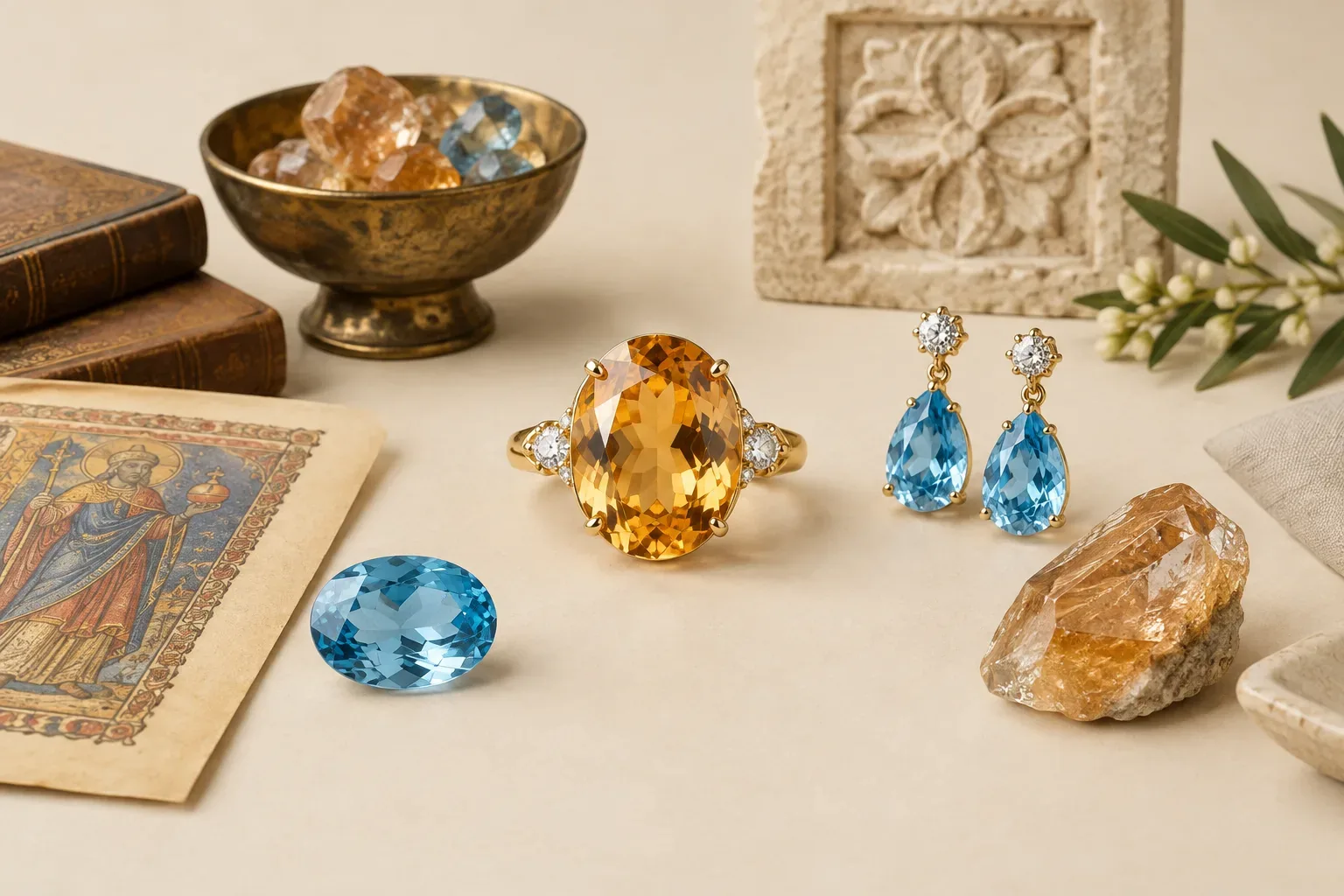
In jewelry collections and exhibitions the gem appears in many forms: as single-stone rings, drops in pendants, accent stones in brooches, and as part of multi-gem ensembles. The V&A documentation shows that jewelers historically used available stones according to the fashions and technologies of their time—cabochons and faceted cuts, settings that protected softer stones, and styles that reflected social rank and aesthetic preference.
As a motif, topaz can function simply as a colored focal point, or it can be incorporated into motifs that carry separate symbolic content (for example, floral, heraldic, or sentimental motifs). Whether the gem is chosen for color, rarity, or personal symbolism depends on the maker and wearer. Museum records focus on the object and context—how the stone was set, who wore it, and when—rather than promoting a single symbolic meaning.
What determines topaz quality and value today
Color is usually the most important visible factor for topaz value. Different hues and saturations command different preferences in the market; stones with richer, clearer color are commonly considered more desirable. Historical sources in museum collections show that color preference shifts over time and across cultures, which is why a color prized in one era may be less sought after in another.
Clarity matters because visible inclusions can interrupt a stone’s transparency and brilliance. Most topazes are relatively eye-clean, and well-cut stones that maximize light return will appear brighter and more attractive.
Cut and shape influence how color and brilliance are displayed. A skilled cut can enhance color saturation and hide minor inclusions, while a poor cut will reduce sparkle and perceived size. Carat weight affects price in a non-linear way: larger topazes are rarer and typically command higher per-carat prices, but large size must pair with good color and clarity to hold value.
Treatments and enhancements significantly affect value and disclosure expectations. Many topaz varieties on the market are treated to improve color—commonly by heat or irradiation followed by heating—or produced synthetically or simulated. The Federal Trade Commission’s guidance on buying gemstones, diamonds, and pearls stresses the importance of clear disclosure for treatments and imitations. Buyers should expect sellers to disclose any color treatments, laboratory synthesis, or simulants and to provide reliable documentation on request.
Origin can influence desirability in some markets, but origin claims should be handled cautiously and supported by laboratory reports when they substantially affect price. Museums and museum catalogs focus on provenance of objects rather than current commercial origin claims; provenance about who owned a gem in the past is different from geological origin statements used by dealers today.
Practical selection and gifting guidance
Decide what matters most to the recipient: color and appearance, durability for everyday wear, symbolic meaning, or investment potential. For everyday wear choose a stone and setting that balance beauty with durability. Although topaz is relatively hard compared with many gems, it is not as hard as corundum (sapphire and ruby) or diamond, so protective settings—such as bezel or halo designs—help reduce the risk of chips when worn daily.
Ask clear questions before purchase. Request written disclosure about any treatments and any laboratory reports that accompany claims of natural, untreated, or origin-specific material. The Federal Trade Commission recommends that sellers disclose treatments and avoid misleading claims; insist on this transparency. If the seller cannot or will not provide clear answers about treatment, consider that a red flag.
Match the stone size and setting to the recipient’s lifestyle. A larger loose topaz in an open prong setting can look spectacular for occasional wear, while a smaller, securely set stone suits active daily use. When gifting with symbolic meaning in mind, make clear whether the symbolic claim is a historical motif, a modern interpretation, or a personal sentiment you attach to the gift—this preserves honest cultural context and avoids overstating historic authority.
Budget realistically. Because treatment and supply affect price, an untreated, richly colored, eye-clean topaz will cost more than a similar-sized treated stone. If you prioritize color over natural status, treated stones can offer dramatic color at lower cost, but that trade-off should be transparent and acceptable to the recipient.
A short buying checklist and red flags
Checklist: examine color under natural light, inspect clarity and cut quality, ask about treatments and request written disclosure, check return policy and any certificates, and choose a setting appropriate to how the ring or pendant will be worn. Museums show how historical settings were chosen to protect and display gems; apply the same principle today when selecting a modern mounting.
Red flags include: evasive answers about treatments or origin, no documentation when such claims are central to the price, unusually low prices for an exceptional-looking stone without explanation, and sellers who refuse independent verification. The Federal Trade Commission’s consumer guidance supports insisting on clear disclosure around treatments and imitations.
Final thoughts
Topaz quality and value factors are a mix of physical attributes and changing human tastes. Use museum-based historical information to understand how meanings and fashions shift, and use consumer-protection guidance to secure clear, honest information about treatments and origin when you buy. Prioritize transparent disclosure, practical durability for the intended use, and a match between the stone’s visual appeal and the recipient’s preferences.
Frequently asked questions
How can I tell whether a topaz has been treated?
Ask the seller for written disclosure and any available laboratory reports. The Federal Trade Commission’s guidance on buying gemstones emphasizes that sellers should disclose treatments such as heating or irradiation and identify synthetic or imitation stones. When in doubt, request an independent gem lab report to confirm treatment status.
Which topaz color is the most valuable?
Value depends on market preferences, but richer, well-saturated colors generally command higher prices. Museum-based research shows that color preferences change across periods and cultures, so 'most valuable' can vary with fashion and the specific buyer.
Is topaz durable enough for everyday rings?
Topaz is reasonably hard compared with many gems, but it is not as hard as sapphire or diamond and can chip if struck. For everyday rings choose protective settings like bezels or halos and avoid wearing the piece during tasks likely to cause knocks.
Do I need a certificate for a topaz purchase?
Certificates are useful when a stone’s treatment status or origin affects its price. The FTC advises buyers to seek clear disclosure; if a seller makes specific claims about natural, untreated material or origin that affect price, a laboratory report can verify those claims.
How should I care for topaz jewelry?
Clean topaz with mild soapy water and a soft brush, avoid sudden temperature changes, and remove the jewelry during heavy manual work. For stones believed to be treated, follow any care guidance provided by the seller or laboratory report.
Sources and further reading
- Bedazzled: A History of Jewellery — Victoria and Albert Museum
- An A-Z of Gemstones — Victoria and Albert Museum
- Buying Gemstones, Diamonds, and Pearls — Federal Trade Commission