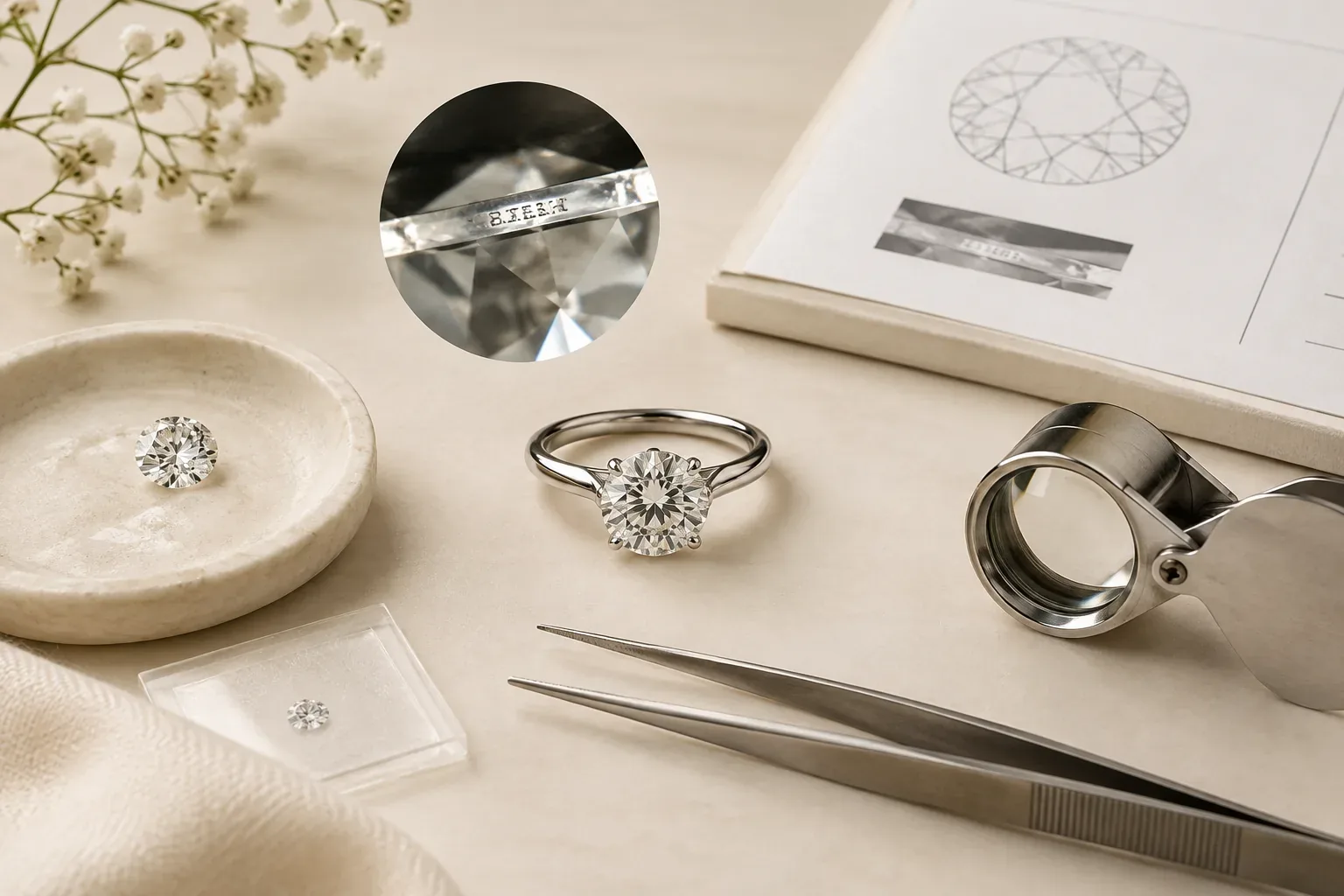
Meaning at a glance
A diamond laser inscription report guide should define what a laser inscription is, explain how to verify it visually and against the issuing laboratory report, set decision criteria and trade-offs for buyers, provide safe care advice, and spell out limits on what a shopper can confirm without a qualified jeweler or gemological laboratory.
Direct answer: What this guide helps you verify
A laser inscription is a microscopic mark applied to a diamond that can match a laboratory report number, record an owner message, or identify a manufacturer. The inscription itself is evidence of a mark, but it is not a substitute for the laboratory certificate or the laboratory's full examination. To read the evidence you need magnification or a photograph of the inscription and you should cross‑check the inscription against the issuing lab's report. For questions beyond that—such as whether the grading is accurate, whether a diamond has undergone treatment, or whether the stone is natural versus lab‑grown—you must rely on the issuing gemological laboratory or a qualified independent grader.
What a diamond laser inscription is and how to read the basic evidence
A diamond laser inscription is a tiny, usually microscopic, set of characters added onto the stone's surface. The most common uses are to show a laboratory report number, to include a manufacturer or retailer serial number, or to engrave a short personal message. When you read a laser inscription report you are really doing two things: confirming that the mark exists on the stone and confirming that the mark matches the supporting documentation.
Practical steps for reading the evidence are straightforward. Use magnification that can resolve small letters (a jeweler's loupe or an imaging tool provided by the seller), capture a clear photograph if possible, and then cross‑reference the visible characters against the lab report number or seller records. If the inscription is claimed to match a laboratory certificate, contact that laboratory to verify the report number and the report details. Absent that cross‑check, the inscription is only a superficial identifier and does not prove anything about the grading, origin, or treatments of the diamond.
Historical evidence and cultural context: modern practice, historic precedents
Laser inscriptions are a modern manufacturing and retail practice used by laboratories, manufacturers, and retailers to identify individual stones. They are part of the contemporary, laboratory‑era toolkit for identification and disclosure and are not an ancient cultural tradition. Institutions that shape modern consumer expectations—such as the Gemological Institute of America (GIA) and regulatory bodies—frame how inscriptions and other disclosures are used today.
Historically, makers' marks, engravings, and assay hallmarks served similar administrative and identification functions in different places and periods, but those practices are materially different from microscopic laser marks applied to gemstones in contemporary supply chains. Modern concerns about disclosure, treatment, detectability, and durability are handled within today's gemological and consumer protection frameworks rather than by historic hallmark traditions. For consumer protection and disclosure questions, the Federal Trade Commission (FTC) outlines the need for clear, written distinctions among natural, lab‑created, treated, and imitation materials.
Distinguishing documented meanings from modern personal interpretations
Documented, verifiable meanings of a laser inscription are limited: the inscription is evidence that a particular symbol, number, or short text exists on the stone. That physical fact is verifiable with magnification and by cross‑reference to the issuing laboratory or seller records. The inscription can be reliably read and associated with a report number when the issuing laboratory confirms the match.
Modern personal interpretations—what an inscription ‘means’ emotionally, culturally, or as a claim about origin—are subjective. An inscription might be read by an owner as a romantic message or as a guarantor of authenticity. Those personal meanings are valid for the owner, but they are not proof of gemological properties. For consumer questions about treatments, detectability, or durability, consult the Gemological Institute of America (GIA), which explains how treatments and disclosure create distinct questions a shopper must resolve through documentation and laboratory testing.
How inscriptions appear on jewelry and what that looks like in practice
In retail practice inscriptions are placed on polished portions of the diamond where they will be preserved during normal wearing but are not prominently visible when the stone is set. Sellers commonly show inscriptions using magnified images or by bringing the stone to a loupe for inspection. For mounted stones, a jeweler can often present the inscription with appropriate tools without removing the diamond from its setting.
Because the inscription is on the diamond itself, it travels with the stone even if the setting changes, and it can help connect a loose or reset diamond to its original report when the report number is legitimate and the laboratory confirms the match. That portability is one of the practical benefits of an inscription, but it is only as reliable as the supporting documentation and the integrity of the chain of custody.
Decision criteria and practical trade‑offs for shoppers
When you evaluate a diamond that bears a laser inscription, ask the following evidence‑led questions: Does the inscription match a current laboratory report? Can the issuing laboratory confirm the report number and the details on the certificate? Does the seller provide clear written disclosure about whether the diamond is natural, treated, or lab‑created? The Federal Trade Commission (FTC) emphasizes the need for clear written distinctions among these categories.
Trade‑offs include convenience versus verification. An inscription tied to a reputable laboratory report can increase confidence and ease resale because potential buyers or appraisers can quickly find the report. The trade‑off is that an inscription alone does not substitute for the laboratory's analysis; it can be forged or misapplied. Another trade‑off is privacy: some buyers prefer a discreet personal message engraved on the stone, while others prefer no inscription to preserve resale anonymity.
Care guidance and the limits of what a shopper can verify without a lab
Normal cleaning and wear typically do not remove a laser inscription, because the marks are applied to a polished surface area designed to tolerate ordinary handling. However, heavy re‑polishing, recutting, or aggressive laboratory treatments can affect or erase an inscription. For questions about durability and treatment effects, consult GIA guidance on treatments, detectability, and durability before making assumptions about permanence.
Important limits: without a qualified jeweler or a gemological laboratory you cannot verify a diamond's full grading, detect hidden treatments, or reliably determine natural versus lab‑grown origin in every case. A visible inscription may be corroborating evidence, but definitive judgments about grading, clarity enhancements, and treatment detectability require laboratory tools and expertise. If you need authoritative verification, contact the issuing laboratory or an independent lab to request confirmation or re‑examination.
Practical selection and gifting guidance
If you want a visible link to a certificate, ask the seller to show the inscription and confirm the lab report number before you buy. If you want a personal inscription as a gift, choose wording that is short and durable; remember that very long messages may not be possible and could complicate resale or appraisal. Make an explicit request in writing so the seller documents the inscription details and the applied inscription text.
Respect recipient preferences: some recipients appreciate a private message only the two of you can read, while others prefer no inscription to keep the stone’s provenance simple. When gifting a diamond, include a photocopy or digital copy of the laboratory report and note any inscription information so the recipient has the documents needed to verify the stone later. For legal and resale reasons, insist on written seller disclosures consistent with FTC guidance about natural, treated, or lab‑created materials.
Final checklist before purchase or gift
Confirm the inscription visually and photographically, confirm the inscription text matches the issuing lab report number, request written disclosure about origin and treatments, and ask the issuing laboratory to verify the report number if you have any doubt. For questions about the accuracy of grading or detectability of treatments, request an up‑to‑date laboratory report or independent examination. These steps minimize surprises and respect both the emotional and financial dimensions of a diamond purchase.
Frequently asked questions
What does a laser inscription prove about a diamond?
A laser inscription proves that the characters you see are physically present on the stone. It is evidence that a mark exists, and when it matches a laboratory report number that match can be confirmed with the issuing laboratory. An inscription alone does not prove grading accuracy, detect hidden treatments, or establish whether a stone is natural or lab‑grown.
Can I check a laser inscription myself?
Yes, you can often view an inscription with a good jeweler’s loupe or by requesting a magnified image from the seller. For full verification, capture a clear photograph, and then cross‑check the characters against the issuing laboratory report. For questions about grading, origin, or treatments you will need a qualified jeweler or a gemological laboratory.
Will a laser inscription affect the diamond’s value?
An inscription that links a stone to a reputable laboratory report can increase buyer confidence and ease resale, but the inscription itself is neither a guarantee of value nor a substitute for the laboratory’s grading. Any effects on value depend on the stone’s graded properties, provenance, and market conditions.
Can a laser inscription be removed or altered?
A laser inscription is microscopic and resistant to normal cleaning, but aggressive re‑polishing, recutting, or certain laboratory procedures can remove or alter it. If permanence is important, request written confirmation of the inscription and keep copies of the laboratory report.
How do consumer protection rules affect inscriptions and reports?
In the United States and many markets, consumer protection guidance requires that sellers clearly disclose whether a diamond is natural, lab‑created, treated, or an imitation in writing. The Federal Trade Commission (FTC) emphasizes clear distinctions among these categories, so always ask for written disclosure and a certificate from a recognized laboratory when provenance or treatment is material to your decision.
Sources and further reading
- Imaginaire Digital — Imaginaire Digital
- Gemological Institute of America — Gemological Institute of America
- Federal Trade Commission — Federal Trade Commission