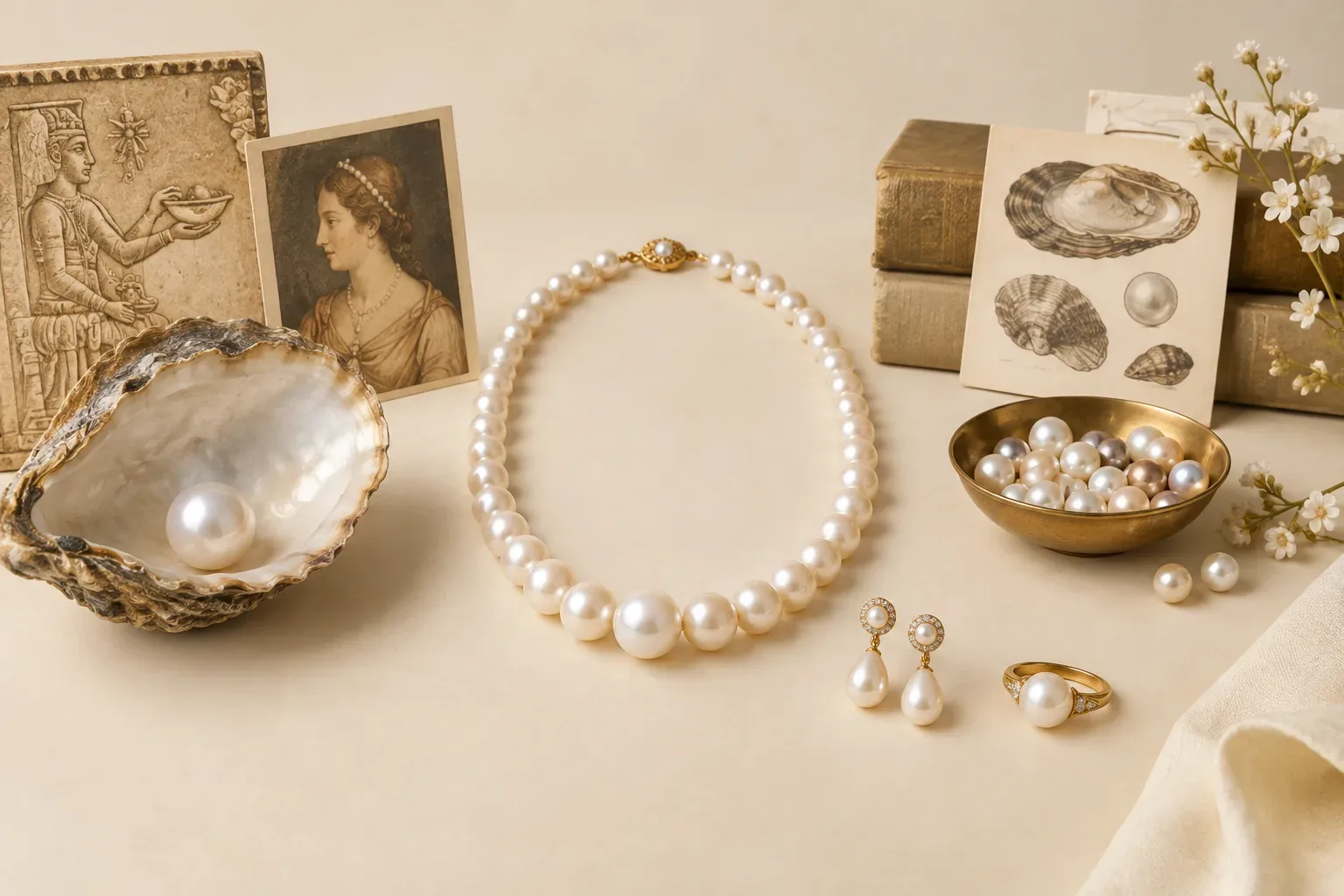
Meaning at a glance
Pearl quality and value are shaped by luster, surface condition, shape, color, size, nacre or bead/nacre thickness, and matching; this guide separates documented historical meanings from later interpretations and gives practical buying and gifting advice.
Core quality and value factors explained
When jewellers and gemologists talk about pearl quality they are usually referring to a set of widely used characteristics: luster (the sharpness and depth of reflected light), surface condition (spots, bumps, or abrasions), shape (round, near-round, drop, button, baroque), color (body color and overtones), size (diameter in millimetres), and the thickness of nacre or, for bead-nucleated cultured pearls, the combined bead and nacre construction. How well a group of pearls match one another for these attributes also matters for strands and matched pairs.
Origin and formation—whether a pearl is a natural wild pearl, a saltwater cultured pearl, or a freshwater cultured pearl—affect rarity and typical price ranges. Treatments, enhancements, and imitations exist; sellers in many jurisdictions are required to disclose them. For consumer guidance on disclosure and common issues with treatments and imitations, see the Federal Trade Commission guidance on buying gemstones, diamonds, and pearls (Federal Trade Commission).
Historical evidence and cultural contexts
Museums and curators trace distinct uses and meanings for pearls across cultures and periods rather than a single universal symbolism. The Victoria and Albert Museum presents pearls as recurring luxury materials in many societies and explains how jewellery fashions and social contexts changed over time, from courtly displays to later popular uses (Victoria and Albert Museum).
In ancient Mediterranean societies and some early imperial courts, pearls were prized as rare natural objects and appeared in high-status jewellery. Byzantine and medieval European court jewellery often used pearls as signs of wealth and rank, with pearls sewn onto garments and crowns. The Victoria and Albert Museum's surveys of jewellery history link these uses to visible status markers in court and religious dress rather than to a single spiritual meaning.
In South and Southeast Asian contexts, including Mughal-period India, pearls were integrated into elaborate jewellery and ornamentation, valued for rarity and incorporated within courtly regalia. The museum's accounts place such uses within the cultures' specific aesthetics and social hierarchies.
From the late 18th century into the 19th century and through the Victorian period in Europe, pearls remained associated with femininity and genteel fashion, and new manufacturing and trade networks changed availability and styles. The V&A's materials on jewellery history explain how changing trade, technology, and fashion influenced pearl use and design over time (Victoria and Albert Museum).
Documented historical meanings versus modern personal interpretations
Documented historical evidence—museum studies and curatorial research—shows that pearls were primarily signifiers of status, wealth, and taste in many recorded contexts. The Victoria and Albert Museum links pearl use to changing social contexts and fashions rather than attributing a single, consistent symbolic meaning across all cultures and periods (Victoria and Albert Museum).
Modern interpretations—such as pearls representing purity, wisdom, or emotional meanings assigned in contemporary marketing and personal gifting—are often personal, cultural, or commercial. These modern meanings are not universal and should be treated as individual or contemporary cultural attributions rather than as continuous historical facts. When choosing pearls for symbolic reasons, separate what is documented by historical research from what you or the recipient may want the pearl to mean today.
How pearls appear in jewellery: forms and settings
Historically and today, pearls appear in a wide variety of jewellery types. Single pearls commonly appear as stud earrings or pendants, where the stone is set to display luster. Strands remain the classic presentation: single- or multi-strand necklaces use matched pearls to create a continuous visual field where matching is crucial to perceived quality.
Pearls are also used as accent stones in rings and brooches, incorporated into tiaras and crowns, and mounted with diamonds or coloured gems in cluster settings. Antique and antique‑inspired pieces sometimes use small 'seed' pearls en pavé or as decorative edging. Baroque and irregular pearls are often showcased in contemporary, artisanal designs where unique shape is a selling point. The Victoria and Albert Museum's resources on gemstones and jewellery history describe these recurring forms and how stylistic preferences changed across periods (Victoria and Albert Museum).
Practical selection and gifting guidance
Decide the purpose and the recipient’s style first. For classic, versatile gifts choose well-matched round or near-round pearls in a size appropriate to the recipient’s style—smaller diameters for subtle daily wear, larger for visible statement pieces. Consider metal colour and setting: warm skin tones often pair well with cream or gold-pearl settings, while cool tones can suit white or silver settings and pearls with cool overtones.
If you are buying a strand or matched set, prioritise matching and luster over absolute size if you can’t have both; a smaller, high-luster, well-matched strand will usually look more cohesive than a larger, duller one. For a ring or single-stone pendant, evaluate surface condition and setting security carefully because pearls sit exposed to wear.
Ask clear questions of the seller. Verify whether the pearl is natural or cultured, its origin (for example, Akoya, South Sea, Tahitian, or freshwater), and whether it has received any treatments. Ask for any available documentation about origin or grading and whether the seller follows disclosure practices recommended by consumer protection authorities. For information on disclosure obligations and common treatments and imitations, consult the Federal Trade Commission's buying guidance (Federal Trade Commission).
Set a realistic budget and remember that origin and rarity influence price: natural pearls are rare and priced accordingly, while many cultured pearls offer accessible price points with good quality. If authenticity and provenance matter to you, buy from reputable dealers who provide clear return policies and written information about treatments and origin.
Gifting respectfully also means considering cultural sensitivity. Because historical meanings vary by culture and period, avoid assuming a single, universal symbolism for pearls. If the recipient values historical meaning, choose a piece whose documented cultural context aligns with their interests and explain the documented history as a thoughtful gesture. If the recipient prefers modern personal meaning, discuss the sentiment you intend to attach to the gift so it is received as intended.
Care, verification, and long-term considerations
Pearls are organic and softer than most gemstones; handle them gently, wipe them after wear to remove oils and cosmetics, and store them separately to avoid abrasion. Avoid exposure to perfumes, acids, and prolonged contact with water or perspiration. Regular stringing checks for strands are practical: silk or other threads may stretch or fray and should be re-knotted or restrung by a professional when needed.
To verify authenticity and understand value, request documentation from the seller and consider an independent appraisal if value assessment is important to you. For consumer-facing rules about disclosure of treatments and imitations, the Federal Trade Commission provides practical advice and warns about undisclosed treatments and synthetic or imitation products (Federal Trade Commission).
Final takeaway
Pearl quality and value factors are tangible characteristics you can learn to evaluate—luster, surface, shape, color, size, nacre or construction, and matching—while provenance and treatment influence price and disclosure. Museum research demonstrates that pearls have held varied social meanings across cultures and periods rather than one universal symbolism (Victoria and Albert Museum). Use clear questions and trusted sellers, prioritise the factors that matter most to you or your recipient, and separate documented historical context from contemporary personal or marketing-driven interpretations when choosing and gifting pearls.
Frequently asked questions
What are the most important factors that determine pearl value?
The primary factors are luster, surface condition, shape, color and overtones, size, nacre thickness or the construction of cultured pearls, and how well pearls are matched in a set. Origin and whether a pearl is natural, cultured, treated, or imitated also affect value and disclosure.
Are natural pearls always more valuable than cultured pearls?
Natural pearls are rare and often command high prices, but cultured pearls offer a wide range of quality and price points. Value depends on quality factors like luster and surface as well as rarity and provenance, not solely on whether a pearl is natural or cultured.
How can I verify a pearl’s authenticity and whether it has been treated?
Ask the seller for written information about origin, whether the pearl is natural or cultured, and any treatments. Reputable sellers provide clear documentation and return policies. For guidance on disclosure and common treatments or imitations, consult the Federal Trade Commission's consumer advice on buying gemstones, diamonds, and pearls (Federal Trade Commission).
How should I care for pearl jewellery?
Wipe pearls gently after wear to remove oils and cosmetics, avoid contact with perfumes and acids, store them separately to prevent abrasion, and have strands re-knotted periodically. Because pearls are organic and softer than most gems, handle them with care.
How do historical meanings affect my choice when gifting pearls?
Museums document diverse historical uses of pearls—often as markers of status and taste—rather than one universal symbolic meaning (Victoria and Albert Museum). If symbolism matters to the recipient, choose a piece whose documented cultural context aligns with their interests, or explain the personal meaning you attach to the gift.
Sources and further reading
- Bedazzled: A History of Jewellery — Victoria and Albert Museum
- An A-Z of Gemstones — Victoria and Albert Museum
- Buying Gemstones, Diamonds, and Pearls — Federal Trade Commission