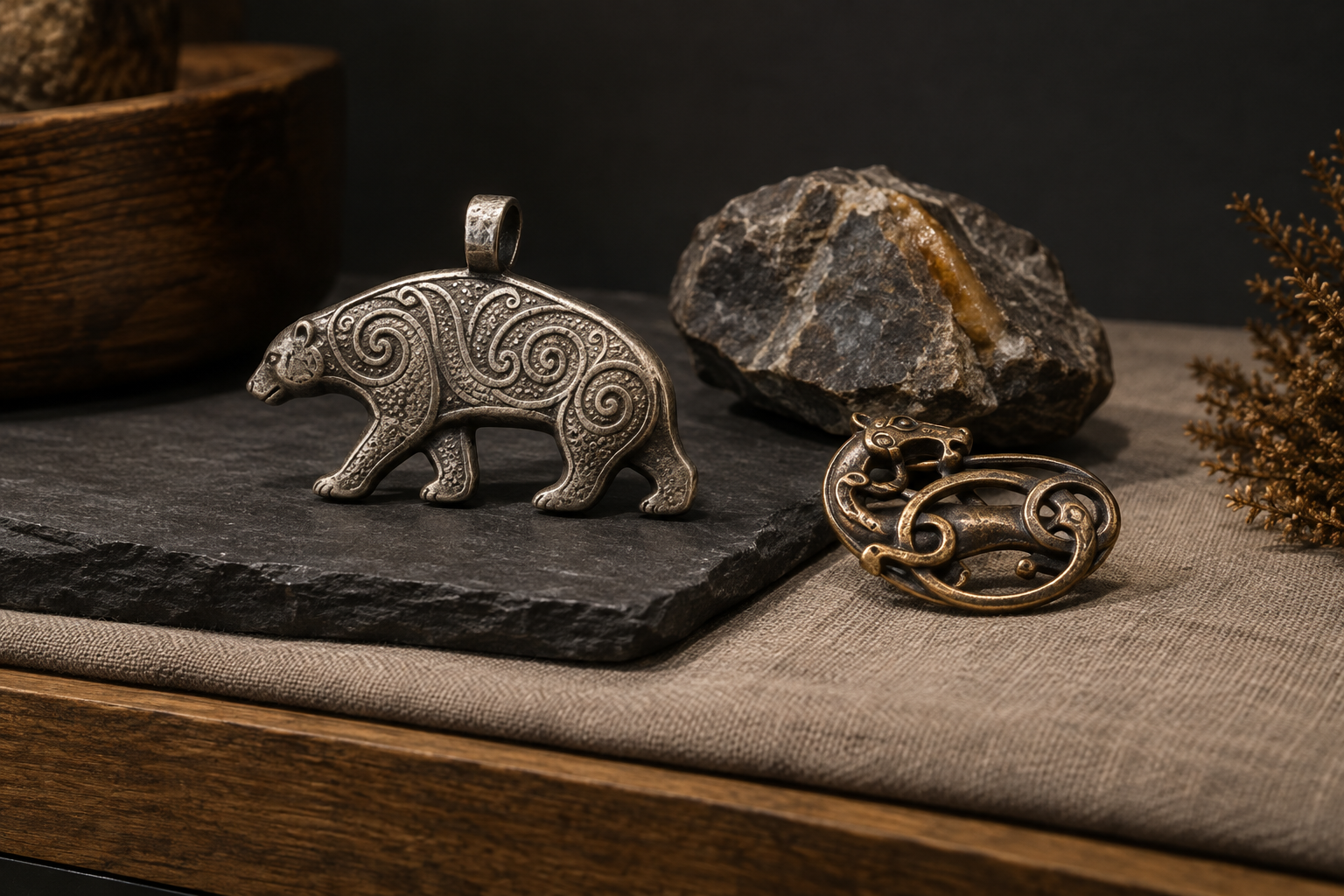
Meaning at a glance
Bears appear across northern environments and in debated discussions of berserkers, but there is no single securely documented Viking Age meaning for bear jewelry; contemporary symbolism—strength, protection, wilderness—is largely a modern reading.
Short answer
Bears appear in northern environments and in debated discussions of berserkers, but bear jewelry does not have one securely documented Viking Age meaning; strength, protection, and wilderness are primarily modern symbolic readings.
What the historical evidence actually shows
Museum and primary-source surveys stress that what we know about the Viking Age comes from a mixture of archaeological finds, place‑names, and later literary sources, and that interpreting motifs requires care. The National Museum of Denmark and the Swedish History Museum present the archaeological and written bases used to reconstruct Viking clothing, ornament, and belief, and they explicitly warn that modern readings can overreach what the material evidence supports.
Archaeology shows that animal imagery appears in Scandinavian metalwork and decorative arts from the Viking Age and surrounding centuries. The museums’ catalogues and overviews present objects with stylized animal forms, but they do not record a single, unambiguous symbolic meaning for every animal motif. In short: animals are present in the material record, but their meanings are not always written on the object and must be inferred from context, literary parallels, and careful scholarship (National Museum of Denmark; Swedish History Museum).
Bears in the literary and archaeological record — precise limits
Later medieval literary sources and saga literature contain stories that include bears and bear-associated figures. Museums that compile the documentary bases for Viking studies emphasize that sagas are complex sources: they mix oral tradition, later Christian-era redaction, and regional storytelling. Because sagas were written down centuries after many of the artifacts that interest collectors and designers, museums caution against treating saga motifs as direct evidence for everyday Viking‑Age beliefs or practices (Swedish History Museum; National Museum of Denmark).
Archaeological finds can show that depictions of animals were meaningful to makers and users, but the evidence rarely—if ever—provides a one‑sentence meaning card. The National Museum of Denmark, for example, presents finds alongside contextual information to avoid asserting modern interpretations as historical fact. Where scholars suggest that an object had a talismanic or emblematic role, that interpretation is usually presented as a hypothesis supported by context, not as a universal truth.
Berserkers, bear‑folk, and the problem of direct links to jewelry
The popular connection between bears and berserkers—that is, warriors who entered trance‑like fury and were sometimes described as taking on animal characteristics—derives from literary, linguistic and folkloric discussions rather than from a clear catalog of Viking‑age amulets labeled as 'berserker gear.' Museums and historical overviews treat these topics as debated; they collect the source types (archaeology, runic inscriptions, sagas) but do not claim a direct, one‑to‑one correspondence between any given piece of jewelry and the idea of a berserker (National Museum of Denmark; Swedish History Museum).
In practice this means that while some modern storytellers and craftspeople reference berserker imagery when designing bear‑themed jewelry, there is no simple archaeological checklist that lets one point to a pendant and say definitively, 'This was a berserker's talisman.' Where scholarship ties animal imagery to warrior identity, it does so cautiously and with context, not as a universal rule.
Documented historical meanings versus modern personal interpretations
Documented historical meanings are limited: museum scholarship emphasizes context and warns against simple translations of image into meaning. The National Museum of Denmark and the Swedish History Museum both display and discuss objects while underscoring that many symbolic attributions are modern reconstructions rather than contemporaneous labels attached to objects.
Modern personal and commercial interpretations, by contrast, commonly read bear imagery as representing strength, protection, courage, wildness, and a connection to northern nature. These contemporary meanings are legitimate as personal or cultural symbolism today, but they should be presented as modern readings rather than as straightforward Viking‑age facts. Museums encourage makers and sellers to label modern symbolic claims clearly so that contemporary meaning is not conflated with historical documentation.
How the bear motif appears in jewelry — past and present
In archaeological displays and museum collections, animal motifs appear in a range of objects: brooches, pendants, buckle plates, and ornamented metalwork. Museums present these finds to show the variety of form and technique used in the past, not as proof that any single motif had one uniform meaning. In the Viking Age and neighbouring periods, artisans used metalworking techniques to produce stylized animal forms; the surviving examples demonstrate artistic conventions rather than explicit meaning tags (National Museum of Denmark; Swedish History Museum).
Contemporary bear jewelry draws on that visual language in multiple ways. Designers produce realistic bear heads, stylized interlaced forms that echo Norse animal art, paw or claw motifs, and abstract emblems meant to suggest wilderness or guard symbolism. Modern materials commonly include sterling silver, bronze or other metals; some pieces incorporate stones or carved materials—such as amber or cabochons—to add color or a regional touch. These choices are artistic and modern rather than evidence that the identical combination was worn for the same reason a thousand years ago.
Practical and respectful guidance for choosing or gifting bear jewelry
If you are selecting bear‑themed jewelry for yourself or as a gift and you care about historical responsibility, be explicit about what you mean. If a piece is inspired by Viking or Norse art, look for labeling that uses words such as 'inspired by' or 'in the style of' rather than asserting direct historical continuity. Museums encourage clear labeling so buyers understand the difference between archaeological specimen and contemporary design (National Museum of Denmark; Swedish History Museum).
Consider the recipient's cultural background and values. Some wearers appreciate modern symbolic readings—strength, resilience, a love of northern landscapes—while others may prefer pieces that celebrate family history, regional craft, or artistic style without claiming ancestral or religious authority. If you wish to honor historical practice, prefer reputable makers who research their references and who accurately describe sources and inspiration. Avoid claiming that a modern piece is an authentic Viking‑age artifact unless it has been authenticated by qualified curators or conservators.
Summary and how to talk about bear jewelry honestly
Bear imagery belongs to a broad visual vocabulary across northern Europe and later Scandinavian storytelling, but museums caution that there is no single, securely documented meaning for bear jewelry in the Viking Age. Contemporary meanings—strength, protection, wilderness—are valid as modern symbolism when presented transparently.
When you discuss or gift bear jewelry, attribute historical claims carefully: name the source of your information, distinguish archaeological fact from modern interpretation, and prefer descriptive labels such as 'Viking‑inspired' or 'Norse‑style' rather than definitive assertions about original use or meaning. The National Museum of Denmark and the Swedish History Museum provide useful overviews of how scholars piece together the archaeological and literary evidence and why cautious presentation matters.
Frequently asked questions
Did Viking Age people wear bear amulets?
Archaeology shows animal imagery in Viking Age metalwork, but museums caution there is no clear, universal evidence that 'bear amulets' were a single, widely attested artifact type with a single meaning. Interpretations vary and are usually presented as hypotheses based on context (National Museum of Denmark; Swedish History Museum).
Were berserkers literally wearing bear skins or bear jewelry?
Literary sources and later traditions link berserkers to bear and bear‑like behavior, but museum overviews treat these connections as debated and do not equate saga descriptions with a direct archaeological catalog of bear jewelry. There is no straightforward artifact checklist that definitively identifies an object as 'berserker gear.'
What does bear jewelry mean today?
Today bear jewelry is most often read as a personal or cultural symbol of strength, protection, courage, or connection to wilderness. These are modern meanings that designers and wearers assign; museums recommend labeling these interpretations as contemporary rather than as Viking‑age facts.
How can I tell if a bear pendant is authentically Viking Age?
Authentication requires expert assessment by curators, conservators, or qualified archaeologists. Look for provenance, museum cataloguing, or independent technical reports. If a seller claims 'Viking age' provenance without documentation, treat the claim with caution and consult specialists or museum references (National Museum of Denmark; Swedish History Museum).
Is it cultural appropriation to wear Viking‑inspired bear jewelry?
Wearing Viking‑inspired jewelry is not inherently appropriation, but sensitivity matters. Be transparent about the modern nature of the piece, avoid claiming ancestral or religious authority you do not hold, and consider the preferences of people or communities for whom the symbol may have particular contemporary meanings.
How should I describe bear jewelry if I sell or gift it?
Use clear language: describe the piece as 'Viking‑inspired,' 'Norse‑style,' or 'modern interpretation' if it is not an authenticated artifact. Explain the design influences and any modern meanings you intend, and avoid asserting historical functions or beliefs without specialist evidence (National Museum of Denmark; Swedish History Museum).
Sources and further reading
- Sources of the Viking Age — National Museum of Denmark
- The sources for what we know — Swedish History Museum
- The Viking gods — National Museum of Denmark