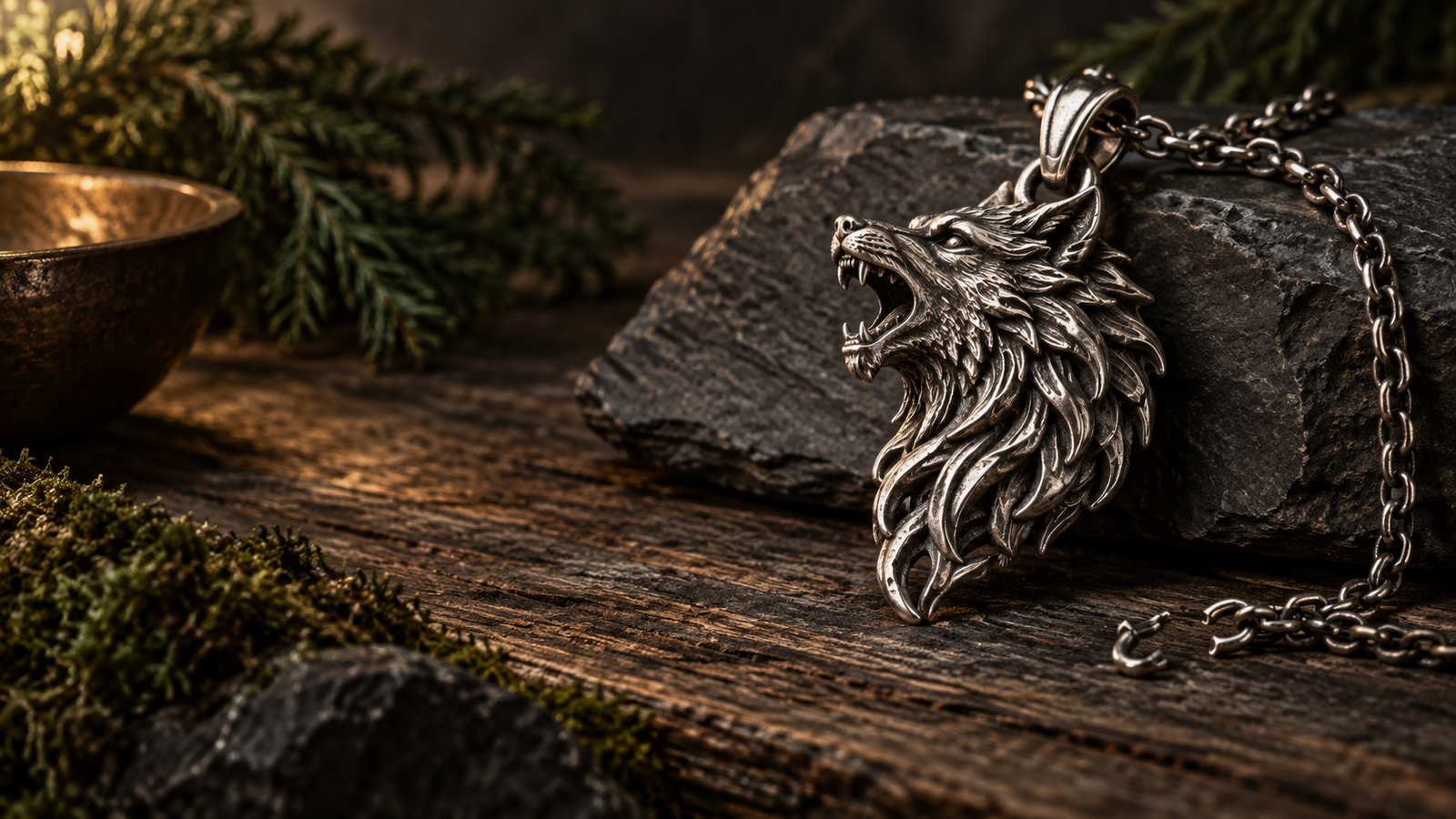
Meaning at a glance
Fenrir jewelry meaning is anchored in the Norse literary image of the great wolf who is bound until the time of Ragnarok; museum and reference sources show the motif in myth and link it to Tyr and the end-time narrative, while modern jewelry designers and wearers project contemporary ideas such as defiance, personal strength, and freedom onto the image. Historical accounts come from later Norse sources and require source caution, and modern meanings are personal or cultural reinterpretations rather than direct continuations of a single Viking Age belief.
What the historical evidence actually shows
Surviving stories about Fenrir come to us through the Norse literary tradition as discussed by institutions that study Viking Age religion and mythology. The National Museum of Denmark describes the ‘‘old religion’’ and makes clear that Fenrir is known in those later Norse accounts as the great wolf who is bound and who is linked to Tyr and the events of Ragnarok. The World History Encyclopedia likewise presents Fenrir as the bound wolf of Norse myth. Both sources emphasize that the textual record informing modern images of Fenrir was preserved and transmitted in material written down after the Viking Age, so researchers and readers should treat the surviving accounts with attention to the nature and timing of those sources.
Because the primary narratives were recorded and transmitted in medieval Icelandic and Scandinavian literary contexts rather than as contemporaneous inscriptions from the entire Viking Age, museum and reference treatments caution against assuming a single, unchanged belief system across all Norse communities. In short, historical evidence ties Fenrir to a specific narrative role in the Norse tradition, and the main dependable statements are that Fenrir is the giant wolf who becomes bound and that his story is linked with Tyr and the cosmological events called Ragnarok.
Documented historical meanings versus modern interpretations
Documented historical meanings are narrowly tied to the narrative role Fenrir plays in Norse literary tradition. Sources used by modern scholars and museums report that the wolf is part of a mythic sequence that culminates in the end-time battle known as Ragnarok and that Fenrir is restrained until those final events. These narrative facts are what is historically supported by the surviving record, per the National Museum of Denmark and World History Encyclopedia.
Modern interpretations — the ideas most consumers encounter on product pages and in contemporary writing — expand on that narrative role. Designers, wearers, and commentators commonly read the bound wolf as a symbol of resistance, raw power, independence, or a refusal to be constrained. These readings are contemporary and culturally variable, not meanings established by the historical sources cited here. In other words, historical sources tell us who Fenrir is in the mythic story; contemporary meanings are personal or collective responses to that story and can differ widely.
How the Fenrir motif appears in jewelry
Jewelry designers translate the Fenrir story into objects in several visual and material ways. A common approach shows a wolf head or full wolf figure, often stylized rather than naturalistic, to signal the animal aspect of the myth. Another frequent device is the depiction of binding: chains, shackles, knots, or a tangle of straps and brambles that visually reference the wolf’s restraint. Designers may combine the wolf and the binding motif to evoke the tension between power and containment.
Materials and techniques used for Fenrir jewelry generally follow broader trends in Norse-inspired pieces. Sterling silver and bronze tones are common because they echo metalwork associated with Viking-age archaeological finds, though modern alloys and plating are widely used as well. Leather cords, heavy chains, and mixed-media pendants are popular for necklaces. Engraved or cast panels may include runic-like marks or interlaced knotwork to add a ‘‘Norse’’ character; however, these graphic choices are modern design decisions and do not always reproduce historically attested patterns.
Gemstones and finishes are chosen for mood rather than any direct historical mandate. Dark stones such as onyx, hematite, or labradorite are often paired with Fenrir motifs to emphasize a somber or powerful aesthetic, while polished silver can suggest a colder, more austere feel. Again, the choice of stone or finish reflects contemporary taste and symbolic association rather than a documented Viking Age practice specific to Fenrir imagery.
Practical and respectful guidance for selecting or gifting Fenrir jewelry
Be intentional about meaning. If you buy or gift Fenrir jewelry because you like the mythic narrative, explain what the symbol means to you or the recipient. If the recipient values historical accuracy, choose pieces that are clearly presented as modern artistic interpretations rather than marketed as ‘authentic Viking relics.’ Transparency about what a design is and what it is not avoids inadvertently misrepresenting cultural history.
Consider cultural context and respect. Fenrir is part of a religious and mythic tradition that is meaningful to many people. Avoid using the image in ways that trivialize or stereotype contemporary Scandinavian or broader Norse-descended communities. If the recipient has Scandinavian heritage, a thoughtful conversation about intent and respect for that heritage is appropriate.
Attend to materials and wearability. Match the piece to the recipient’s style and practical needs: select an appropriate chain length, check for metal allergies, and consider weight and durability. Sterling silver is a common, wearable choice; bronze or darker finishes can suit moodier designs. If the piece includes leather or glued settings, note that these require different care than solid metal or stone pieces.
Choose symbolic variations carefully. A Fenrir pendant showing the wolf bound might be a good gift for someone drawn to narratives about struggle and transformation, whereas a plain wolf-head design will read more generally as a nature or animal motif. If you want to emphasize themes of resilience or personal freedom but worry about misinterpretation, pair the jewelry with a short note that describes your intended meaning.
Support ethical makers. When possible, purchase from designers who disclose their materials, production methods, and cultural approach. Buying from artisan makers who acknowledge that their work is a contemporary reinterpretation of Norse myth helps keep the exchange honest and supports craftsmen who specialize in quality pieces.
Putting Fenrir jewelry in context with other Norse motifs
Fenrir designs sit alongside many other Norse-inspired motifs in contemporary jewelry. Pieces such as Mjölnir (Thor’s hammer) or the valknut are often used with clear references to their literary histories. If historical fidelity matters, compare how different symbols are described in museum or reference materials. Our site’s related pieces on Mjölnir and the Valknut discuss what history supports and where modern jewelry has layered new meanings, which can help when deciding how a Fenrir piece may fit into a wider collection.
Frequently asked questions
Is Fenrir jewelry an authentic Viking artifact?
No. Fenrir jewelry sold today is a modern design inspired by Norse literary tradition. Museums and reference sources show that the Fenrir story itself is part of later Norse literary transmission, and contemporary pieces are artistic reinterpretations rather than direct Viking Age artifacts.
Does Fenrir always mean danger or evil?
Historically, Fenrir is a complex mythic figure tied to the narrative of Ragnarok; modern symbolic readings vary. Some people interpret the wolf as dangerous or destructive because of its role in the end-time story, while others emphasize strength, resistance, or protection. There is no single, universal meaning.
What materials are common in Fenrir-themed jewelry?
Fenrir pieces commonly use sterling silver, bronze tones, darker metal finishes, leather cords, and occasionally dark stones such as onyx or labradorite. These material choices are contemporary aesthetic decisions rather than historically mandated elements tied specifically to Fenrir.
Is it appropriate to gift Fenrir jewelry to someone with Scandinavian heritage?
You can gift Fenrir jewelry respectfully if you consider the recipient’s perspective. Be transparent that the piece is a modern interpretation of a mythic figure, and avoid framing it as an authentic Viking religious object. A thoughtful note explaining your intent can help ensure the gesture is received respectfully.
What should I look for if I want historically informed designs?
If historical inspiration matters, look for designers who clearly state that their work is influenced by Norse sources and who avoid claiming archaeological authenticity for decorative motifs. Museum publications explaining Norse religion and myth can guide you toward symbols and styles grounded in the scholarly record.
Can wearing Fenrir jewelry be seen as political or extremist?
Symbols from Norse mythology have been used by a range of groups for very different purposes. Wearing a Fenrir motif as a personal symbol does not automatically signal political intent, but context matters. If concerned, choose makers who explain their designs and avoid appropriated or politicized variants of mythic imagery.
Sources and further reading
- The old religion — National Museum of Denmark
- Odin, Tor and the other Norse Gods — National Museum of Denmark
- Fenrir — World History Encyclopedia