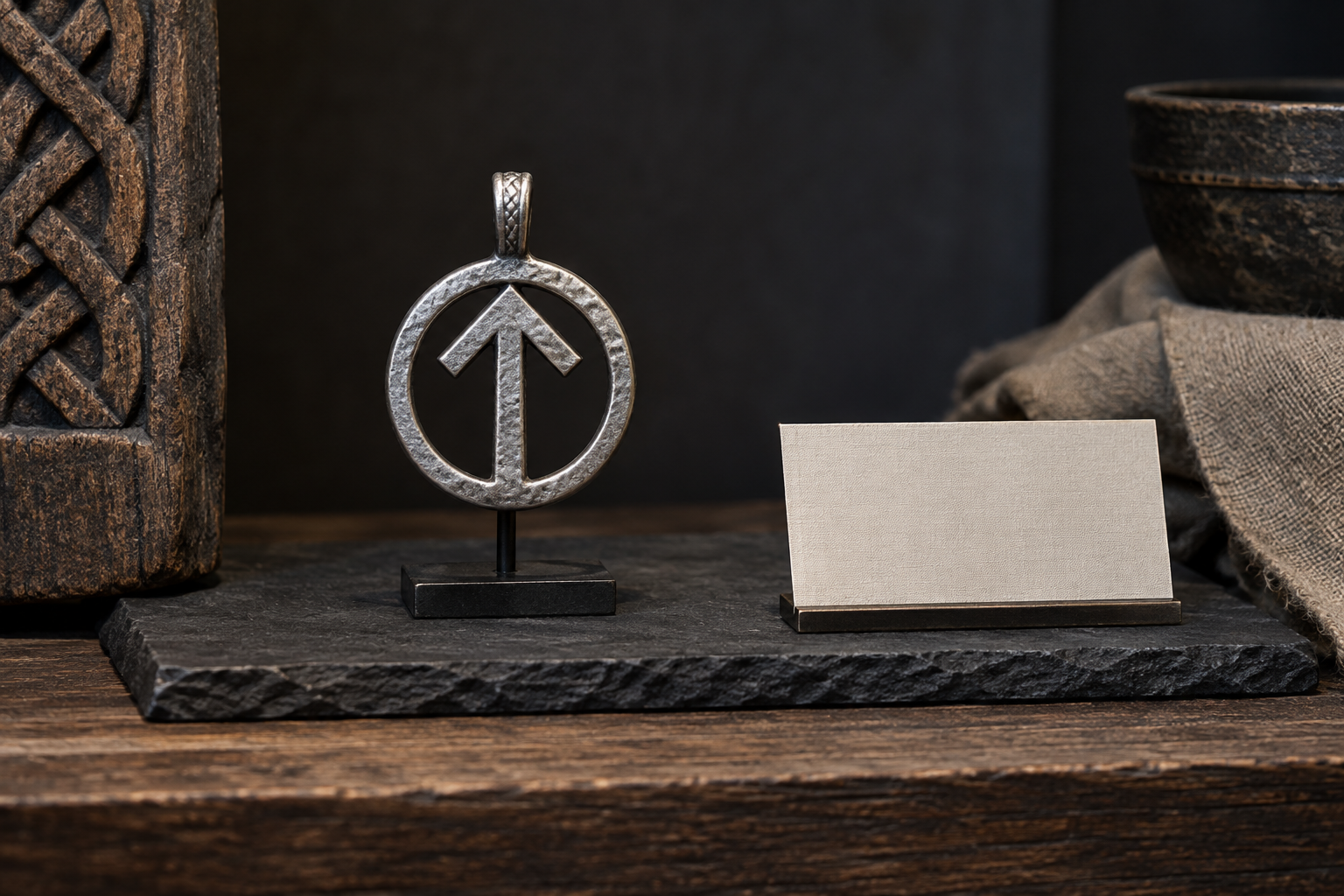
Meaning at a glance
Tiwaz has a historical rune name connected with Tyr, yet modern jewelry meanings such as justice, courage, or victory are interpretations and the symbol's twentieth-century misuse must be evaluated in context.
Short answer
Tiwaz is the runic name historically associated with the god Tyr; the rune was primarily a letter in runic alphabets, and contemporary jewelry meanings—justice, courage, and victory—are modern interpretations while the symbol’s twentieth‑century misuse requires careful context and labeling.
What the historical evidence shows (who said what and when)
The surviving scholarly and museum literature treats runes first as characters in writing systems and secondarily as named signs that connect to mythic names. The Swedish History Museum summarizes runes as an alphabetic tradition used across Germanic-speaking areas and preserved in multiple runic systems, and it emphasizes that rune names and their shapes are part of that larger textual and material record.
The Swedish National Heritage Board documents principles for transliteration and the established practices scholars use to read runic inscriptions. That guidance explains how individual runes are identified in archaeological inscriptions and how rune names such as Tiwaz are treated in transliteration systems, linking the written sign to a conventional name rather than to any single, fixed symbolic meaning across all contexts.
Because the runes functioned as letters and names rather than as a single codified symbolic language, historical evidence supports identifying Tiwaz with the runic sign for a /t/ sound and a name associated with the god Tyr. Museum and heritage publications therefore place the rune within writing and naming practice rather than as proof that every historical object bearing the mark had the same meaning or use.
Documented historical meanings versus modern interpretations
Documented historical meaning: In the primary archaeological and transliteration record, the Tiwaz sign is attested as a runic character whose conventional name in older futharks is associated with the deity Tyr. This linkage—between a rune name and a mythic figure—is the historical fact recorded in runological and museum resources such as those from the Swedish History Museum and the Swedish National Heritage Board.
Modern interpretation: Many contemporary jewelers and wearers interpret the Tiwaz motif as a symbol of justice, individual courage, personal sacrifice, or victory. These are interpretive layers applied in recent centuries, and they reflect modern symbolic vocabularies, personal meanings, and design choices rather than a single, documented historical use. The distinction matters: historical sources support the name and alphabetic function; modern meanings are contemporary attributions that vary by maker, wearer, and cultural context.
Appropriation and caution: Professional monitoring organizations note that some runic symbols, including forms interpreted as the Tyr/Tiwaz rune, were appropriated by extremist groups in the twentieth century. The Anti‑Defamation League documents that certain stylized versions of the Tyr rune have been used as hate or extremist symbols in modern contexts. This modern misuse does not change the rune’s historical character as part of runic alphabets, but it does affect how the symbol is perceived and requires careful framing when used in jewelry or public display.
How the Tiwaz motif appears in jewelry
In modern jewelry the Tiwaz rune commonly appears as a simple, angular motif based on the rune’s upright form. Designers engrave or cast the rune into pendants, rings, bracelets, and cufflinks, or they use it as part of a larger composition such as a bind-rune (a modern fusion of runic signs). The form’s economy of line makes it suitable for small cast or stamped pieces and for engraving on metal surfaces.
Materials and stylistic choices vary widely. Contemporary makers use metals such as silver, bronze, and steel and may finish pieces with antiquing, polish, or patina. Some designers set the rune near or alongside gemstones chosen for their modern symbolic associations—stones selected for perceived grounding, courage, or personal meaning—while other designers present the rune as an unadorned graphic mark.
Jewelry that claims a historical connection should clearly state what aspect is historical and what is modern interpretation. If a piece is a contemporary artist’s design inspired by runic shapes, reputable sellers will describe that inspiration rather than implying direct continuity from an archaeological object. For examples and discussion of bind-rune use in contemporary pieces, see our related article on bind runes in jewelry.
Choosing and gifting Tiwaz rune jewelry respectfully
Know what you are buying. Ask the maker or seller whether the piece is an archaeological replica, a historically informed design, or a contemporary interpretation. Accurate labeling helps preserve historical nuance and prevents misleading claims about provenance. The Swedish History Museum and the Swedish National Heritage Board’s materials on runes emphasize precise identification and transliteration; modern retail descriptions should mirror that clarity rather than blur historical categories.
Consider context and perception. Because some modern extremist groups have appropriated runic motifs, including stylized Tyr forms, consult the Anti‑Defamation League’s resources if you are unsure about a particular design’s associations. Avoid gifting or wearing runic jewelry in settings where it may be misread or provoke harm, and be mindful that meanings differ by audience and place.
When gifting, think about the recipient’s values and knowledge. If you intend to honor traits such as courage or fairness, explain your interpretation and include a note about the piece’s inspiration. If the object is a modern artist’s piece, consider including the artist’s statement or a card that explains the historical roots and the contemporary meaning you wish to convey. For a historically responsible purchase, follow guidance on provenance and maker transparency from resources like our article on how to choose historically responsible Viking jewelry.
Summary and practical takeaways
The historical record, as presented by museum and heritage authorities, treats the Tiwaz sign primarily as a runic character whose conventional name links to the god Tyr. Modern jewelry meanings—justice, courage, victory—are contemporary interpretations layered onto that historical fact, not direct documentary continuations of a single historic symbolic usage.
Practical choices: when buying or gifting Tiwaz rune jewelry, prefer clear labeling, reputable sellers, and contextual information for the recipient. Be aware of modern political appropriations and avoid designs that echo extremist stylizations. When in doubt, choose an artist statement or plaque that explains the maker’s intent and your personal meaning for the piece.
Frequently asked questions
Is the Tiwaz rune a symbol of justice historically?
Historically the Tiwaz rune is attested as a runic character named for the god Tyr; museum and heritage sources treat that as a name and alphabetic sign rather than proof that the rune uniformly meant justice in every historical context. The association with justice is a modern interpretive layer many people apply today.
Can wearing Tiwaz rune jewelry be politically sensitive?
Yes. The Anti-Defamation League documents that some twentieth-century extremist groups appropriated stylized runic motifs, including forms associated with the Tyr rune. Context matters: check the design and seller, avoid versions that echo extremist stylizations, and provide explanatory context when gifting or wearing the piece.
How can I tell if a piece is historically informed or purely modern?
Ask the seller or maker about their intention and provenance. Reputable sellers will state whether a piece is a replica, a design inspired by runes, or an artist’s modern interpretation. Museum and heritage materials emphasize careful transliteration and labeling; expect the same clarity from trustworthy retailers.
Are there traditional gemstones tied to the Tiwaz rune?
No specific gemstones are documented in the runic record as historically tied to the Tiwaz rune. Contemporary designers sometimes pair the rune with stones chosen for modern symbolic associations, but those pairings are artistic choices rather than direct historical continuations.
Is the Tiwaz rune the same as the Norse god Tyr?
The rune’s conventional name is associated with the figure Tyr in runological and heritage literature, which links rune names to mythic names in the tradition. That association reflects naming practice within runic alphabets rather than a claim that every instance of the rune directly invokes the deity.
Sources and further reading
- Runes — Swedish History Museum
- Begrepp och principer for translitterering — Swedish National Heritage Board
- Tyr Rune — Anti-Defamation League