Meaning at a glance
Viking Age beads and necklaces reveal dress, craft, trade, and social choices through materials such as glass, amber, ivory, and metal, while color or stone meanings promoted today should not be projected backward without evidence.
What the archaeological and museum evidence shows
Archaeological finds and museum research make clear that beads and necklaces were common parts of dress across the Viking Age. The National Museum of Denmark presents excavation and material studies showing women and men wore multiple strands of beads and that jewelry was an everyday part of how people presented themselves in the Viking world. The physical evidence comes from graves, hoards and settlement sites where beads survive in large numbers.
Material studies in museum collections help us identify what those beads were made of. Glass beads—often produced in many colors and sometimes in millefiori or drawn forms—appear frequently in Scandinavian contexts. Amber, a fossilized resin abundant on Baltic shores, is another characteristic material, found both as polished beads and as raw pieces worked into necklaces. Metal beads and mounts—bronze, silver and, in higher-status contexts, gold—also appear in dress ensembles, and the Metropolitan Museum of Art’s research highlights fine work in ivory and gold around 1000 A.D., linking luxury materials with advanced carving and metalworking techniques.
Trade and manufacture: how materials reached Viking hands
The physical mix of bead materials reflects broad trade networks and local craft. The National Museum of Denmark documents Viking-period trade and exchange, showing how glass bead types and raw materials circulated across Northern Europe and beyond. Some glass beads were imported ready-made from workshops in continental Europe or the Islamic world, while local production and recycling of glass also occurred.
Amber was often locally sourced from the southern Baltic and then traded or shaped regionally, which made it both a readily available and widely traded commodity. Metalwork—silver in particular—often reflects the flow of bullion and the reuse of foreign coins and objects into jewelry. Ivory and finely worked gold, as discussed by the Metropolitan Museum of Art for the period around 1000 A.D., are indicators of connections to high-status craft and to elite artistic fashions in the North Atlantic and neighboring regions.
Regional and social variations
Material mixes and styles vary by place and social context. Excavations in Denmark, Norway, Sweden and the British Isles yield differing concentrations of glass, amber and metal beads, reflecting local raw material availability and regional fashion. The National Museum of Denmark emphasizes that dress and jewelry choices were shaped by local custom as well as by imported goods, so necklaces found in different regions should be read against their archaeological context.
Status and gender differences are visible in assemblages. Everyday necklaces could contain large numbers of inexpensive glass beads, while high-status graves and hoards may include silver or gold elements, fine ivory carving and fewer but larger, worked beads. The quality of workmanship, not just the material, is a key marker for interpreting social value in these objects.
Documented historical meanings versus modern interpretations
What the evidence documents is that beads and necklaces were important elements of dress and identity in the Viking Age: they were worn visibly, made and exchanged, and sometimes deposited in graves. Museum publications underline dress and jewelry as expressions of social choices and participation in trade networks. The archaeological record supports these practical and social readings.
What we cannot do from the material record alone is assign fixed symbolic meanings for colors, specific stones or motifs in the way modern marketing and popular culture often do. The National Museum of Denmark explicitly warns that modern interpretations of jewelry symbolism require careful labeling. Unless a specific meaning is attested in contemporary written sources or unambiguous ritual contexts, statements that a particular color, bead or stone 'meant' a single thing for all Vikings are speculative and reflect present-day perspectives more than past belief.
How motifs, materials and traditions appear in jewelry
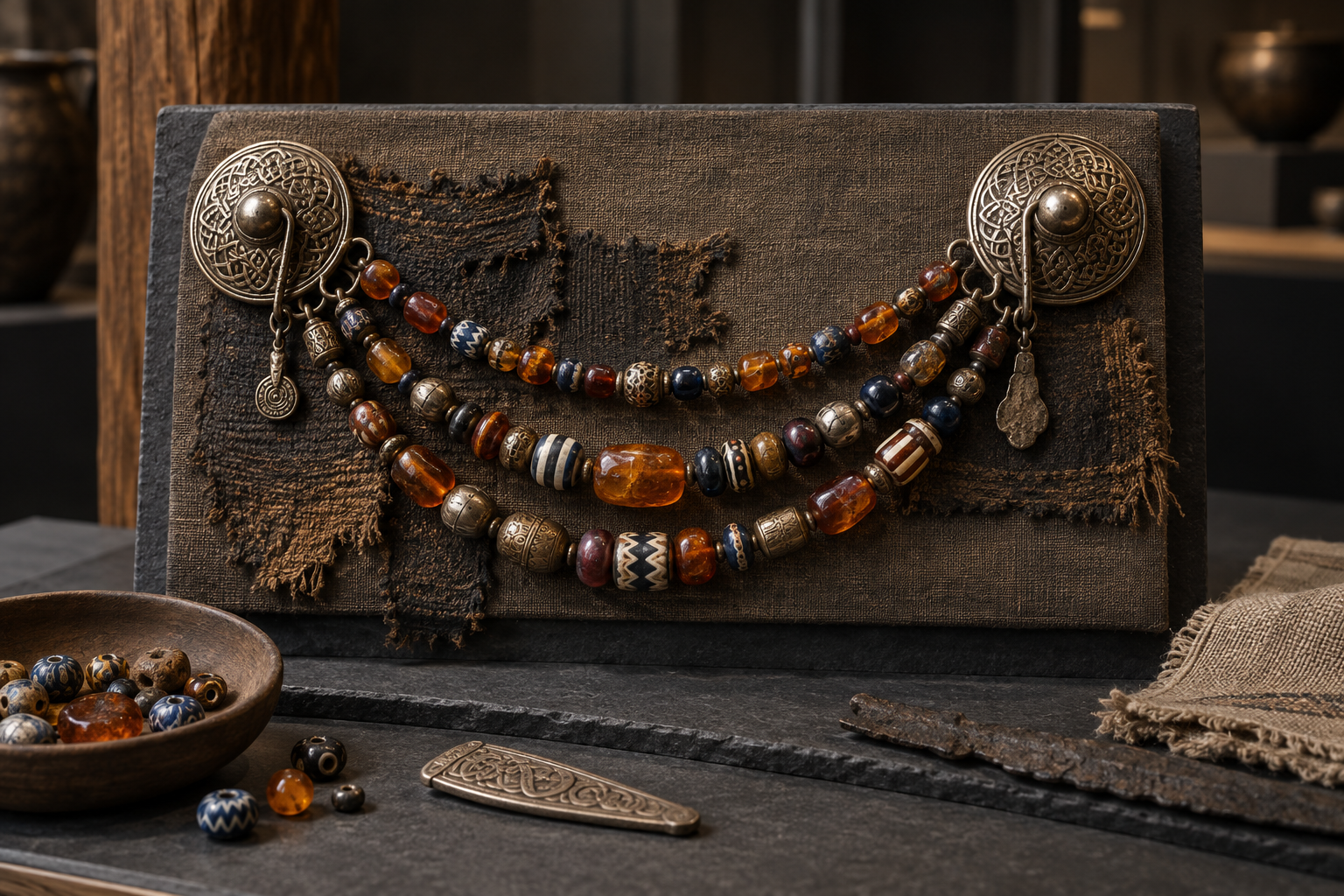
Amber typically appears as rounded or cylindrical beads, often polished and strung as many-bead necklaces. Its yellow and brown tones and ability to be worked into smooth forms made it a favored material for durable, attractive beads that also signaled access to Baltic resources.
Glass beads appear in a wide range of colors and techniques. Some are simple wound or drawn beads; others show millefiori patterns or lamp-worked designs suggestive of imported workshop traditions. The variety of glass types in northern finds illustrates both imports and regional tastes.
Metal appears as beads, spacers, mounts and terminals in necklaces and as larger pendants and mounts incorporating stamped or worked decoration. Fine work in ivory and gold—documented in museum treatments of art around 1000 A.D.—appears in more elite contexts where small carved elements or intricately chased mounts form part of a necklace or a pendant. Across types, necklaces are often found as multiple-strand arrangements and were worn with other dress elements such as brooches and pins that held garments in place.
Practical and respectful guidance for choosing or gifting Viking-style beads and necklaces
If you are buying or gifting Viking-style jewelry, start by deciding whether you want a museum-accurate reproduction, a design inspired by Viking-era types, or an authentic archaeological piece. Museum reproductions and responsibly made modern designs allow you to enjoy the look without the ethical and legal complications of trading in antiquities.
Avoid claiming ancient meanings you cannot support. When gifting, frame the piece as inspired by Viking Age dress and craft rather than as carrying a specific historic meaning. If gifting an antique bead or necklace, ask the seller for clear provenance and documentation. The National Museum of Denmark and major museum publications stress the importance of contextual information for understanding archaeological objects.
Be mindful of material ethics. Amber sourced from the Baltic is a traditional material but confirm sustainable and legal sourcing. Ivory and certain forms of wildlife-derived materials raise conservation and legal issues and should be avoided unless provenance and legality are fully documented. For metalwork, consider pieces made from recycled or ethically sourced metals to respect environmental and cultural concerns.
Care and display: treat older beads as fragile. Use soft stringing materials for reproductions and avoid high-tension knots that stress ancient beads. For display or wear, avoid exposing fragile beads to extremes of heat, sunlight or chemicals.
Conclusion
Viking beads and necklaces are best read as tangible evidence of dress choices, technical skill and long-distance exchange. Museums document the materials—glass, amber, ivory and metals—and the ways those materials moved and were worked across Viking Age societies. Interpretations that assert fixed symbolic meanings for colors or stones should be labeled as modern readings unless they rest on specific historical evidence. Selecting or gifting Viking-style jewelry with respect for provenance, material ethics and historical nuance lets the objects honor the past without imposing unsupported narratives about ancient belief.
Frequently asked questions
What materials did Vikings use for beads and necklaces?
Archaeological and museum records show Vikings used glass, amber, metal (bronze, silver, gold), and organic materials such as bone or ivory for beads and necklace components, with the finest ivory and gold work appearing in higher-status contexts (sources: National Museum of Denmark; The Metropolitan Museum of Art).
Do colors or stones have fixed Viking-age meanings?
No single, documented set of color or stone meanings can be reliably applied across the Viking Age. Museums caution that assigning modern symbolic meanings is speculative unless supported by contemporary textual evidence or clear ritual contexts (source: National Museum of Denmark).
Were beads imported or made locally?
Both. The archaeological record shows imported glass types alongside local production and working of amber and metal; trade brought many bead types into Scandinavian contexts while local workshops also produced or modified beads (source: National Museum of Denmark).
How can I tell an authentic Viking bead from a modern reproduction?
Authenticity is established by provenance, context and specialist analysis. Reproductions are common; ask sellers for clear provenance, laboratory or museum reports for antiques, and look for documentation that ties a piece to a legitimate archaeological excavation (source: National Museum of Denmark).
Is it appropriate to wear Viking-style jewelry today?
Yes—wearing designs inspired by Viking beads is common and can be done respectfully. Avoid presenting modern stylistic choices as literal statements about historical belief and be cautious about buying items made from prohibited or problematic materials (for example certain ivory) unless their legality and provenance are documented.
What should I consider when gifting a Viking-style necklace?
Choose ethically sourced materials, prefer modern reproductions or responsibly acquired antiques with clear provenance, and present the piece as inspired by Viking-age dress rather than as carrying an asserted ancient symbolic meaning; also consider cultural sensitivity and the recipient’s interest in historical authenticity.
Sources and further reading
- Clothes and jewellery — National Museum of Denmark
- Trade in the Viking period — National Museum of Denmark
- The Art of Ivory and Gold in Northern Europe around 1000 A.D. — The Metropolitan Museum of Art