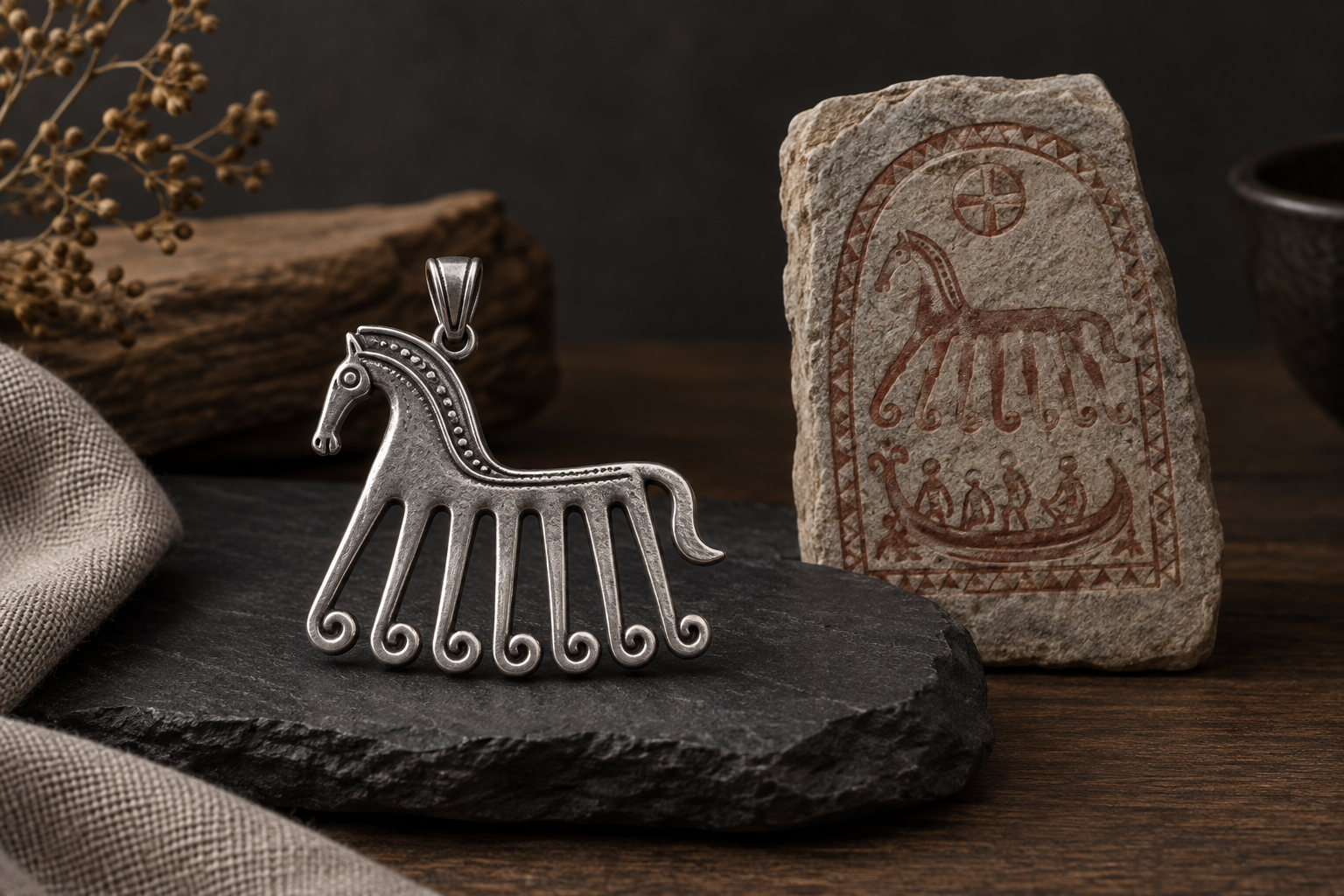
Meaning at a glance
Sleipnir is Odin's eight‑legged horse in Norse literary tradition and may inform interpretations of some early Scandinavian imagery, while modern travel, balance, and transformation meanings belong to contemporary jewelry culture.
Brief answer
Sleipnir is Odin’s eight‑legged horse in Norse literary tradition and may inform interpretations of some early Scandinavian imagery, while modern travel, balance, and transformation meanings belong to contemporary jewelry culture. This is the concise, evidence‑based thesis used by scholarship and responsible curators (Viking Society for Northern Research; Swedish History Museum).
Historical evidence and chronology
The primary literary attestation for Sleipnir comes from medieval Norse manuscript tradition collected in the Eddas. The Uppsala codex edition and translations preserved by the Viking Society for Northern Research reproduce texts in which Sleipnir is explicitly named as Odin’s extraordinary eight‑legged mount (Viking Society for Northern Research). These texts are the closest thing we have to a coherent written record about Sleipnir in the Old Norse literary corpus and form the basis for the character’s place in Norse myth.
Archaeological and iconographic evidence from early medieval Scandinavia is more complex and often ambiguous. Museums such as the Swedish History Museum explain that archaeological finds, regional art styles, and runic inscriptions provide context for the gods and associated animals but rarely give a single, unambiguous identification for a motif. Curators and researchers therefore treat connections between the literary Sleipnir and particular motifs in portable art or stone carvings as plausible interpretations rather than established facts (Swedish History Museum).
In short, the literary record (as preserved and presented by the Viking Society for Northern Research) gives us the clearest historical statement that Sleipnir is Odin’s eight‑legged horse, while museum scholarship (Swedish History Museum) urges cautious interpretation when linking that literary figure to specific archaeological motifs.
Documented historical meanings separated from modern interpretations
Documented historical meaning: In the Old Norse literary tradition, Sleipnir is the exceptional horse associated with Odin. That is a textual claim recorded in the Eddas and preserved in manuscript form; it is the historically attested association scholars rely upon (Viking Society for Northern Research).
Documented ambiguity: When scholars and museums discuss imagery that might depict an eight‑legged horse or an unusually rendered equine, they usually present multiple reading options, because portable art and stone carvings rarely include identifying labels. The Swedish History Museum highlights the need to treat such identifications carefully and to rely on contextual evidence rather than supposition (Swedish History Museum).
Modern interpretations: Contemporary jewelry designers, wearers, and retailers have layered additional meanings onto the Sleipnir motif. Common modern themes include travel and speed because Sleipnir is described as swift; balance and stability because of the unusual eight legs; and transformation or the uncanny because Sleipnir’s parentage and origins in myth are dramatic and liminal. These contemporary symbolic associations belong to modern jewelry culture rather than to medieval textual or archaeological certainty. They are valid personal or aesthetic meanings but should be presented transparently as modern interpretations rather than historical facts.
How the motif, gemstone, or tradition appears in jewelry
Designers working with Norse imagery use the Sleipnir motif in several consistent ways. Some pieces aim for literal representation, showing an eight‑legged horse figure or silhouette as a pendant, brooch, cufflink, or charm. Other pieces use stylized references: a horse head with flowing legs rendered in knotwork, a single horse with repeated leg motifs implying multiplicity, or a compact emblem that nods to Scandinavian animal style without copying a specific historic object.
Material choices are diverse and usually driven by contemporary taste rather than historical prescription. Historically inspired metalwork often uses silver, bronze tones, or iron finishes to evoke a Viking aesthetic, but modern metals, mixed metals, and alloys are also common. Gemstones appear primarily as accent elements. Designers sometimes pair Sleipnir imagery with stones that carry contemporary symbolic meaning—labradorite for travel and intuition, moonstone for transformation, or darker stones for a more dour, mythic look—but these pairings are modern stylistic choices, not continuations of medieval gemstone symbolism.
Technique and finish matter for how the piece reads. A hand‑carved or cast silver pendant with clear eight legs and an inscription will read as a direct mythic reference. A minimalist line drawing or geometric interpretation may signal that the piece is inspired by Norse motifs but intended for modern, personal symbolism. Reproductions of archaeological objects should be clearly labeled as copies; original historical artifacts require provenance and specialist authentication.
Practical and respectful selection or gifting guidance
Be clear about intent. If you want a historically framed piece—either a reproduction of a known object or a design that cites a particular manuscript illustration—ask the maker or seller for references and labeling that ties the design to the source. Museums and specialist vendors typically provide clearer provenance and context than mass-market sellers. The Swedish History Museum’s guidance on sources and interpretation is useful background when evaluating claims about authenticity or historical accuracy (Swedish History Museum).
Respect cultural context and personal identity. Not everyone of Scandinavian descent practices or endorses modern Norse pagan symbolism, and not every wearer intends a spiritual claim. If you are gifting Sleipnir jewelry to someone with Scandinavian heritage, consider asking discreetly whether they prefer historically framed pieces, modern symbolic designs, or no cultural symbolism at all. Avoid marketing items as carrying automatic protective or spiritual power unless the wearer personally endorses that meaning.
Choose material and maker responsibly. If you want a long‑lasting piece, prioritize reputable metals and secure settings, confirm metal hallmarks when buying fine metalwork, and ask about care. For contemporary gemstone pairings, verify treatments and origins with the seller if that matters to you. For antique or purportedly historic objects, request documentation of provenance and a certificate of authenticity from a recognized authority or dealer.
Label modern symbolism honestly. If you sell or gift a piece infused with contemporary meanings—travel, balance, or personal transformation—label it as modern interpretation inspired by Sleipnir rather than as an unbroken historical tradition. This transparency respects both the historical record represented by manuscript evidence (Viking Society for Northern Research) and the interpretive caution urged by museum scholarship (Swedish History Museum).
Consider scale and daily wear. Sleipnir motifs can be intricate. For everyday wear choose a size and weight that fit the recipient’s lifestyle and consider closures and chains that match their routine. For an heirloom or ceremonial gift, a more elaborate piece with documentary notes about the design and its inspiration may be appropriate.
Final note
Sleipnir jewelry sits at the intersection of textual myth and contemporary meaning. The Eddic manuscripts reproduced by the Viking Society for Northern Research give the clearest historical statement that Sleipnir is Odin’s eight‑legged mount, while museum scholarship such as that of the Swedish History Museum reminds us that matching literary figures to visual motifs in the archaeological record requires care. Modern wearers and makers are free to adopt Sleipnir as a personal symbol of journeying, balance, or transformation, but doing so responsibly means distinguishing what is recorded in the historical record from what is a modern layer of meaning.
Frequently asked questions
Is Sleipnir a historical symbol I can rely on for spiritual protection?
Historically, Sleipnir is a literary figure recorded in the Old Norse Eddas; the sources support the identification as Odin’s eight‑legged horse but do not establish a uniform protective function. Any spiritual use in jewelry today is a modern personal interpretation and should be presented as such.
How can I tell if a Sleipnir pendant is a genuine historical reproduction?
Ask the seller for documentation tying the design to a specific artifact or illustration, request provenance for antiques, and prefer museum‑quality reproductions or pieces from reputable makers who cite their sources. The Swedish History Museum’s guidance on sources can help you evaluate claims.
What materials are appropriate for a Sleipnir‑themed piece if I want a historically inspired look?
Historically inspired pieces often use silver or bronze tones and hand‑worked finishes to evoke early medieval metalwork, but the historical record does not mandate a single material. Choose a durable metal you and the recipient will wear comfortably and verify any gemstone claims with the seller.
Does every depiction of a horse with many legs represent Sleipnir in archaeological art?
No. Many multi‑legged or stylized animal figures in Scandinavian art are open to interpretation. Museums like the Swedish History Museum treat such identifications cautiously and rely on broader contextual evidence rather than assuming a direct match to the literary Sleipnir.
Is it cultural appropriation to wear Sleipnir jewelry if I am not Scandinavian?
Wearing Sleipnir imagery is not inherently appropriation, but sensitivity matters. Learn the difference between historical context and modern spiritual claims, respect living traditions and personal beliefs, and avoid commercializing sacred practices of contemporary religious communities without permission.
Can Sleipnir jewelry be a meaningful travel or transformation talisman?
Many people adopt Sleipnir as a personal symbol of journeying or transformation today; this is a contemporary symbolic meaning layered onto the mythic figure. If you intend the piece as a talisman, present and accept that meaning as personal and modern rather than as a documented medieval practice.
Sources and further reading
- The Uppsala Edda: DG 11 4to — Viking Society for Northern Research
- The Aesir – the gods of the aristocracy — Swedish History Museum
- The sources for what we know — Swedish History Museum