Meaning at a glance
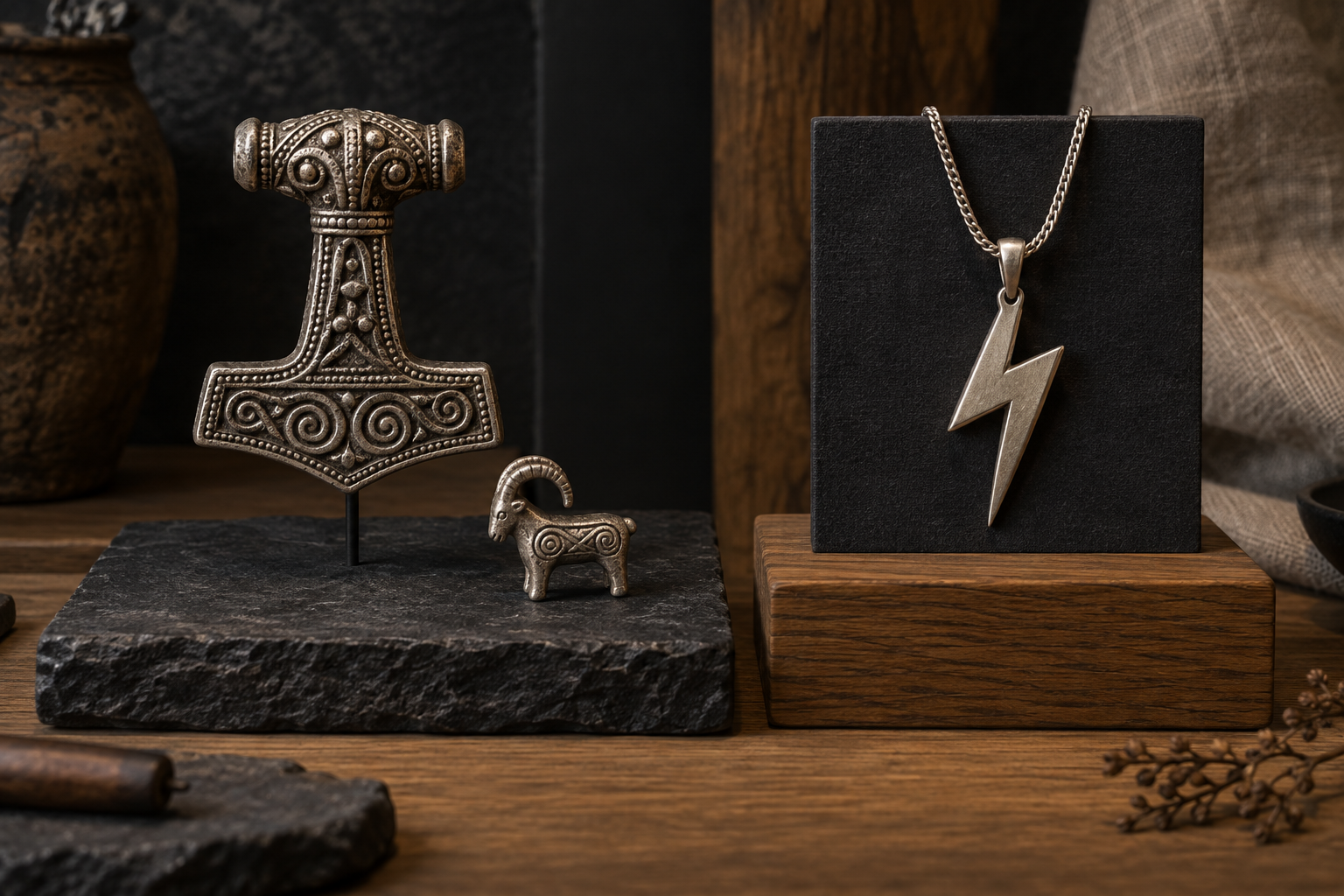
Thor's hammer is the clearest archaeological Thor-related jewelry form, while goats, lightning, the belt, and iron gloves come primarily from textual tradition or modern design and require explicit evidence labels.
What the archaeological record shows
Archaeological finds from Viking Age Scandinavia include numerous pendants and small metal objects shaped like a hammer, commonly identified in museum literature as representations of Mjolnir and worn as pendants or amulets. The National Museum of Denmark discusses Viking Age dress and jewellery and treats the hammer-shaped pendants as an identifiable form associated in the archaeological record with personal adornment in the Viking Age. These finds—recovered from graves and settlement contexts across Scandinavia—provide the clearest physical evidence linking Thor-related imagery to wearable objects.
Thor in the Norse textual tradition
The broader set of Thor-related attributes—his chariot pulled by two goats, his belt that doubles his strength, the iron gloves he needs to grasp Mjolnir, and his association with thunder and lightning—appear in the Old Norse poetic and prose traditions. The Uppsala Edda (as published by the Viking Society for Northern Research) preserves many of these descriptive motifs in mythic narrative and lays out attributes of Thor that are central to his role in the corpus of Norse myth. These literary items are vital evidence for what medieval Scandinavians imagined about Thor, but they are not themselves archaeological objects.
Separating documented historical meanings from modern interpretation
It is important to keep the types of evidence distinct. The archaeological presence of hammer-shaped pendants allows a direct historical claim: people in the Viking Age owned and wore small hammer-like amulets. By contrast, while the Eddic texts describe goats, a belt, gloves, and thunderbolts as Thor's attributes, there is far less direct archaeological evidence showing those attributes depicted specifically on wearable objects as a consistent category. The National Museum of Denmark emphasizes caution in moving from archaeological finds to modern symbolic claims, and the Uppsala Edda must be treated as literary testimony about mythic belief rather than an inventory of contemporary material culture.
How these motifs appear in contemporary jewelry
Modern jewelry designers draw on both the archaeological record and the Norse texts. Hammer pendants are reproduced in a wide variety of metals and styles, from historically informed silver and bronze copies to stylised contemporary designs. Designers also adapt literary motifs—goats, stylized lightning bolts, belt motifs, and gauntlets—into brooches, rings, pendants and engraved motifs. When modern pieces reference the Eddic elements they are often explicitly creative reworkings that combine textual imagery with modern aesthetics rather than straightforward continuations of a single historical object type.
Materials, motifs and traditional techniques in jewelry
Viking Age jewellery in Scandinavian contexts used metals and beads as common materials for personal ornament, and the hammer pendants found archaeologically are often metalwork made to be worn. Contemporary pieces that reference Viking Age work may adopt similar metals and finishing techniques—oxidised silver, cast bronze, and hand-hammered textures—to evoke antiquity. Designers who borrow literary motifs sometimes incorporate engraved runes or stylised animal forms to echo Norse story-worlds, but these are modern design choices that layer interpretation on top of the historical record rather than direct copies of documented historical types.
Choosing or gifting Thor-themed jewelry respectfully
If you are choosing or gifting Thor-themed jewelry, first decide whether you value archaeological authenticity, literary symbolism, or contemporary design. For historically grounded choices, select responsibly made hammer pendants that are described as inspired by Viking Age finds and that include clear provenance or a curator's note. If you prefer pieces that reference the stories—goats, belts, gloves, lightning—look for designers who label the motif as coming from Norse myth so the wearer understands the source of the symbolism. Whether buying for personal wear or as a gift, avoid claiming any single universal meaning for the piece and respect the diversity of modern and historical receptions.
Context and cultural sensitivity
Be mindful that Norse imagery is used in many different contemporary contexts, some of which are political or exclusionary. Museums such as the National Museum of Denmark draw a clear line between documenting Viking Age beliefs and endorsing any modern politicised use of the past. When acquiring Thor-related jewelry, prefer reputable makers, museum reproductions, or scholarly-annotated pieces and avoid any vendor or label that promotes exclusionary or extremist symbolism. Clear labeling of whether a design is archaeological reproduction, literary-inspired, or purely contemporary helps recipients understand the cultural and historical framing.
Practical tips for wear and care
Treat historically inspired jewellery much like any other metal or mixed-material piece: follow the maker's care instructions, keep softer materials such as leather or cord dry, and store metalwork away from humidity to reduce tarnish. If you own a piece that reproduces an archaeological find, consider keeping documentation or a provenance note with the item; this helps preserve its educational value and signals the owner's attention to historical context when sharing the piece with others.
Final note on evidence and honesty
In writing about Thor symbols in jewelry, honesty about sources matters. The archaeological record supports hammer pendants as a visible, material form associated with Thor in Viking Age Scandinavia, while other attributes of Thor rest largely on textual sources such as the Uppsala Edda. Present modern uses of Thor's goats, belt, gloves, or lightning as inspired by myth and literature, not as direct archaeological continuations, and you will both honor the evidence and enable informed, respectful enjoyment of these motifs.
Frequently asked questions
Is Mjolnir the only historically attested Thor symbol in jewelry?
Archaeologically, hammer-shaped pendants are the clearest Thor-related jewelry form from Viking Age Scandinavia and are discussed in museum literature such as the National Museum of Denmark. Other Thor attributes are well attested in Norse texts but are not as clearly represented as a distinct, widespread category of wearable objects in the archaeological record.
Do the Eddas show Thor wearing a belt or gloves that could be made into jewelry?
The Uppsala Edda and related Old Norse texts describe Thor possessing a belt (Megingjörð) and iron gloves (Járngreipr), but these are literary descriptions of mythic attributes. Modern jewelry that echoes a belt motif or glove motif is a creative, text-inspired design choice rather than direct archaeological continuation.
Are goats associated with Thor on historical jewelry?
Goats are a known part of Thor's mythic imagery in the Norse textual tradition—Thor's chariot is drawn by two goats in the Eddas—but clear archaeological examples of goat motifs used specifically and repeatedly as Thor-related wearable items are not the same kind of direct evidence as hammer pendants. When designers use goat imagery for Thor-themed pieces, it should be labeled as literary inspiration.
What should I look for if I want a historically informed piece?
If you want a historically informed piece, look for well-documented reproductions of hammer pendants that reference a specific find or museum catalogue entry and that include information about the period (Viking Age) and find context. Reputable makers and museum shops often provide provenance notes or curator commentary.
Is it respectful to wear Thor-themed jewelry today?
Yes, wearing Thor-themed jewelry can be respectful if it is presented honestly about its sources, avoids appropriative or politicised contexts, and is chosen from makers who clearly label whether a piece is archaeological reproduction, text-inspired, or a modern reinterpretation. Museums such as the National Museum of Denmark emphasise careful contextualisation of historical symbols.
Can gemstones or specific metals make a piece more authentic?
Materials alone do not determine authenticity. While Viking Age jewellery used metals and beads in many forms, authenticity depends on a piece's connection to documented finds, the maker's transparency, and provenance information. If historical accuracy matters to you, prioritise documentation and reputable makers over marketing claims about particular stones or finishes.
How can I tell if a vendor is responsibly using Norse imagery?
Responsible vendors will state their sources, indicate whether a design is inspired by archaeological finds or by literary motifs from the Eddas, and avoid political or exclusionary imagery. Clear labeling, provenance for reproductions, and positive reviews from museum shops or academic projects are good indicators of responsibility.
Sources and further reading
- The Viking gods — National Museum of Denmark
- Clothes and jewellery — National Museum of Denmark
- The Uppsala Edda: DG 11 4to — Viking Society for Northern Research