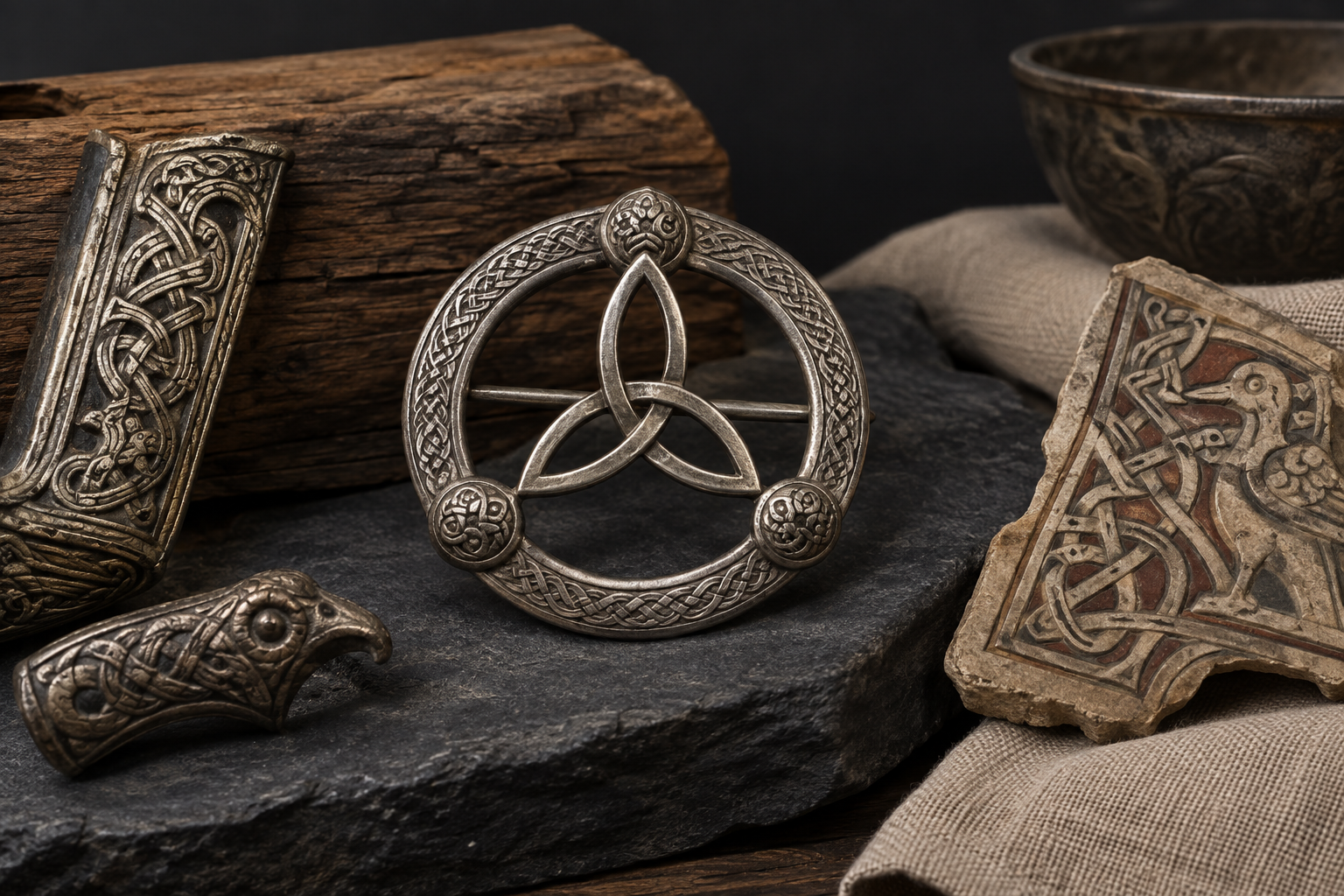
Meaning at a glance
Three‑lobed knot motifs occur across northern European art, and examples appear in Scandinavian contexts, but there is no single documented Viking meaning for the triquetra; modern uses are interpretive and should be described carefully.
What the historical evidence shows
Archaeological and art‑historical sources make clear that three‑lobed or three‑fold knot motifs appear across a wide span of northern European material from late antiquity through the early medieval period. The Metropolitan Museum of Art’s survey of Migration Period art demonstrates how motifs moved and transformed across regions from about A.D. 300 to 800, appearing on metalwork and portable objects in styles that circulated between communities (The Metropolitan Museum of Art).
Later Viking‑age and early medieval northern European art continued to reuse and adapt interlace and knotwork. The Metropolitan Museum of Art’s essay on ivory, gold, and related luxury arts around 1000 A.D. describes carved ivories, metal fittings, and inlaid objects in which interlace and triadic designs are one of several visual vocabularies used by craftsmen across the North Sea and Baltic worlds (The Metropolitan Museum of Art).
The National Museum of Denmark summarizes the kinds of documentary and material sources scholars use for the Viking Age—including hoards, grave goods, portable art, and imported objects—and emphasizes the interconnected nature of Scandinavian culture with neighboring regions during the Viking period (National Museum of Denmark). Taken together, these museum publications support two points: that triadic knot motifs appear in northern European and Scandinavian contexts, and that artistic exchange makes it inappropriate to treat any single motif as a uniquely 'Viking' invention.
Which cultures and periods are involved
The Migration Period (roughly A.D. 300–800) saw broad movement of decorative motifs among Germanic and insular communities; museum scholarship groups these visual traditions to show shared patterns rather than isolation (The Metropolitan Museum of Art).
The later Viking Age and the turn of the first millennium (roughly late 8th through 11th centuries) is the period covered in studies of northern ivory carving and goldsmithing; Metropolitan Museum of Art research on ivory and metal arts around 1000 A.D. places triadic ornament among the repertoire used by goldsmiths, carvers, and metalworkers working in an interconnected North Sea world (The Metropolitan Museum of Art).
Archaeological syntheses such as those assembled by the National Museum of Denmark use hoards, ship graves, and portable luxury goods to contextualize ornament across these centuries, underlining that Scandinavian finds often reflect long‑distance trade and shared artistic languages (National Museum of Denmark).
Documented historical meanings versus modern interpretations
Museum publications and primary archaeological records do not record a single, authoritative 'Viking' meaning for three‑lobed knot motifs. The scholarship assembled by The Metropolitan Museum of Art and the National Museum of Denmark treats these patterns as decorative and symbolic elements within a broader visual vocabulary rather than as carrying a single documented doctrinal meaning.
Because the archaeological record rarely preserves explicit statements of meaning from the makers or wearers, any claim that a particular motif represented a single shared belief in the Viking world is not supported by the museum sources. The Metropolitan Museum of Art emphasizes contextual and stylistic analysis rather than fixed symbolic attributions (The Metropolitan Museum of Art).
Modern personal or spiritual readings of the triquetra—such as associations with the Christian Trinity, with triplicity in nature, or with contemporary neopagan beliefs—are contemporary interpretations, not direct translations of an archaeologically documented Viking belief. These interpretive meanings can be meaningful to present‑day wearers, but they should be presented as modern meanings rather than historical certainties, in line with the museums’ caution about labeling and interpretation (The Metropolitan Museum of Art; National Museum of Denmark).
How the motif appears in historical jewelry and objects
In surviving northern European material, three‑lobed and triadic patterns show up in a variety of media. The Metropolitan Museum of Art documents examples of metalwork, carved ivory plaques, and decorative fittings from around 300–1000 A.D. where knotwork and triadic devices form part of ornamental panels or openwork designs (The Metropolitan Museum of Art). These motifs could be incised, stamped, cast in metal, or carved in bone and ivory and appear on objects intended for personal display or liturgical use.
In Viking‑period Scandinavian contexts, the same visual vocabulary appears on brooches, belt fittings, harness mounts, and small personal objects, often alongside stylized animals, interlace, and geometric ornament. Museum scholarship stresses that these items frequently reflect exchange networks: the same decorative elements can be found on objects made in different regions and in different materials, which complicates any simple attribution of the motif to a single ethnic or religious identity (National Museum of Denmark; The Metropolitan Museum of Art).
Modern reproductions and contemporary jewelry inspired by these traditions use the triadic knot as a pendant motif, ring engraving, or surface decoration on small metalwork. Contemporary jewelers may render the motif as continuous knotwork, as three overlapping vesicae, or as an openwork casting; sometimes gemstones are set into the lobes or into a central space to add color and focal interest. These current practices reflect modern design choices rather than direct evidence of how historical pieces were always made or worn.
Selecting or gifting triquetra‑style jewelry respectfully
If you are choosing or gifting a piece that features a triquetra or three‑lobed knot, consider how you will label and present the item. Given the mixed archaeological record, it is more historically responsible to describe such a piece as 'a three‑lobed or triquetra‑style knot motif used in northern European decorative traditions' rather than to assert that it is an 'authentic Viking symbol' with a single, fixed meaning. Both The Metropolitan Museum of Art and the National Museum of Denmark recommend careful contextual labeling when presenting historical motifs (The Metropolitan Museum of Art; National Museum of Denmark).
Ask about provenance and maker intent. For museum‑inspired or reproduction jewelry, find out whether the maker copied a specific archaeological object or created a modern design inspired by a range of historic sources. Provenance and honest description help avoid misleading claims and show respect for the cultures and histories involved.
Match metal and craftsmanship to the recipient. If the wearer prefers durable everyday jewelry, choose solid silver or gold alloys appropriate to their lifestyle. If a piece is meant as a display or occasional wear item, consider finer finishing or gemstone accents. If the recipient values historical accuracy, select makers who document their sources and describe which period or find inspired their design.
Be mindful of modern religious and cultural meanings. Some wearers use triadic motifs to express Christian, neopagan, or personal spiritual ideas. If you are uncertain about the recipient’s beliefs, avoid presenting the motif as carrying only one doctrinal meaning; instead, offer it as a meaningful aesthetic form with a complex history that allows personal interpretation.
Final notes
The best approach when wearing, selling, or gifting triquetra‑style jewelry is transparent description. Museum scholarship shows that triadic knot motifs circulated across northern Europe and appear in Scandinavian material, but it does not support a single, universally documented Viking meaning. Labeling items accurately honors the archaeological evidence and respects both historical complexity and modern personal meanings (The Metropolitan Museum of Art; National Museum of Denmark).
Frequently asked questions
Was the triquetra a Viking symbol?
Museum scholarship indicates that triadic knot motifs appear in Scandinavian contexts but does not support a single, universal Viking meaning. The motif circulated across northern Europe, and the archaeological record does not provide one documented doctrinal meaning specific to the Viking world (The Metropolitan Museum of Art; National Museum of Denmark).
Is the triquetra Celtic or Norse?
Triadic knot motifs occur in both insular (often called 'Celtic') and continental northern European traditions. The presence of similar motifs in multiple contexts reflects artistic exchange; labeling a motif as exclusively 'Celtic' or 'Norse' oversimplifies this history (The Metropolitan Museum of Art).
Does the triquetra mean the Christian Trinity historically?
While some later medieval and modern contexts use a three‑fold knot to connote the Christian Trinity, the archaeological record for the Viking period does not record a single fixed meaning for the motif. If the motif is presented as symbolizing the Trinity, that is a modern or later interpretive reading rather than a universally documented Viking-era meaning.
How can I be respectful when buying triquetra jewelry?
Choose makers who document their sources, prefer accurate descriptions such as 'triquetra‑style knot from northern European traditions,' and avoid asserting a single historical meaning. Consider the recipient’s beliefs and ask sellers about the inspiration and provenance of the design (The Metropolitan Museum of Art; National Museum of Denmark).
How did historical craftsmen make these motifs?
Historic craftspeople rendered triadic and interlace motifs in a variety of media: incised or stamped decoration on metal, openwork casting, and carved bone or ivory. Museum research on Migration Period and thousand‑year‑old northern European work describes these techniques as part of a shared decorative vocabulary (The Metropolitan Museum of Art).
Sources and further reading
- Migration Art A.D. 300–800 — The Metropolitan Museum of Art
- The Art of Ivory and Gold in Northern Europe around 1000 A.D. — The Metropolitan Museum of Art
- Sources of the Viking Age — National Museum of Denmark