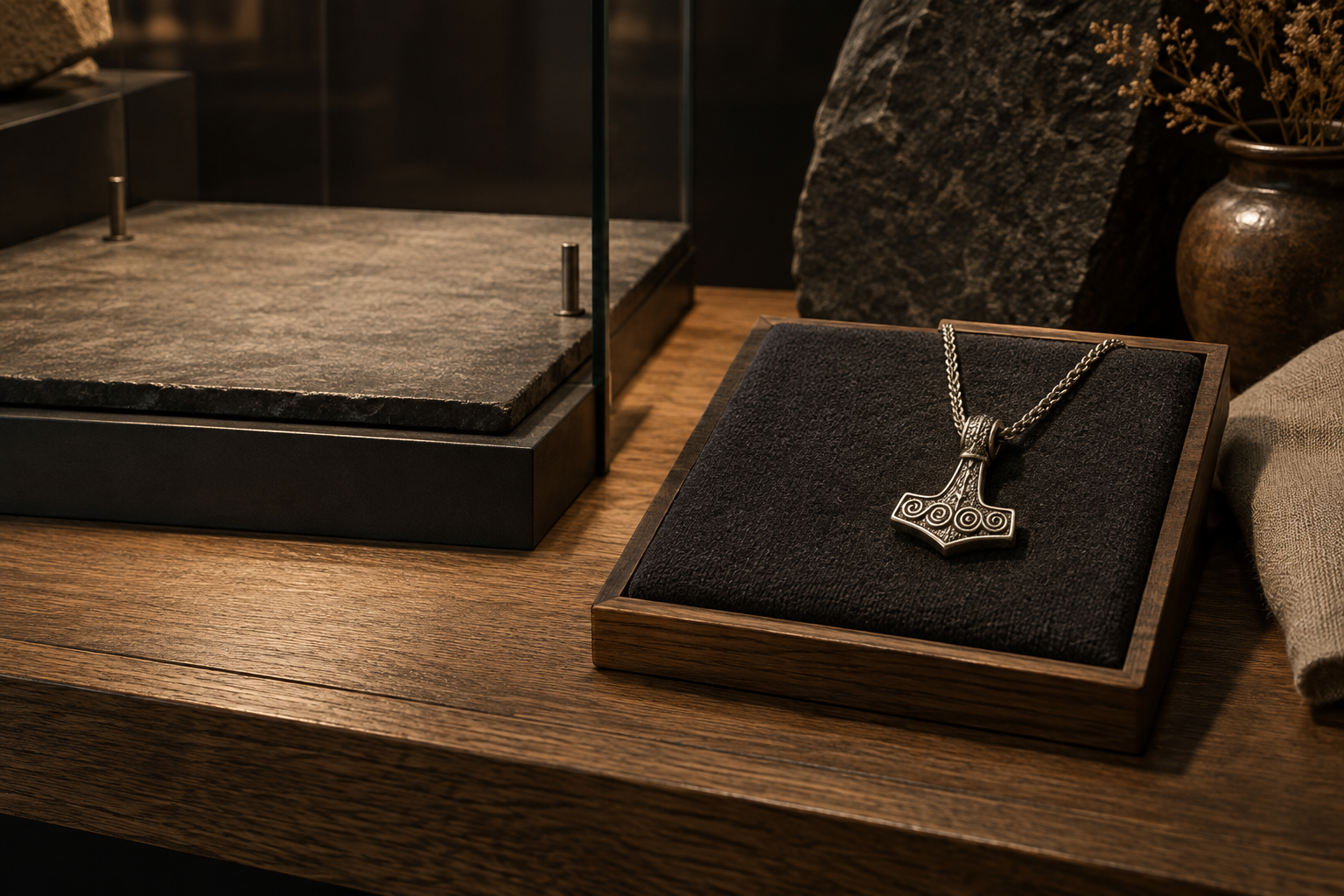
Meaning at a glance
The bent-iron form marketed as the Troll Cross is a modern Nordic jewelry design without secure Viking Age archaeological documentation; its protective meaning should be presented as a recent tradition rather than an authentic Viking-era symbol.
Short answer
The bent-iron form commonly sold as a "Troll Cross" is a modern Nordic jewelry design and not a securely documented Viking Age artifact; museums and national collections advise that its protective interpretation belongs to recent tradition and modern marketing rather than established archaeological fact.
What people mean by the "Troll Cross"
When people refer to a Troll Cross they usually mean a small bent-iron pendant shaped into a looped or hooked cross, worn on a cord or chain and sold as a folk amulet that protects against trolls, malevolent spirits, or bad luck. The motif has become popular in contemporary Scandinavian-inspired jewelry, tourist markets, and online craft marketplaces. Its appearance is rustic and intentionally archaic, which helps it read as ‘‘old’’ even when it is newly made.
Historical evidence and chronology
Institutions that curate Viking and medieval material culture caution that there is no secure archaeological evidence tying this bent-iron pendant form to the Viking Age. The British Museum notes an item in its collection described as a pendant or amulet where questions of authenticity were raised, and the institution uses such finds to illustrate how apparent folk objects must be critically assessed before being presented as historical artifacts. The Swedish History Museum explains the types of source material that underpin what we know about the Viking Age and why clear provenance and context matter when attributing an object to that period. The National Museum of Denmark provides guidance on primary sources for the Viking Age and emphasizes rigorous standards for linking material culture to historical practice. Taken together, these museum resources show that claims about an object's Viking origin require secure archaeological context and documentary support, which the Troll Cross lacks.
Exactly which cultures or periods are we discussing?
When assessing the Troll Cross claim, it is important to separate modern Scandinavian culture from the Viking Age. The Viking Age refers to roughly the late 8th to the mid-11th centuries in Scandinavia and areas influenced by Norse activity. Modern Nordic folk revivals, contemporary craft traditions, and tourist-oriented design are phenomena of the 19th century to the present. The assertions that a specific pendant design dates to the Viking Age should be treated as a hypothesis requiring archaeological evidence from that earlier period; without such evidence the pendant should be described as a recent Nordic design or modern folk-inspired object.
Why the Viking attribution is unsupported
The museums cited above stress provenance and context. Objects recovered by controlled archaeological excavation with reliable dating and stratigraphic context are the basis for attributing artifacts to the Viking Age. Items sold later without excavation records, or objects of unknown or questionable provenance, cannot be confidently assigned to that period. The British Museum entry that discusses a pendant and the possibility of forgery demonstrates how superficially antique-looking items can be modern creations or misattributed. The Swedish History Museum and the National Museum of Denmark both highlight the need to rely on documented finds, contemporary written sources, and reliable dating methods when reconstructing material culture from the past. Because the Troll Cross form is not supported by securely dated finds presented in the archaeological literature referenced by these institutions, asserting it as a Viking artifact would be misleading.
Documented historical meanings versus modern interpretations
Documented Viking Age amulets and pendants do exist, and museums base their interpretations on well-documented finds, inscriptions, and contemporary texts. When museums describe protective objects from the past they do so with reference to find contexts and comparative research. By contrast, the claim that a particular modern bent-iron pendant protected wearers from trolls is a contemporary interpretation, part folklore revival and part marketing. Presentations that label the Troll Cross as ‘‘Viking’’ or ‘‘ancient’’ conflate modern meanings with historical practice. It is more accurate and honest to say that the protective meaning attributed to the Troll Cross is a modern tradition: people today may wear it to express cultural affinity, personal belief, or as a protective talisman, but these uses are contemporary rather than historically corroborated.
How the motif appears in jewelry today
In contemporary jewelry, the Troll Cross motif appears in a range of materials and styles. Artisans commonly craft pendants in iron, silver-plated metal, sterling silver, and even base metal castings that mimic the rough look of hand-forged iron. Designers may intentionally patinate or distress metal to create an antique feel. The motif is often reduced to a small pendant worn on a leather cord, simple chain, or incorporated into mixed-media pieces with beads and other Nordic-inspired charms. Some makers label pieces as inspired by ‘‘old Norse’’ or ‘‘Nordic folk’’ aesthetics while noting that the specific form is a modern design. Because the motif has no secure Viking provenance, reputable sellers will describe the piece as a contemporary or neo-folk symbol rather than an authentic Viking relic.
Choosing and gifting a Troll Cross respectfully
If you are selecting or gifting a Troll Cross-style pendant, do so with attention to honesty about its origins and respect for cultural context. Choose makers who describe their work accurately, using terms such as modern, inspired-by, or contemporary rather than claiming archaeological authenticity. Consider the recipient’s cultural background and beliefs: some people appreciate wearing modern folk-inspired jewelry as a sign of heritage or personal meaning, while others may prefer historically documented symbols. Opt for quality materials and clear maker information if you want the piece to last. When gifting, explain whether the pendant is a modern design with a contemporary protective meaning rather than a guaranteed ancient talisman. This approach honors both the recipient and the historical record.
Care and display in a historical context
If you collect or display pieces inspired by Viking motifs, separate genuine archaeological replicas and museum-quality reproductions from mass-produced designs. Store modern and historical items with appropriate labeling that explains their date and provenance. Museums stress the importance of clear interpretive labels; collectors can follow the same principle by documenting purchase information, maker statements, and any accompanying claims about origin. This preserves the distinction between modern practice and historical evidence that researchers and institutions emphasize.
Final takeaway
The Troll Cross meaning should be presented honestly: the pendant is a modern Nordic jewelry motif whose protective associations are contemporary in origin. Major museum resources from the British Museum, the Swedish History Museum, and the National Museum of Denmark underline the need for secure archaeological provenance before assigning an object to the Viking Age. If you value the design for its aesthetic or personal symbolism, wear or gift it as a recent tradition and not as an authenticated Viking artifact.
Frequently asked questions
Is the Troll Cross an authentic Viking symbol?
No. Museums with Viking collections caution that the bent-iron form called the Troll Cross lacks secure archaeological provenance linking it to the Viking Age; it is best described as a modern Nordic design.
What does the Troll Cross mean?
Its protective meaning is a modern interpretation: wearers today may treat it as a talisman against trolls or bad luck, but that protective significance is recent tradition rather than a historically documented Viking belief.
How can I tell if a Troll Cross pendant is historically accurate?
Look for documentation from the seller or maker stating provenance and whether the piece is a modern reproduction. Authentic archaeological claims should include excavation context and references to museum cataloguing; absence of those details indicates a modern object.
What materials are common for Troll Cross jewelry?
Contemporary Troll Cross-style pendants are commonly made in iron, sterling silver, plated base metals, or cast alloys. Designers may patinate or texturize the metal to give an intentionally rustic look.
How should I gift a Troll Cross respectfully?
Describe it honestly as a modern or folk-inspired piece, consider the recipient’s cultural perspective, choose a reputable maker, and explain whether its protective meaning is a contemporary personal symbol rather than an ancient fact.
Sources and further reading
- Pendant, amulet, forgery — British Museum
- The sources for what we know — Swedish History Museum
- Sources of the Viking Age — National Museum of Denmark