Meaning at a glance
This guide defines styling choices for trillion cut engagement rings, gives decision criteria and trade-offs for finger coverage and proportion, explains gemstone care and disclosure issues, and lists what shoppers must verify through a jeweler or gemological laboratory.
What historical evidence exists for the trillion cut and meanings
There is limited documented historical meaning tied specifically to the trillion cut. Unlike rounds, ovals or certain antique shapes that appear in long-standing cultural jewelry traditions, the trillion is documented primarily as a modern faceting and design choice rather than a symbol with a traceable cultural origin.
Contemporary industry observers note that demand and stylistic interest in modern forms and colored gemstones remain strong; Jewelers Mutual reports 2026 trends emphasizing fluid forms, modern stacking, colored gemstones and versatility, which aligns with the trillion's appeal as a contemporary, geometric option. Imaginaire Digital's search estimates for 2026 further show strong consumer interest in contemporary engagement shapes and related categories in the UK market, indicating the trillion cut functions chiefly as a modern aesthetic rather than a long-standing cultural motif.
Documented meanings versus modern personal interpretation
Documented historical meanings tied to specific gemstone cuts are sparse for the trillion shape. There are no widely recognized, culture-specific symbolic meanings for trillion cuts recorded in the trade literature cited here, so any symbolism attached to a trillion cut ring is a modern, personal or designer-driven interpretation rather than a verified historical tradition.
Modern interpretations are valid personal meanings but they should be distinguished from documented cultural symbolism. If a buyer or giver wants a piece to carry a particular meaning, that intention is meaningful for the wearer but it is not the same as a historically documented emblem. Keep that distinction clear when describing provenance and meaning to recipients or on resale.
How the trillion cut appears in jewelry and common styling roles
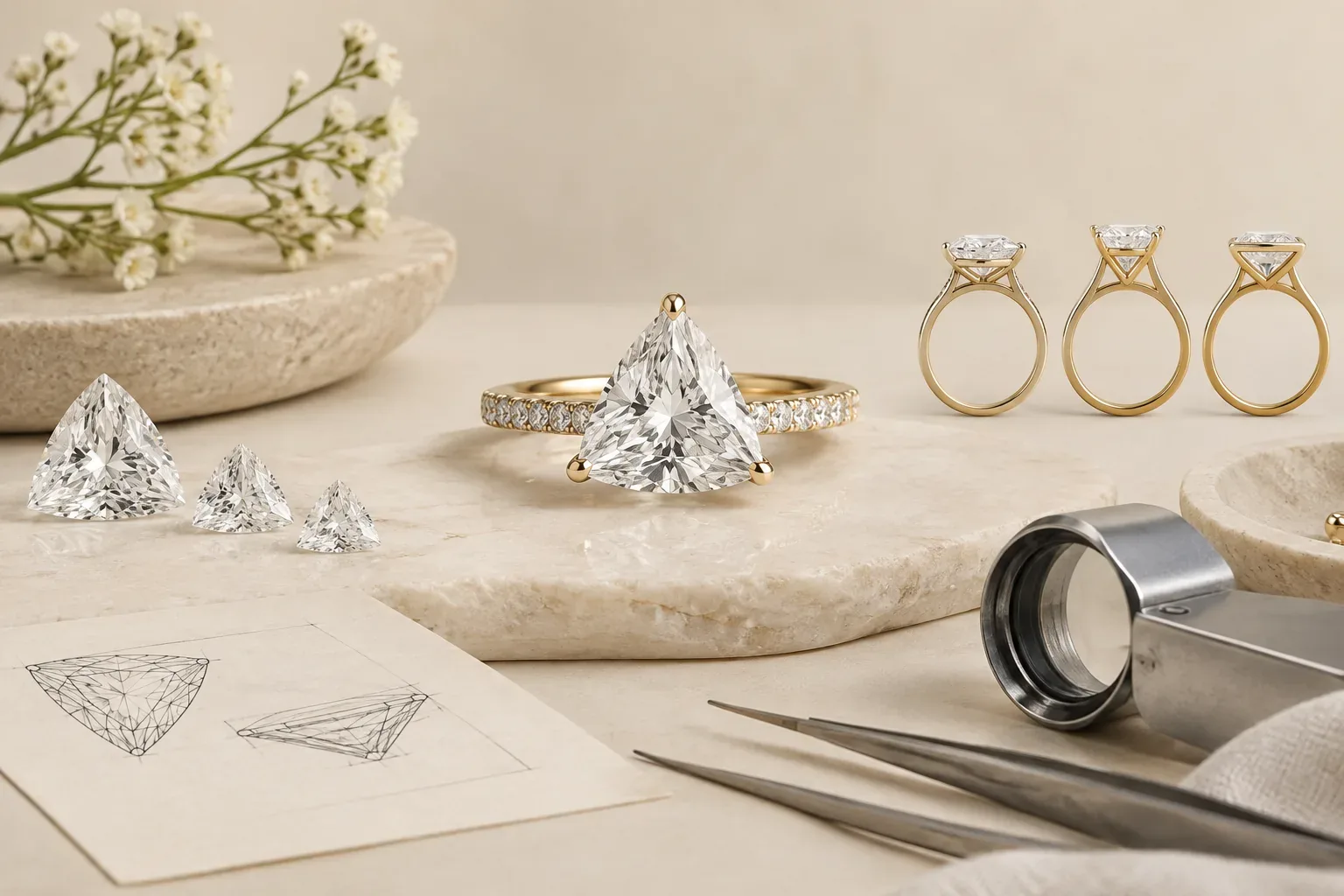
The trillion cut appears as a center stone, accent or side stone. As a center, its triangular outline creates a bold, contemporary silhouette that reads differently on the finger than round or oval shapes. Designers use the trillion both as a single solitaire and as part of multi-stone settings, including three-stone rings where a central brilliant is flanked by trillion side stones, and in halo or cluster arrangements where the triangle forms a dynamic focal point.
Because the trillion emphasizes a flat, faceted plane and pointed corners, settings often include prong designs that protect those corners or bezels that mitigate snagging. The cut also shows significant face-up spread for its weight—wearers see more surface area relative to some deeper cuts—so perceived size can feel larger than the carat weight alone suggests.
Finger coverage and proportion: decision criteria and trade-offs
Start with proportion goals: do you want maximum face-up presence, a low-profile everyday ring, or a dramatic architectural look? Trillion cuts tend to maximize face-up spread, so smaller carat weights can still provide substantial visual coverage. If you prioritize face-up size, choose a stone with generous spread and a setting that exposes the table.
Consider finger width and silhouette. A wide triangular face can visually widen a narrow finger or balance a broader hand; conversely, a small triangular stone on a wide finger may appear delicate. As a practical guideline, match the stone's longest dimension to roughly half to two-thirds of the visible width of the finger at the base of the knuckle. This preserves balance while avoiding a silhouette that overwhelms or vanishes, but treat this as a flexible starting point rather than a strict rule.
Band and shank proportion matter. A thicker band anchors a bold trillion and helps mask the transition from finger to stone; a slim band emphasizes the stone's shape and creates a more delicate look. For durability and daily wear, a modestly wider band and reinforced prongs or bezel corners reduce the risk of damage to the stone's points.
Trade-offs: maximizing spread or opting for a low-profile bezel both have costs. An exposed, high-spread trillion maximizes sparkle and apparent size but increases exposure to knocks at the corners. A deep or bezel setting protects the stone but can reduce apparent size and alter light performance. Decide which value—visual impact or long-term durability—is most important for how the ring will be worn.
Gemstone choice, treatments, and care
Gemstone selection affects wearability and care. Diamonds and many colored gemstones can be cut into trillion shapes, but hardness and toughness differ and influence daily durability. Because treatments, disclosure and detectability affect both value and care, buyers should consult reliable sources before purchase. The Gemological Institute of America emphasizes that treatments, their detectability and the durability implications are distinct consumer questions and recommends transparent disclosure and appropriate care guidance.
The Federal Trade Commission stresses the importance of clear distinctions among natural, lab-created, treated and imitation materials and the need for written seller disclosures. Ask the seller for written statements on whether the stone is natural or lab-grown and whether it has received color, clarity or stability treatments. Those disclosures matter for cleaning methods and for future resale.
For routine care, avoid harsh chemicals, ultrasonic cleaners and steam only when you know the stone's stability. Use gentle cleaning with mild soap and water and a soft brush for most faceted stones, and have prongs and settings inspected regularly to ensure corner protection for the triangular points.
Practical selection and gifting guidance
Begin by clarifying wear preferences: is the ring intended for daily wear, occasional wear, or as a fashion-forward statement? A daily-wear trillion should prioritize corner protection, sturdier mounting and a gemstone known for toughness. For occasional or fashion wear you may prioritize a more exposed, high-spread look.
When gifting, discuss aesthetic preferences without promising symbolic history that does not exist. If you intend a special meaning, explicitly attach that meaning in a note or inscription so the recipient understands the personal intent rather than relying on assumed cultural symbolism.
Request written disclosures and independent documentation when origin, treatment and durability matter to price or care. If the retailer cannot provide clear written information about treatment or origin, plan to have the stone examined by a qualified independent jeweler or sent to a gemological laboratory for verification before finalizing the gift if those attributes are important to you.
What only a qualified jeweler or gemological laboratory can verify
Shoppers can judge shape, face-up size, setting style and subjective proportion themselves, but important technical facts require professional verification. Only a qualified jeweler or gemological laboratory can reliably confirm whether a stone is natural, lab-grown, treated, or whether certain enhancements are present and detectable. The Gemological Institute of America explains that treatments and detectability are technical matters best handled by specialists.
The Federal Trade Commission reinforces that written seller disclosures are required and that consumers should seek laboratory reports for material confirmation. For disputes over origin, treatments or grading specifics, only an accredited laboratory report or a qualified appraisal provides the objective verification that affects insurance, resale and long-term care.
Final considerations
Styling a trillion cut engagement ring is an exercise in balancing visual intent, wearability and verifiable attributes. Use proportion rules as flexible guides, prioritize corner protection if the ring is for everyday wear, and insist on written disclosure about treatments and origin. For any technical verification—especially origin, treatments and grading—use a qualified jeweler or an accredited gemological laboratory.
Frequently asked questions
How does a trillion cut affect finger coverage compared with a round stone?
Trillion cuts tend to show more face-up spread relative to weight, so they often provide greater visual coverage than some deeper cuts. That means a smaller carat weight may appear larger face-up, but the triangular silhouette and pointed corners change balance on the finger compared with a round stone.
What setting offers the best protection for a trillion cut's corners?
Settings that protect the three points—such as bezel partials, V-prongs or reinforced prongs—reduce the risk of chipping. A sturdier band and regular prong inspections add durability for daily wear.
Can I verify whether a trillion cut stone is treated or lab-grown myself?
No. Only a qualified jeweler with appropriate instruments or an accredited gemological laboratory can reliably confirm treatments or whether a stone is natural or lab-grown. The FTC advises getting written disclosures from the seller and lab reports when these attributes matter.
How should I clean a trillion cut engagement ring?
Use mild soap, warm water and a soft brush for routine cleaning unless you have documentation that the stone is sensitive to ultrasonic or steam cleaners. The Gemological Institute of America recommends following guidance tied to the stone's specific material and any treatments it has undergone.
How do I choose band width to match a trillion cut?
Choose a band that balances the visual weight of the stone. A modestly wider band anchors a bold trillion and improves durability, while a slimmer band emphasizes the stone's triangular silhouette. Consider finger size and personal comfort when deciding.
Is there a traditional cultural meaning for the trillion cut?
There is no widely documented cultural or historical symbolism tied specifically to the trillion cut in the sources used here. Contemporary meaning is typically personal or design-led rather than historically established.
Sources and further reading
- Imaginaire Digital — Imaginaire Digital
- Jewelers Mutual — Jewelers Mutual
- Gemological Institute of America — Gemological Institute of America
- Federal Trade Commission — Federal Trade Commission