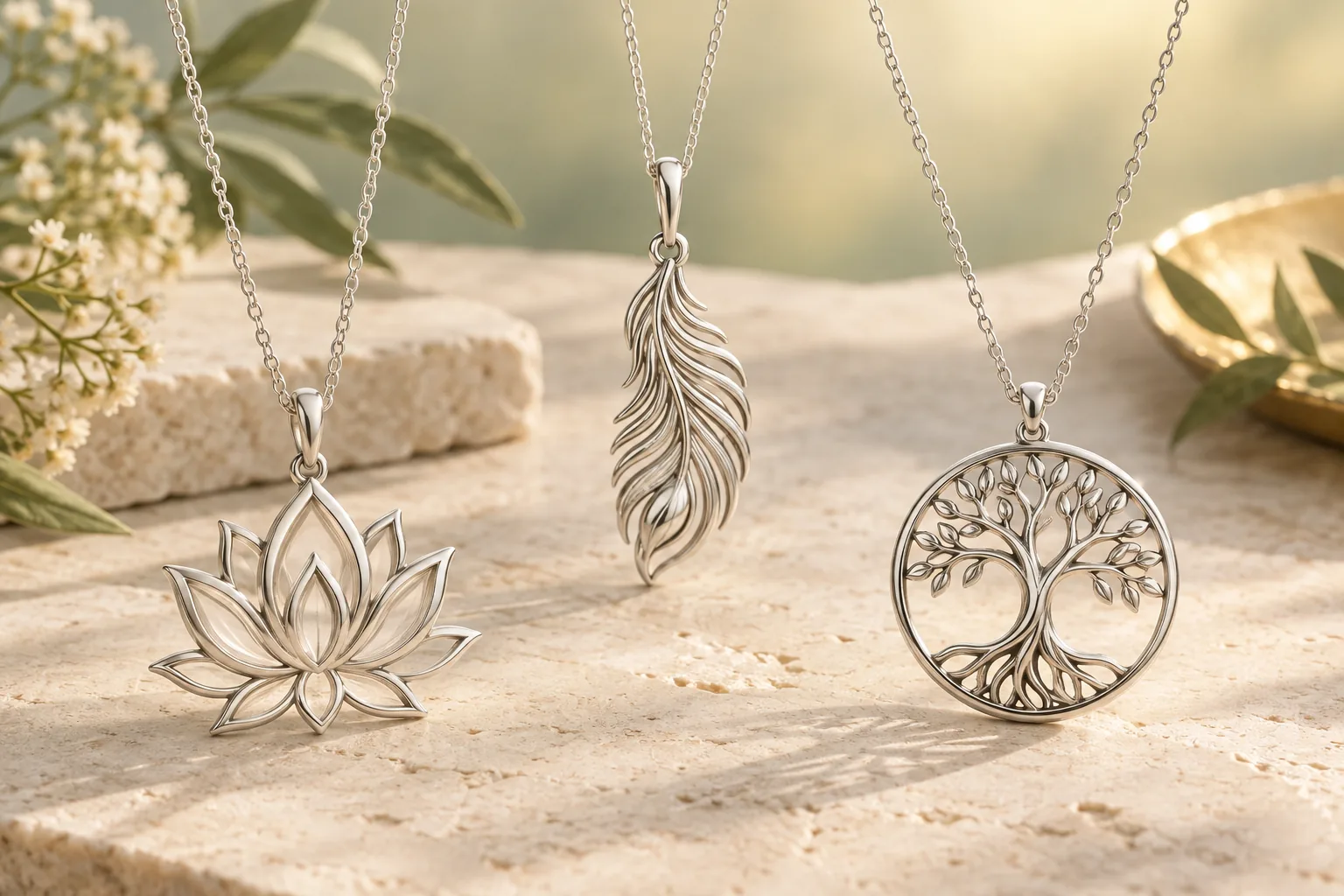
Meaning at a glance
Jewelry for a new beginning can feature a lotus, phoenix, or Tree of Life, but no symbol has one universal meaning. Choose a motif whose documented history and modern associations fit the wearer's own story, then check the material, design, care needs, and seller information before buying.
What a new-beginning symbol can—and cannot—say
A piece of jewelry can mark graduation, recovery, relocation, a new relationship, a career change, parenthood, or a private decision to begin again. The object does not create that change. Its value comes from becoming a wearable reminder of a real event, intention, or relationship. That distinction keeps the message personal without turning symbolism into a promise of luck, healing, or protection.
Symbols also do not operate like a universal dictionary. The same image may have different meanings across centuries, religions, regions, and artistic settings. Modern jewelry sellers often compress those differences into a few appealing words. A more thoughtful approach begins with documented context, clearly labels contemporary interpretation, and lets the wearer decide what the design means in their own life.
Three motifs work especially well for a new-chapter gift: the lotus, the phoenix, and the Tree of Life. Each can support ideas such as renewal, continuity, or growth, yet each reaches those ideas through a different history. They should be compared, not blended into one invented tradition.
Lotus jewelry: daily renewal with cultural context
In ancient Egyptian art, the plant commonly called the lotus is botanically a water lily. The Metropolitan Museum of Art explains that its flower closes at night and opens again in the morning. Ancient Egyptians connected that visible cycle with sunrise, creation, daily rebirth, and rejuvenation. This evidence gives a historically grounded reason why lotus jewelry can feel appropriate for a fresh start.
Lotus imagery also appears in Hindu and Buddhist traditions, where its meanings and uses are not identical to the Egyptian context. A buyer should avoid reducing these traditions to the generic claim that every lotus always means spiritual awakening. If a wearer has a specific religious or cultural relationship to the motif, that context should lead. Otherwise, the gift message can stay modest: the flower is being chosen as a modern reminder of renewal and continued growth.
A lotus design suits someone who prefers a calm, botanical form and a message of gradual change. It can mark a new routine, recovery period, move, or personal reset. The most respectful note explains why the flower was chosen for this person rather than claiming that the pendant carries a guaranteed spiritual effect.
Phoenix jewelry: transformation after difficulty
The phoenix is widely associated with destruction followed by renewed life. A medieval phoenix manuscript in the J. Paul Getty Museum collection shows how the bird could be connected with death and resurrection in Christian interpretation. Classical, Egyptian, Chinese, Persian, and later European bird traditions are not interchangeable, even when modern accounts place them together under the convenient label phoenix.
For contemporary jewelry, the phoenix often represents resilience, transformation, or beginning again after loss. That is a modern interpretive use of older imagery, not proof that every historical culture assigned the bird the same message. An article or product description should name the tradition it actually discusses and should not substitute dramatic marketing language for history.
Phoenix jewelry may fit a person who wants a bold and visible symbol of change. It can be meaningful after completing a demanding period, leaving an unhealthy situation, rebuilding a career, or recovering confidence. Because the imagery is intense, consider whether the recipient wants that story displayed publicly. A quieter feather-like design may feel more wearable than a large bird surrounded by flames.
Tree of Life jewelry: growth, connection, and continuity
Tree imagery appears in many traditions, but there is no single Tree of Life story shared by all of them. The Metropolitan Museum of Art documents a tree flanked by birds on an eleventh- or twelfth-century textile attributed to Iran and notes that the motif traveled through parts of the Islamic world, the Byzantine Empire, and the Mediterranean. Other sacred-tree and world-tree traditions developed in their own cultural settings.
Modern Tree of Life jewelry commonly emphasizes growth, roots, family connection, continuity, and the relationship between past and future. Those ideas can make the motif suitable for marriage, a new home, adoption, parenthood, migration, or a multigenerational gift. They should be presented as current readings unless a specific historical tradition is being documented.
This design often works for someone whose new beginning is connected to other people rather than individual reinvention. Branches can suggest new possibilities while roots suggest memory and belonging. That balance may feel more appropriate than a phoenix when the occasion celebrates continuity as well as change.
How to choose the right symbol for the wearer
Begin with the event and the recipient. A lotus may suit gradual renewal, a phoenix may express dramatic transformation, and a Tree of Life may emphasize growth supported by family or community. These are useful modern comparisons, not fixed rules. Ask which image the person already wears, draws, collects, or mentions. Their existing connection is more important than a list of meanings copied from a product page.
Next, consider cultural and religious context. Do not give sacred imagery casually to someone whose beliefs you have guessed. If the symbol comes from a tradition important to the recipient, research that tradition specifically and describe it accurately. When no such connection exists, keep the message personal and transparent: you chose the form because it reminded you of their new chapter.
Finally, match the visual strength of the design to the person's style. A small outline pendant may be appropriate for daily wear, while a sculptural phoenix or detailed tree may function as a statement piece. Meaningful jewelry succeeds when the recipient wants to wear it; symbolism cannot compensate for an uncomfortable size, unwanted metal color, or impractical form.
Check material, construction, and care before buying
Confirm whether the piece is sterling silver, solid gold, gold-filled material, vermeil, plated base metal, or another clearly identified material. These options differ in price, maintenance, longevity, and suitability for sensitive skin. Product photographs alone cannot show metal thickness, chain strength, clasp quality, or the scale of a pendant, so check written dimensions and construction details.
If the design includes gemstones, look for accurate identification and treatment disclosure. Natural, laboratory-created, imitation, and treated materials can all be attractive, but they should not be described as though they are the same. Avoid products that replace basic facts with unsupported promises about healing, energy, fortune, or protection. Honest specifications strengthen rather than weaken a meaningful gift.
Two contemporary Rimossa examples match this guide directly: a Lotus Flower Necklace and a Phoenix Feather Necklace. They belong in the modern-design section, not in the historical evidence. Before selecting either, compare finish, size, chain, care guidance, return terms, and the recipient's preferences. A direct motif match is useful; it is not a reason to force a product into every symbolic article.
Write a message that makes the jewelry personal
The note presented with the jewelry should explain the choice in plain language. Instead of writing that a symbol always guarantees renewal, describe the real connection: the lotus reminded you of the recipient's patient progress, the phoenix honored the courage required to rebuild, or the tree represented a new branch growing from shared roots.
Avoid telling someone how they must interpret a difficult experience. A recovery, divorce, bereavement, move, or career change may contain relief and hope alongside grief or uncertainty. Offer the symbol as an invitation rather than a verdict. Phrases such as 'I chose this because it made me think of your next chapter' leave room for the wearer to create their own meaning.
A thoughtful new-beginning gift combines context, personal knowledge, accurate material information, and practical wearability. The best symbol is not the one with the grandest marketing story. It is the one the wearer understands, accepts, and can carry comfortably into the life they are building.
Frequently asked questions
What jewelry symbol is best for a new beginning?
There is no single best symbol. A lotus can suggest gradual renewal, a phoenix can represent transformation after difficulty, and a Tree of Life can express growth with continuity and connection. The wearer's own story should decide.
Does lotus jewelry always mean rebirth?
No. Ancient Egyptian lotus imagery was connected with daily rebirth and rejuvenation, while lotus meanings in Hindu and Buddhist traditions have their own contexts. Modern jewelry may use renewal as a personal interpretation.
Is phoenix jewelry suitable after a major life change?
It can be, especially when the wearer connects with themes of resilience or transformation. Because the image can carry an intense story, consider whether the recipient wants that meaning displayed publicly.
How do I make symbolic jewelry feel personal?
Choose a motif connected to the recipient's actual experience, verify materials and wearability, and include a short note explaining why the design reminded you of their new chapter without claiming a universal or guaranteed effect.
Sources and further reading
- Model Lotus Flower — The Metropolitan Museum of Art
- A Birdwatcher's Eye View — J. Paul Getty Museum
- Textile Fragment with Facing Pairs of Birds Flanking a Tree of Life — The Metropolitan Museum of Art