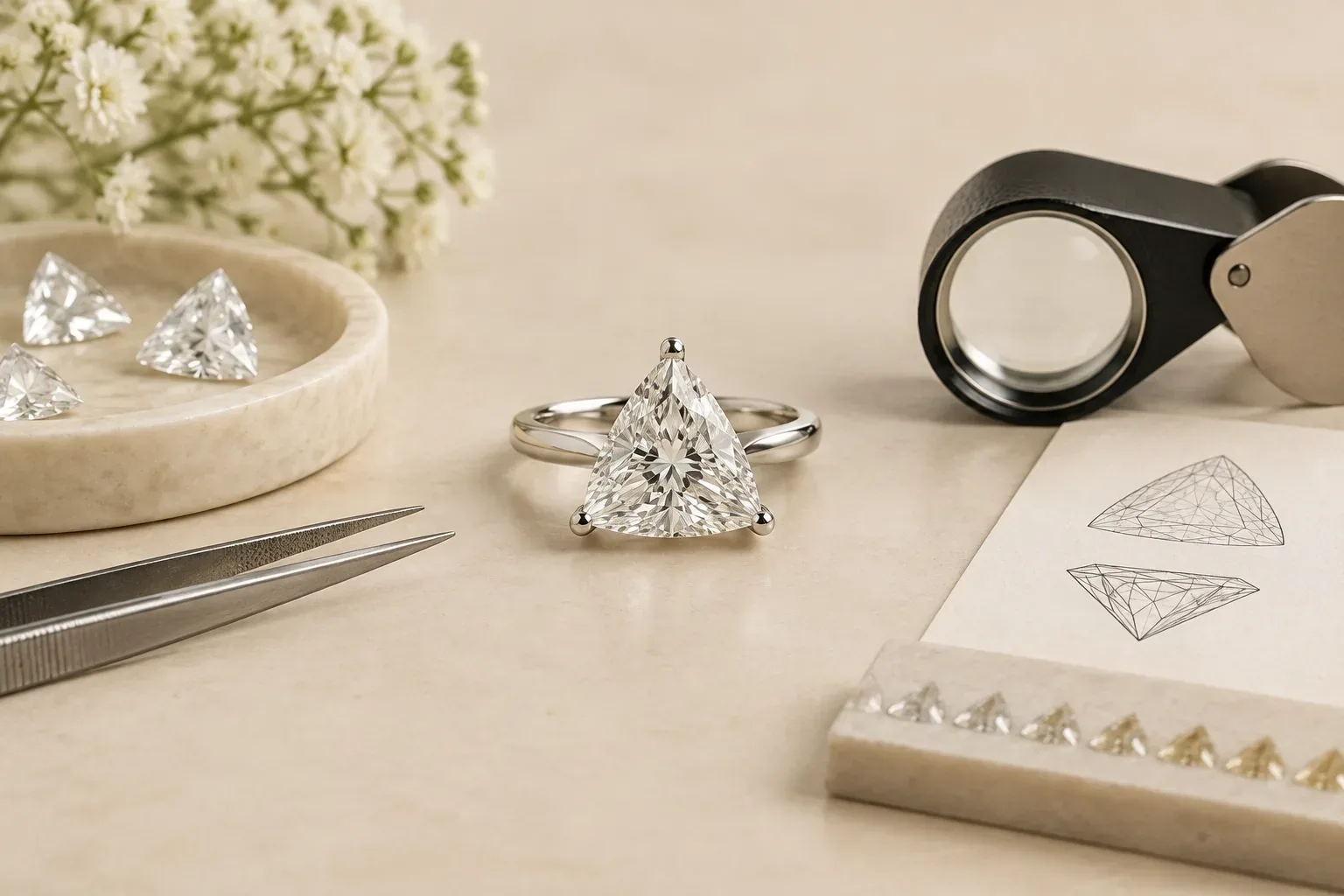
Meaning at a glance
A trillion cut engagement ring checklist should define the cut and your goals, evaluate the gemstone and setting for durability and style, require written disclosure on origin and treatments, confirm return/warranty/insurance options, plan for sizing and daily wear, and understand which attributes (treatments, origin, and grading) need a qualified jeweler or gemological laboratory to verify.
Quick answer
A practical trillion cut engagement ring checklist starts by defining whether you mean a triangular 'trillion' (sometimes spelled trilliant) faceted stone as a centre or accent, then moves through concrete decision points: gemstone type and treatments, hardness and daily durability, setting and prong protection, written disclosure and certification, return and warranty terms, insurance or appraisal, and routine care. Expect to trade off brilliance and size appearance against durability and cost; require written seller disclosures and lab reports for claims you can’t verify at home, and accept that confirming treatments, precise origin, and official grades requires a qualified jeweler or a gemological laboratory.
How we handle historical evidence
Specific, documentary history tying the trillion cut to an identifiable culture or ancient period is not present in the approved sources for this article. None of the supplied references document a discrete historical origin for the trillion cut or assign a traditional cultural meaning to that triangular faceting.
Because approved sources do document modern consumer behavior and industry expectations, this checklist concentrates on evidence-led decision criteria, contemporary uses, and the limits of consumer verification rather than asserting an unsupported historical lineage.
Documented meanings versus personal interpretations
Documented meanings: The approved sources used here discuss broad market trends, buyer preferences, and industry obligations (for example, consumer disclosure and gem-treatment issues) rather than symbolic or cultural meanings attached to particular cuts. The Federal Trade Commission emphasizes clear seller disclosure about natural, lab-created, treated, or imitation materials and written documentation for claims, and the Gemological Institute of America clarifies how treatments, detectability, and durability affect consumer questions about gemstones.
Personal or modern interpretations: Many wearers and makers attach personal significance to triangular forms—associations with balance, three-part symbolism, or modern minimalism—but these are contemporary, individual interpretations and not universal or historically documented by the sources cited. Treat such symbolic meanings as personal or cultural preferences rather than established fact.
How the trillion cut appears in modern jewelry
Contemporary jewelry makers use triangular-faced stones in multiple roles. Industry reporting on 2026 trends highlights demand for fluid forms, modern stacking, colored gemstones, craftsmanship, versatility and gender-neutral styling, which aligns with designers placing triangular stones as centrepieces, accent stones or in asymmetric, modern settings (Jewelers Mutual).
Market visibility data from 2026 also shows strong consumer demand for engagement rings among many other styles (Imaginaire Digital). That modern demand creates the context in which trillion-shaped stones are chosen—for visual impact, to complement other stones, or to suit modern, less-traditional aesthetics.
A practical trillion cut engagement ring checklist
Define the objective: Decide whether you want a trillion as a centre stone or as side stones; whether you prefer diamond, sapphire, or another coloured gemstone; and whether you prioritise sparkle, colour, or everyday durability. These choices determine the rest of the checklist.
Ask about the exact cut and measurements: Request length-to-width ratio, table percentage, depth percentage, and detailed photos from multiple angles. For a triangular stone, small changes in proportions strongly change face-up size and brilliance; photos and measurements help evaluate the look and balance with the chosen setting.
Confirm gemstone type and hardness: Know the Mohs or relevant durability considerations for your chosen gemstone because triangular points are exposed and can chip. Discuss prong protection or bezel options with the seller to mitigate risk for softer stones.
Demand written disclosure and documentation: Request written statements that specify whether the stone is natural, lab-created, treated, or an imitation. The Federal Trade Commission requires clear distinctions among these categories and written seller disclosures.
Request a laboratory report for diamonds and ask about lab reports for coloured stones: A full lab grading report (for a diamond) or a reputable laboratory assessment for a coloured gemstone provides authoritative verification of key attributes. The Gemological Institute of America explains that treatments and detectability affect what information consumers need.
Verify return, warranty and service: Confirm the return window, resizing policy, warranty coverage for manufacturing defects, and available routine services like prong-checks and cleaning. Jewelers Mutual’s guidance on consumer priorities includes craftsmanship and service as important selection factors.
Plan for insurance and appraisal: Obtain a formal written appraisal for insurance replacement value and discuss homeowner or jewelry insurance options. Jewelers Mutual emphasizes the modern consumer interest in durability and protectiveness as part of buying decisions.
Assess setting and security: For a trillion cut, check how many prongs are used, whether the points are wrapped or shielded, and whether accent stones might compromise structural integrity. Ask to see or request CAD renders or in-person inspection of similar-setting examples.
Consider finger ergonomics and ring profile: Because triangular stones can show different visual mass than round stones of the same carat weight, try on comparable rings or ask for computer renderings to confirm how the stone will sit and move with daily wear.
Confirm mounting metals and hypoallergenic needs: Ask about metals and platings used in the mounting, and request nickel-free or other hypoallergenic options if needed.
Budget and trade-offs: Clarify how changes to clarity, colour, carat and treatments affect price. Decide whether you prefer a higher-clarity smaller stone versus a larger stone with more visible inclusions, and consider how treatment disclosure affects long-term value and care.
What only a qualified jeweler or gemological laboratory can verify
Treatments and detectability: The Gemological Institute of America notes that treatments and their detectability affect durability and care. Only trained professionals with appropriate equipment or a laboratory can reliably detect many treatments or confirm their permanence and implications for wear.
Origin and formal grading: Claims about geographic origin, advanced grading details, or exact certification must come from recognized gemological laboratories. Consumers should not rely solely on in-store visual inspection to confirm these attributes.
Precise durability predictions: While sellers and retailers can explain general hardness and care recommendations, a qualified professional should evaluate a specific stone’s vulnerability to chipping at its points or other structural issues that affect long-term wearability.
Care, cleaning and long-term maintenance
Follow guidance on special care for treated stones: The Gemological Institute of America explains that certain treatments change a gemstone’s stability and cleaning requirements. Ask whether your trillion cut stone has undergone heat, fracture-filling, diffusion or other treatments and whether ultrasonic or steam cleaning is recommended.
Daily wear precautions: Because triangular points are prone to knocks, protect points with prongs or bezels, avoid wearing the ring during heavy manual work, and have prongs checked semiannually by a jeweler. Jewelers Mutual notes that consumers are placing higher value on craftsmanship and practical serviceability when choosing modern pieces.
Professional servicing: Schedule regular professional inspections for settings and prongs and obtain periodic cleaning from a trusted jeweler. Maintain written records of any appraisals and services to support insurance claims if needed.
Gifting and respectful selection guidance
Respect personal meaning and style: Rather than assuming the cut carries a universal symbolic meaning, prioritise the wearer’s style, daily activities and gemstone preferences. Contemporary trends show interest in versatile, gender-neutral and coloured-stone options, so a trillion cut can be an excellent modern choice if it matches the recipient’s tastes (Jewelers Mutual; Imaginaire Digital).
Practical gifting steps: If the proposal is a surprise, get a reliable ring size estimate, verify the store’s return and resizing policy in writing, and secure documentation about materials and treatments so the recipient can choose later to obtain lab verification or an alternate setting.
Buy with protection: Choose a seller that provides clear written disclosures, a realistic return policy, and options for post-sale service and insurance. The Federal Trade Commission’s consumer guidance highlights the importance of written disclosure about natural versus lab-created versus treated gemstones.
Final summary
A trillion cut engagement ring checklist should combine stylistic choices with hard verification steps: define the stone’s role and look, demand written disclosure and laboratory reports for claims you cannot test yourself, confirm setting security for the stone’s points, and plan for ongoing care and insurance. Use Jewelers Mutual’s and Imaginaire Digital’s market-context evidence to match style with modern consumer priorities, and rely on the Gemological Institute of America and the Federal Trade Commission for guidance about treatments, detectability and required seller disclosures.
Frequently asked questions
What exactly is a trillion cut and how is it used in engagement rings?
In contemporary jewelry, a trillion (or trilliant) cut is a triangular faceted stone used as a centre or accent. Its faceting emphasises brilliance and can create a bold, modern look. Modern industry reporting highlights that such shapes are chosen for versatility and contemporary styling, but specific historical meanings are not documented in the approved sources.
Do I need a laboratory report for a trillion cut diamond or gemstone?
For diamonds, a lab grading report is strongly recommended. For coloured gemstones, a reputable laboratory assessment helps confirm treatments and important attributes. The Gemological Institute of America explains that treatments and detectability affect consumer care and value, and the Federal Trade Commission requires clear disclosure about treated, lab-created or imitation materials.
How can I protect the points of a trillion cut stone?
Choose a secure setting with protective prongs or bezels that wrap the triangular points, avoid wearing the ring during heavy manual tasks, and have a jeweler inspect prongs regularly. Because points are vulnerable to chipping, the setting and regular maintenance are essential for longevity.
What should I ask the seller before buying?
Ask for written disclosure stating whether the stone is natural, lab-grown, treated or an imitation; request measurements and photos; ask about return, resizing and warranty policies; request lab reports when available; and confirm service and insurance options. The Federal Trade Commission emphasises the need for clear, written seller disclosures.
Can I verify treatments myself?
No. Many treatments require specialized equipment and expertise to detect reliably. The Gemological Institute of America notes that detectability and the nature of treatments affect durability and care, and only a qualified jeweler or gemological laboratory can confirm such treatments with certainty.
How should I clean a trillion cut engagement ring?
Follow the seller’s and laboratory’s guidance about cleaning, especially if the stone has known treatments. Some treatments make ultrasonic or steam cleaning unsuitable. When in doubt, use gentle soap, warm water and a soft brush and seek professional cleaning for periodic maintenance.
Sources and further reading
- Imaginaire Digital — Imaginaire Digital
- Jewelers Mutual — Jewelers Mutual
- Gemological Institute of America — Gemological Institute of America
- Federal Trade Commission — Federal Trade Commission