Meaning at a glance
Pairing a trillion cut stone with a wedding band is primarily a matter of shape fit, setting style, metal color, and lifestyle trade-offs; choose contour or notched bands for a seamless fit, prioritize secure settings and appropriate metals for durability, follow seller disclosures about treatments and origin, and consult a qualified jeweler or gemological lab for certification or treatment verification.
What 'trillion cut' refers to and why shoppers ask about pairing
In jewelry trade usage the term 'trillion' commonly describes triangular-shaped stones cut to maximize brilliance. Shoppers searching for 'trillion cut wedding band pairing' are usually asking three practical questions at once: what band shape will sit cleanly against a triangular stone, which metal and finish will complement the cut, and what compromises are required for durability and daily wear.
This article addresses those practical decisions, trade-offs and verification limits that a shopper can reasonably resolve without specialized lab testing, and points to the situations where a qualified jeweler or gemological laboratory is necessary.
Documented historical evidence and cultural notes
There is limited published, long-form historical scholarship specifically tracing a symbolic history for the trillion cut in distinct cultures or historical periods. Contemporary industry reporting and trend analysis emphasize modern stylistic preferences rather than long-standing cultural meanings. For example, Jewelers Mutual identifies 2026 demand trends that center on modern stacking, fluid forms, and gender-neutral styling, which explains much of the trillion cut’s contemporary popularity as a modern, graphic shape rather than a historically coded symbol.
Market-level research from Imaginaire Digital shows strong interest in modern engagement forms and specific shapes in current UK search data, reinforcing that present-day demand for unconventional cuts is trend-driven. These sources document modern consumer behavior and styling trends rather than discrete historical or ceremonial meanings attached to the triangular cut across older cultures.
Separating documented history from modern personal meaning
Documented history: industry and trend sources cited above describe the trillion cut as a modern, stylistic choice within the broader market for contemporary engagement and stackable rings. Those sources do not support a claim that the trillion cut held consistent symbolic meanings in named historical cultures or rites.
Modern personal interpretations: many wearers assign private significance to a triangular stone, such as representing three life elements, a trinity, or a relationship milestone. Those personal or symbolic choices are valid and meaningful at an individual level, but they are not documented as universal or historically consistent meanings by the industry sources cited here.
How the trillion motif appears in jewelry
The triangular or trillion cut appears in engagement rings as a center stone, side stone, or accent. Designers use the shape’s pointed corners and broad table to create angular, contemporary silhouettes, to add contrast beside round or oval centers, or to form repeating geometric motifs in multi-stone rings.
In settings, trillions may be set with three prongs at each corner, bezel-wrapped for protection, or channel-set when used as accent stones in band designs. Choosing between a raised prong setting and a low bezel will influence how closely a wedding band can sit against the stone and how susceptible the corners are to knocks.
Shape pairing: managing gaps and profiles
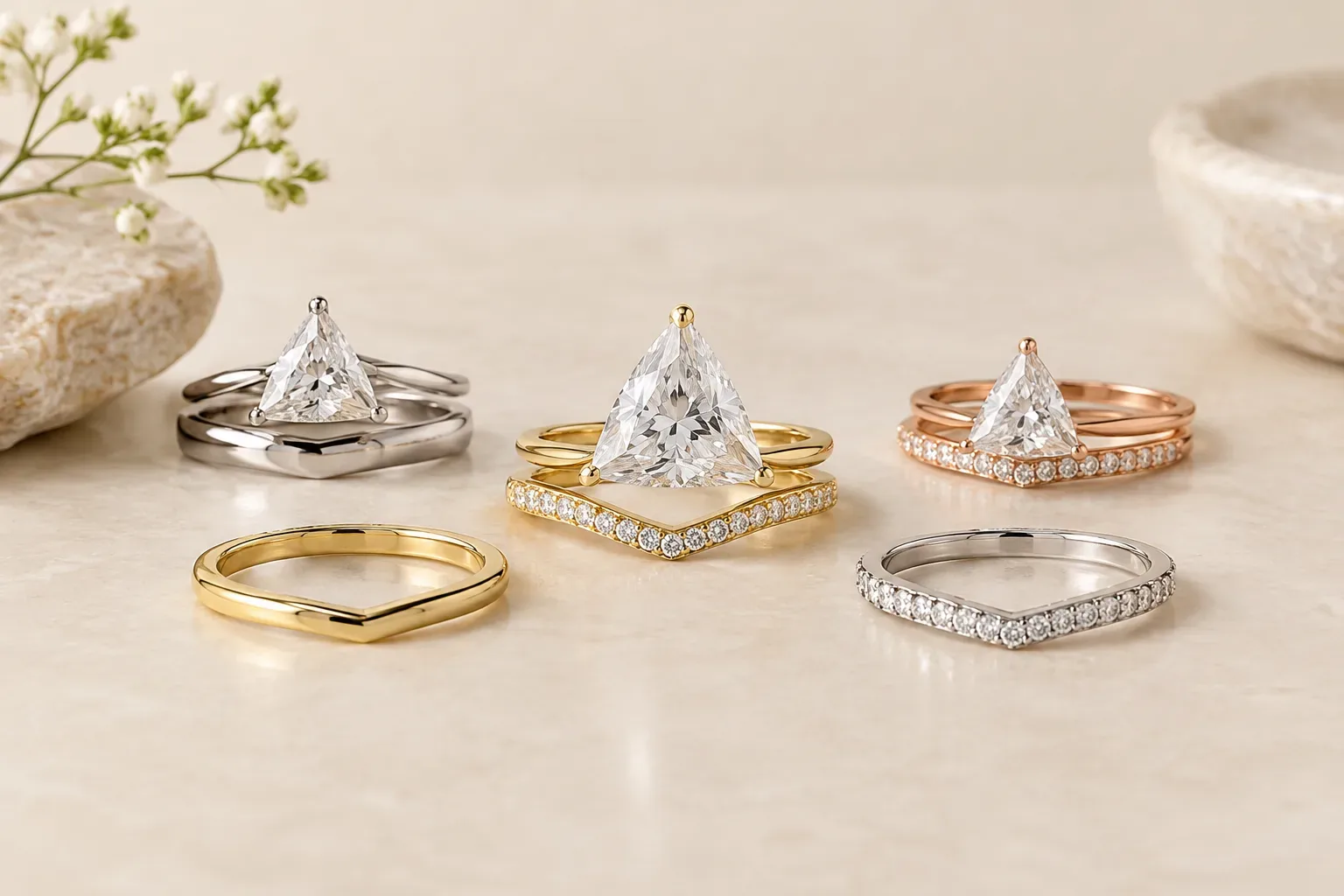
For the tightest visual join, choose a contoured or V-notched wedding band made to cradle the trillion’s points; this minimizes visible gaps and distributes stress around the stone more evenly. A custom-contoured band can follow the engagement ring’s profile exactly, producing the cleanest look.
If you prefer a small visible space, a slightly wider plain or domed band provides contrast and is easier to size or replace later. Consider ring guards or floating inserts as reversible options if you want to trial a contoured look without committing to a permanent matching band.
Be mindful of the engagement ring’s setting height. A high-set trillion will create a larger gap with flat bands unless the wedding band is specially shaped. Low-profile or bezel settings reduce the overall stack height and make a closer fit easier with simpler bands.
Metal choices and trade-offs
Metal color affects appearance and perceived contrast. Yellow gold warms and emphasizes the stone’s color, white gold or platinum offers a cooler, more continuous look with white diamonds, and rose gold gives a trendy, softer contrast. Jewelry market reporting highlights the current popularity of mixed and gender-neutral metal styling, which supports thoughtful mixing if that suits the wearer’s aesthetic.
Durability and maintenance are practical considerations. Platinum is very durable and resists wear while holding prongs well, but it is heavier and may cost more. Gold alloys vary in hardness by karat and color; higher-karat gold is softer and may require more maintenance where the band contacts the stone’s points. Choose metals based on daily wear needs and the hardness of the center or accent stone.
Gemstone treatments, verification, and what you can check
Treatments and origin affect value and care. The Gemological Institute of America emphasizes that treatments, disclosure, detectability and durability are important consumer concerns. The Federal Trade Commission requires clear distinctions among natural, lab-created, treated, cultured, and imitation materials and calls for written seller disclosures.
What a shopper can verify without a lab: you can and should request written disclosures from the seller about whether a stone is natural, lab-grown, or treated. Ask for any available gemological reports and check that the report is from a recognized laboratory. For questions about treatment detectability or origin that are material to price, consult a qualified jeweler or seek testing from an accredited gemological laboratory.
Practical selection and gifting guidance
Choose ring widths and profiles that reflect comfort and proportion. A narrow, contoured wedding band tends to sit better around a triangular stone without overpowering it, but wider bands can balance a large center stone visually. Try different combinations on the hand and consider the wearer’s daily activities when deciding how low-profile and secure the setting should be.
When gifting, ask the seller about return and resizing policies, request written disclosures about the stone, and consider a temporary option such as a ring guard if you are unsure about a permanent custom match. Jewelry trend reporting suggests many shoppers now value versatility and stackability, so prioritize options that adapt to changing tastes.
Care and maintenance for trillion-set rings
Protect the corners: the pointed corners of a trillion are potential snag or impact points. Consider bezel or protective prong styles if the wearer is active. Inspect prongs regularly and have a jeweler retighten them year-to-year depending on wear.
Cleaning and storage: follow manufacturer and GIA guidance for safe cleaning methods suited to the gem material and setting. Avoid harsh chemicals, ultrasonic cleaners for treated stones unless confirmed safe, and store rings separately to prevent scratches.
Limits and when to consult a professional
A shopper can evaluate visual fit, metal color, written disclosures and basic wearability in person or online. For definitive answers about authenticity, origin, or undetectable treatments, rely on an accredited gemological laboratory. The GIA and FTC guidance recommend written disclosures and formal reports when origin or treatment materially affects value, and a qualified jeweler can advise on structural safety and custom contouring.
If you need certification for insurance, estate purposes, or resale, obtain a formal report from an established laboratory rather than relying solely on a seller’s label or in-store appraisal.
Closing: decision criteria at a glance
Prioritize the visual fit and daily-wear durability first, then refine metal color and stylistic contrast. Use contour or V-notched bands for the closest join, choose protective settings if the wearer is active, and insist on written disclosures about treatments or origin. When doubt remains about value or treatment, consult a qualified jeweler or accredited gemological laboratory.
Frequently asked questions
Can a plain round wedding band sit flush with a trillion cut engagement ring?
A plain round band rarely sits completely flush against a triangular stone because of the stone’s points, so expect a small gap unless you choose a contoured or V-notched band made to match the engagement ring’s profile.
Is a trillion cut more fragile than a round cut?
Points on triangular cuts are more vulnerable to impact than a round outline, so protective settings or bezel styles and regular prong inspections are advisable to reduce the risk of damage.
Should I get a custom-contoured band or buy an off-the-shelf ring guard?
Custom-contoured bands give the cleanest, permanent fit and are ideal for long-term matching, while off-the-shelf ring guards are cost-effective, reversible options to trial a closer fit before committing to customization.
How can I verify whether a trillion stone is natural, treated, or lab-grown?
Request written disclosures and any available laboratory reports from the seller. For definitive verification of treatments or origin, consult an accredited gemological laboratory; the FTC and GIA both recommend written disclosure and lab testing when material to value.
Which metal is best for everyday wear with a trillion stone?
Platinum and harder gold alloys will resist wear and retain prong security better with everyday use, but choose a metal that balances durability with the wearer’s comfort and aesthetic preferences.
Sources and further reading
- Imaginaire Digital — Imaginaire Digital
- Jewelers Mutual — Jewelers Mutual
- Gemological Institute of America — Gemological Institute of America
- Federal Trade Commission — Federal Trade Commission