Meaning at a glance
Tiger’s eye is a chatoyant variety of quartz; its silky, moving band of light arises from aligned fibrous structures. Scientific sources document its mineral identity and optical effect, while meanings of courage and protection are modern symbolic interpretations rather than universal historic facts.
What tiger’s eye actually is (science and optical effect)
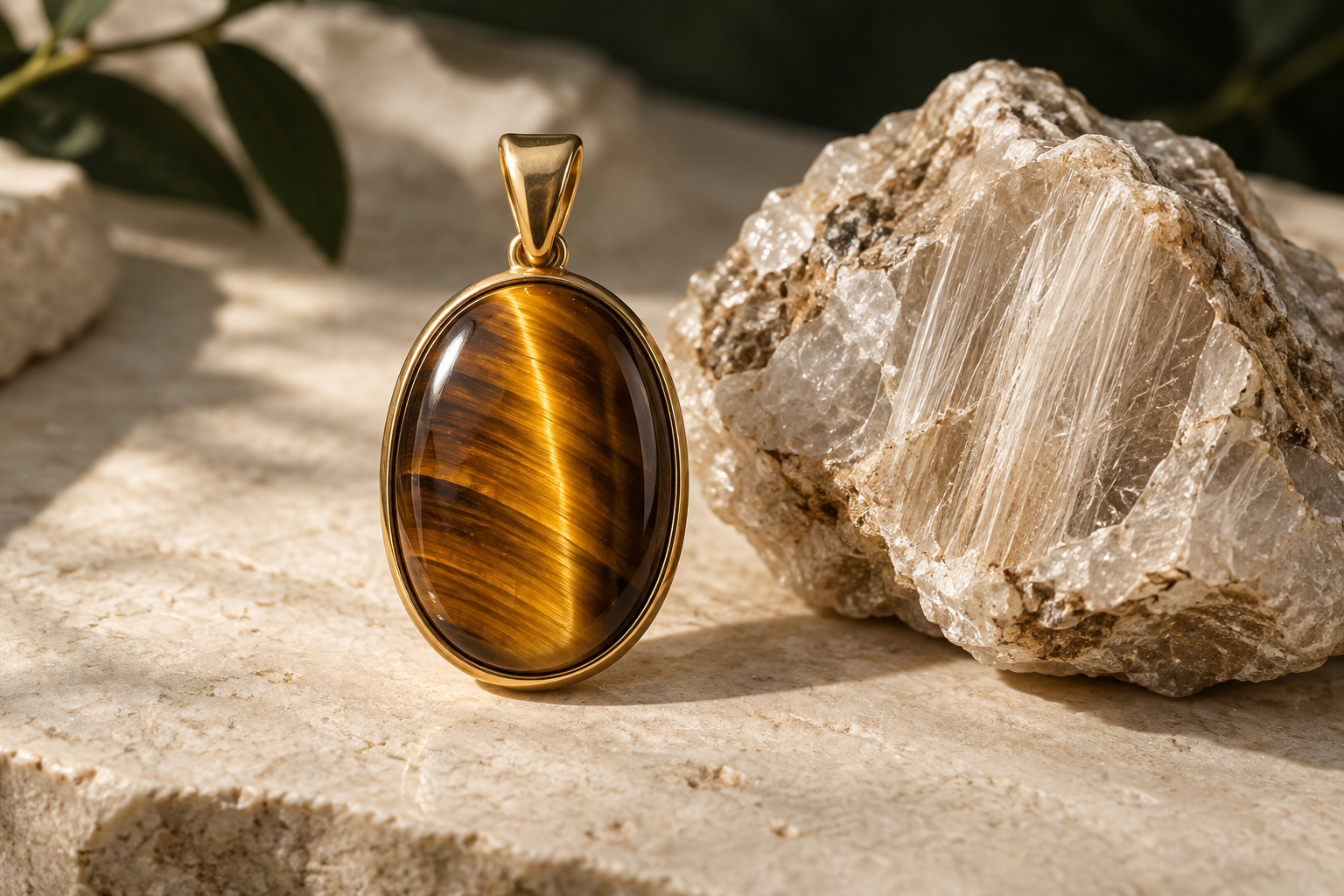
Tiger’s eye is a variety of quartz that exhibits chatoyancy, an optical phenomenon commonly described as a band of light that appears to glide across the surface as the stone or the light source moves. The Gemological Institute of America (GIA) explains chatoyancy as an optical effect produced by parallel fibrous or needle-like inclusions or structures within a gemstone that reflect light in a concentrated band. In tiger’s eye the effect comes from iron-oxide–altered crocidolite fibers that have been replaced by silica while preserving the original fibrous alignment, producing the silky, luminous line characteristic of the material.
The Smithsonian National Museum of Natural History includes tiger’s eye within broader surveys of quartz varieties, noting that a wide range of textures, colors, and inclusion patterns can appear across quartz minerals. Together, these professional sources describe tiger’s eye primarily as a mineralogical and optical phenomenon rather than as a bearer of fixed symbolic properties.
Historical evidence and cultural periods
Authoritative mineralogical and natural history sources consulted for this article focus on the stone’s physical characteristics and classification rather than on detailed ancient symbolic records. The Smithsonian National Museum of Natural History catalogs quartz varieties and provides context for how different forms of quartz have been identified and collected, while the GIA describes the optical phenomena such as chatoyancy. These professional bodies document what the material is and how its appearance arises, but they do not provide extensive primary-source evidence for specific symbolic meanings assigned by particular ancient cultures.
Because the approved sources emphasize mineralogy, any precise historical claims about which cultures used tiger’s eye and for what symbolic purpose would require additional, explicitly archaeological or ethnographic sources. In short, the mineralogical record is clear about composition and optical effects, while authoritative public museum and gemological summaries consulted here do not themselves establish a documented, culture-specific symbolic history.
Documented historical meanings versus modern interpretations
Documented historical meanings for tiger’s eye are not comprehensively detailed in the mineralogical and museum sources used for this article. The GIA and Smithsonian discussions are centered on identification, varieties, and optical phenomena rather than on ancient belief systems that attached specific symbolic functions to the stone.
By contrast, modern symbolic interpretations—especially in popular and metaphysical contexts—often read tiger’s eye as a talisman of courage, focus, or protection. Those readings are contemporary cultural attributions that developed over the 19th to 21st centuries in a range of folkloric, commercial, and New Age contexts. They reflect evolving human practices of assigning meaning to visually striking materials, not a single, universally documented ancient tradition. When presenting or discussing symbolic meanings, it is important to treat them as later cultural layers or personal choices rather than as universally recorded historical facts.
How tiger’s eye appears in jewelry: cuts, settings, and motifs
In jewelry, tiger’s eye is prized for its chatoyant band, which is typically displayed by cutting the stone en cabochon (a smooth, rounded, non-faceted shape) so that the line of light can move across the surface. Cabochons are the most common cut for tiger’s eye bracelets, rings, pendants, and beads. Faceting tends to diminish the chatoyancy, so jewelers choose shapes and orientations that maximize the silky effect.
Color and patterning also guide design choices. Traditional golden-brown tiger’s eye is often polished to a high sheen and set in warm metals such as yellow gold or bronze to echo its color. Blue chatoyant varieties (sometimes called hawk’s eye) and cat’s-eye forms are used similarly but may be set in white metals for contrast. Designers frequently use tiger’s eye as a focal cabochon in statement rings and pendants, as a string of polished beads for necklaces or bracelets, and sometimes as inlays or accent stones where the banding provides visual movement within a piece.
Practical selection guidance
When choosing tiger’s eye jewelry, focus first on the quality of the chatoyancy. A well-cut stone will show a sharp, continuous band of light that moves smoothly across the surface as you tilt the piece. Inspect cabochons in natural light when possible and observe how the band behaves at different angles. Stones with a single clear eye or band tend to be more visually striking and are often priced higher.
Color consistency and surface condition also matter. Look for deep, even color without cloudy or pitted surfaces, and check for polish quality. Because tiger’s eye is a form of quartz, it is relatively durable—Mohs hardness around 7—but it can still be scratched by harder materials and can chip on thin edges, so examine settings for protective bezels or secure prongs if the stone will be worn daily. For beads and inlays, check that drilling is clean and that the stringing or setting complements the stone’s movement rather than obscuring it.
Respectful gifting guidance
If you plan to gift tiger’s eye jewelry and intend symbolic meaning, be explicit about the distinction between historical documentation and personal sentiment. Say, for example, that you find the stone visually compelling and that you personally associate it with qualities like resilience or steadiness, rather than presenting those associations as ancient or universal facts.
Consider the recipient’s style and lifestyle. A bold cabochon ring may delight someone who prefers statement pieces, while a beaded bracelet or small pendant suits a more understated wearer. If the recipient values material provenance, ask the seller about the stone’s origin and any treatments it has undergone. Finally, include simple care guidance with the gift so the recipient knows how to maintain the stone’s polish and chatoyancy.
Care and maintenance
Tiger’s eye is reasonably hard, but it should still be treated with common-sense care. Clean it with mild soap, warm water, and a soft cloth or brush, then dry thoroughly to restore surface luster. Avoid harsh chemicals, ultrasonic cleaners, and prolonged exposure to extreme heat, as these can damage the polish or, in rare cases, affect the appearance of the chatoyant band.
Store tiger’s eye pieces separately from harder gemstones to avoid scratches. If your jewelry setting includes softer metals or delicate mountings, remove the piece for activities that could knock or strike the stone. Periodic professional inspection of prongs and settings will help prevent accidental loss or damage.
Final thoughts
Tiger’s eye remains popular because of a simple visual fact: its chatoyant band creates a sense of motion and depth that other materials do not. Mineralogical authorities like the Gemological Institute of America explain the optical phenomenon, and institutions such as the Smithsonian place tiger’s eye within the rich family of quartz varieties. When discussing meaning, keep mineralogy and cultural interpretation clearly separate: the stone’s physical properties are documented science, while associations such as courage, protection, or clarity are culturally and personally assigned, not universal historical facts.
Choose tiger’s eye jewelry for the look you love, describe any symbolic intent as your own or contemporary tradition, and care for it as you would other polished quartz to preserve its distinctive shimmering band.
Frequently asked questions
What causes the moving band of light in tiger’s eye?
The moving band, or chatoyancy, is produced by aligned fibrous structures or inclusions within the stone that reflect light as a concentrated band. Gemological authorities describe it as an optical effect arising from parallel internal features rather than from surface treatment.
Is tiger’s eye the same as cat’s eye or hawk’s eye?
Tiger’s eye is one variety of chatoyant quartz. Cat’s eye typically refers to chatoyancy in chrysoberyl, a different mineral, while hawk’s eye is a blue to bluish-gray chatoyant quartz closely related to tiger’s eye in formation and appearance.
Are historical claims that tiger’s eye was used as a protective amulet documented?
The mineralogical and museum sources used here document the stone’s material properties and varieties but do not comprehensively catalog culture-specific symbolic attributions. Modern claims of protective or talismanic use are largely later cultural interpretations rather than universally documented ancient facts.
How should I clean and care for tiger’s eye jewelry?
Clean tiger’s eye with warm water, mild soap, and a soft cloth or brush, then dry it. Avoid harsh chemicals and ultrasonic cleaners, store pieces separately to prevent scratches, and protect settings from hard knocks.
What should I check when buying tiger’s eye jewelry?
Inspect the chatoyancy in natural light to see how the band moves, evaluate color consistency and surface polish, check the security and type of setting, and ask the seller about any treatments and the stone’s provenance if that matters to you.
Sources and further reading
- Guide to Phenomenal Gems — Gemological Institute of America
- All Sorts of Quartz — Smithsonian National Museum of Natural History