Meaning at a glance
Hematite jewelry meaning centers on the stone's identity as an iron oxide with metallic to earthy appearances and a red streak; claims that it 'grounds' are symbolic rather than scientific, and buyers should seek treatment disclosure and pick finishes and settings that suit style and wear.
Short answer
Hematite is an iron oxide mineral that ranges from metallic gray-silver to earthy brown-black in appearance and characteristically produces a red to reddish-brown streak when rubbed on unglazed porcelain. Claims that hematite "grounds" or affects mood or health are modern symbolic interpretations rather than established scientific facts; present grounding and related ideas as symbolism, not science.
What the record says: composition and museum documentation
Museum and mineral records focus on what hematite is physically. The Smithsonian National Museum of Natural History identifies hematite as an iron oxide and documents its metallic and earthy appearances and its diagnostic red streak. Those kinds of mineralogical descriptions are the strongest, verifiable historical evidence available in the museum and mineralogical record.
Historical evidence and cultural attributions
In the published museum and mineral collection literature, including materials from the Smithsonian National Museum of Natural History, the emphasis is on hematite's physical properties and its occurrence in geological settings and collections rather than a single, universal symbolic meaning. Museum catalogs and mineral descriptions document specimens, their localities, and their physical character; they do not provide a comprehensive catalog of cultural meanings across every society that used iron oxides.
Documented historical meanings versus modern interpretations
When scholars or curators attribute cultural meaning to hematite or other minerals, they typically do so by connecting archaeological context, written documents, iconography, and ethnographic records to objects in museums. The Smithsonian's documentation shows that hematite is identifiable by its appearance, but any specific symbolic meaning for a particular culture should be traced to that culture's archaeological or written record rather than to the mineral description itself.
In contrast, contemporary jewelry and wellness markets frequently describe hematite as "grounding," "stabilizing," or associated with strength and protection. These are modern symbolic uses that evolved in recent decades and are expressed by people today as personal or cultural symbolism. Present these uses as contemporary meanings and personal beliefs, not as historical facts or scientific effects.
How hematite appears in jewelry
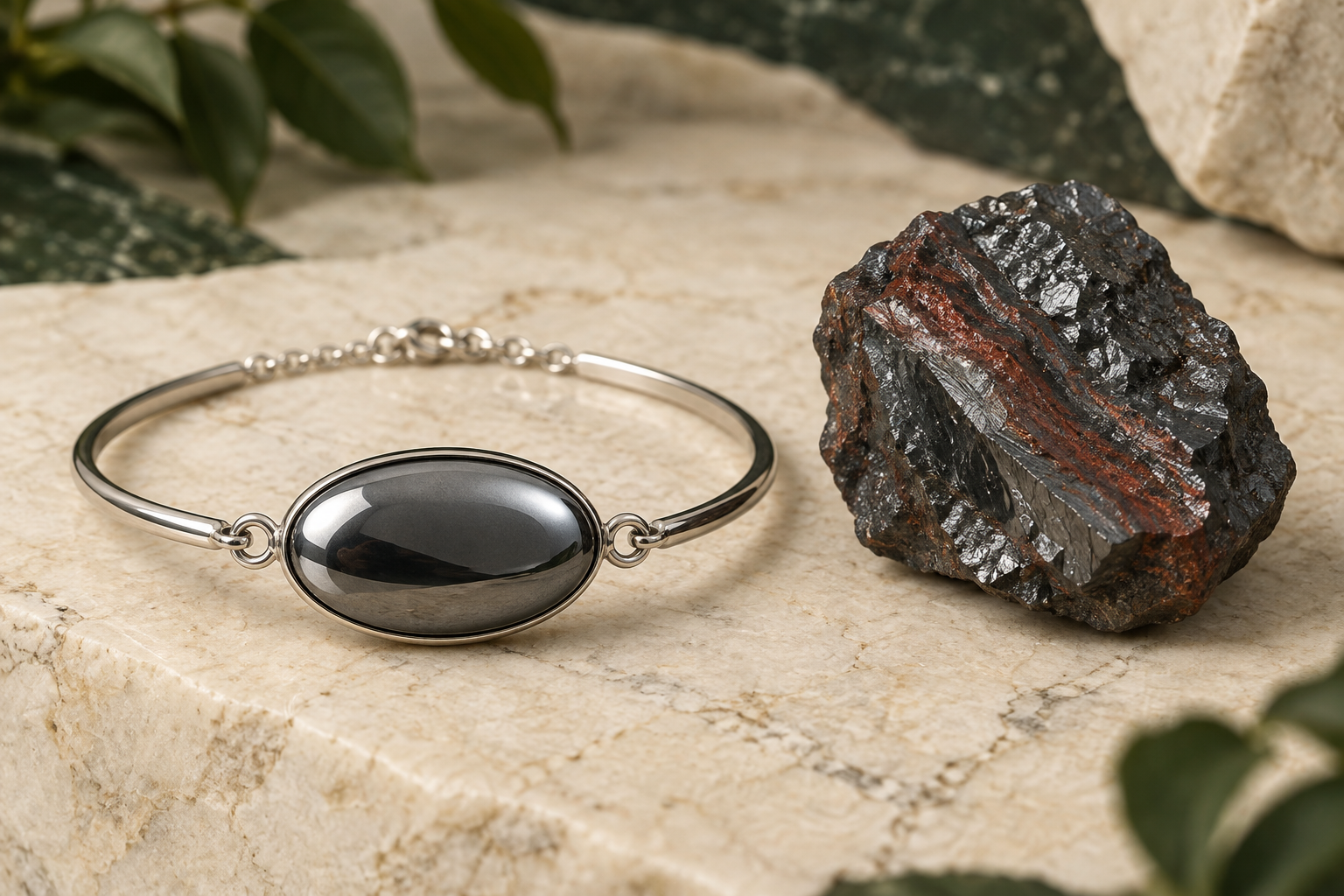
Hematite's metallic luster and dark tone make it visually striking in jewelry. It commonly appears as polished beads, smooth cabochons, inlays, and small carved elements where its mirror-like surface or muted sheen complements metalwork. Finishes range from high polish that reads like metal to a more subdued, matte surface that shows the stone's earthy aspect.
Because hematite is opaque and reflective when polished, designers often use it where a strong tonal contrast is desired, for example set next to brighter metal or lighter gemstones. Hematite may also be cut and shaped into worry stones, pendants, bracelet beads, cufflinks, and other pieces where its dense, solid appearance is part of the aesthetic. When shopping, expect to see both natural hematite and items finished or assembled in ways that alter appearance, so be sure to ask about how the piece was made.
Treatments, disclosure, and buying guidance
The Gemological Institute of America emphasizes transparency about gem treatments and encourages buyers to request disclosure. Apply that same standard to hematite jewelry: ask the seller whether the piece is natural hematite, whether the surface has been coated or plated, and whether any composite techniques were used to stabilize or enhance appearance. Sellers should disclose treatments, and reputable vendors will answer questions about origin and treatment.
When you are comparing pieces, consider finish, weight, and how the stone is set. Hematite has a dense, substantial feel in many presentations, so weight can be a cue to authenticity. Also ask about fastening and construction details if the piece will be worn daily, since settings and stringing choices affect longevity.
Selection and respectful gifting guidance
Choose a hematite piece that matches the recipient's style and practical needs. For someone who favors minimalist, modern looks, a high-polish hematite cabochon or bead necklace may be appropriate; for someone who prefers organic textures, a matte or carved piece will feel more natural. Consider how the recipient wears jewelry: if they favor rings or bracelets that receive frequent knocks, look for secure settings and sturdy construction.
Be respectful when gifting hematite with symbolic intent. If you plan to give hematite as a "grounding" or "protective" gift, phrase your message as a sentiment rather than a medical or scientific claim. For example, say that you hope the piece brings them a sense of calm or strength rather than asserting measurable physiological effects. When cultural meanings are part of the gift, acknowledge their specific cultural origin rather than suggesting universality.
Care and maintenance
Care for hematite jewelry with practical, conservative steps to maintain appearance. Wipe polished surfaces with a soft, dry or slightly damp cloth to remove oils and fingerprints. Avoid harsh chemical cleaners that could affect coatings or metal settings and take pieces off for heavy work that could scratch or chip the stone.
Because polishing and surface treatments can affect how a piece looks, ask the seller about any special care instructions tied to the finish or any coatings. If a piece is strung as a bracelet or necklace, periodically check the stringing or clasps and have a jeweler repair or restring as needed to prevent loss.
Concluding note
Hematite jewelry meaning combines a clear mineral identity with a wide range of symbolic uses today. Museum records such as those at the Smithsonian document hematite's composition and appearance while professional gem organizations like the Gemological Institute of America stress disclosure and consumer awareness when purchasing treated or modified gems. Keep historical documentation and modern symbolism distinct when you discuss meaning, and choose, gift, and care for hematite pieces with attention to finish, construction, and transparent seller information.
Frequently asked questions
What is hematite exactly?
Hematite is an iron oxide mineral noted for a metallic to earthy appearance and a characteristic red to reddish-brown streak when rubbed on unglazed porcelain, as described by the Smithsonian National Museum of Natural History.
How can I tell if a piece is real hematite?
One practical indicator is the red streak that hematite leaves on unglazed porcelain; authentic specimens and many natural pieces show that reddish streak. Also check finish and weight and ask the seller about treatments and whether the piece is natural or composite.
Are claims that hematite "grounds" you scientific?
No. Claims that hematite has grounding, healing, or medical effects are modern symbolic interpretations and personal beliefs, not scientific facts. Present such claims as symbolic meaning rather than evidence-based effects.
Should I ask the seller about treatments?
Yes. The Gemological Institute of America recommends requesting disclosure for any gem treatment. Ask whether hematite has surface coatings, plating, or composite construction and whether the seller can document treatment and construction details.
How should I care for hematite jewelry?
Clean hematite with a soft, dry or slightly damp cloth and avoid harsh chemicals and abrasive cleaners. Remove hematite jewelry for heavy manual work and check settings and stringing periodically for wear.
Is hematite appropriate as a symbolic gift?
Hematite can be a meaningful gift when framed as a personal sentiment. If you intend to gift its symbolic qualities, describe your intention as a wish or metaphor—for example, offering it as a token of steadiness—rather than asserting medical or universal effects.
Sources and further reading
- Hematite — Smithsonian National Museum of Natural History
- Gem Treatment — Gemological Institute of America