Meaning at a glance
Carnelian is an orange-to-red chalcedony historically used in beads, seals, and jewelry; museums document those uses while modern wearers often interpret the stone as symbolizing confidence and vitality.
Quick answer
Carnelian is orange-to-red chalcedony with documented use in beads, seals, and jewelry; confidence and vitality are cultural interpretations.
Historical evidence: what museums document
The most direct historical evidence for carnelian’s use in personal adornment and objects of utility comes from museum collections and archaeological catalogs. The Metropolitan Museum of Art’s online collection includes a catalog entry for a carnelian necklace and a separate entry for a carnelian seal stone, demonstrating that carved and drilled carnelian pieces were made into wearable items and functional seals. The museum’s documentation shows object-level evidence rather than general claims, which lets readers see how individual societies shaped the material’s use (The Metropolitan Museum of Art).
Beyond those individual catalog entries, scientific overviews of gems and minerals place carnelian within the broader family of chalcedony, a cryptocrystalline form of quartz that has been worked by humans for millennia. The Smithsonian National Museum of Natural History’s educational material on gems and minerals provides context on why chalcedony varieties such as carnelian were practical for beads and small carved objects: the material can take a good polish, is translucent to opaque, and was widely available in many regions (Smithsonian National Museum of Natural History).
To be precise: the Metropolitan Museum of Art entries document specific objects—a necklace cataloged as carnelian and a carved seal stone cataloged as carnelian—so the historical record at that institution confirms craft and use in those object types rather than a single universal meaning. For exact provenance, date, and cultural attribution of an individual object, consult the museum’s catalog entry for that object, which records the period or culture assigned by curators and the evidence on which that attribution rests (The Metropolitan Museum of Art).
Documented historical meanings versus modern interpretations
Documented historical meanings are what contemporary records, inscriptions, or close museum documentation actually show people intended in the past. The museum catalog entries cited above provide strong evidence that carnelian was valued for beads, necklaces, and carved seal stones, indicating practical and decorative uses. A seal stone, for example, produces an impression and therefore had administrative or personal-signature functions; the fact that carnelian was used for seals is a functional, object-level fact recorded in museum collections (The Metropolitan Museum of Art).
Modern interpretations often layer symbolic qualities onto the stone. In contemporary jewelry writing and popular culture, carnelian is frequently associated with qualities such as confidence, courage, vitality, and motivation. These attributions are contemporary interpretive frameworks applied to the stone and are not single, unbroken historical meanings preserved across time. Such symbolic readings are valid as personal or cultural modern meanings but should be distinguished from the object-level historical record documented in museum collections.
In short, museums document the material use of carnelian in objects and tools; modern symbolic language—calling carnelian a stone of confidence or vitality—is a present-day interpretation and not a universal historical fact.
How carnelian appears in jewelry and motifs
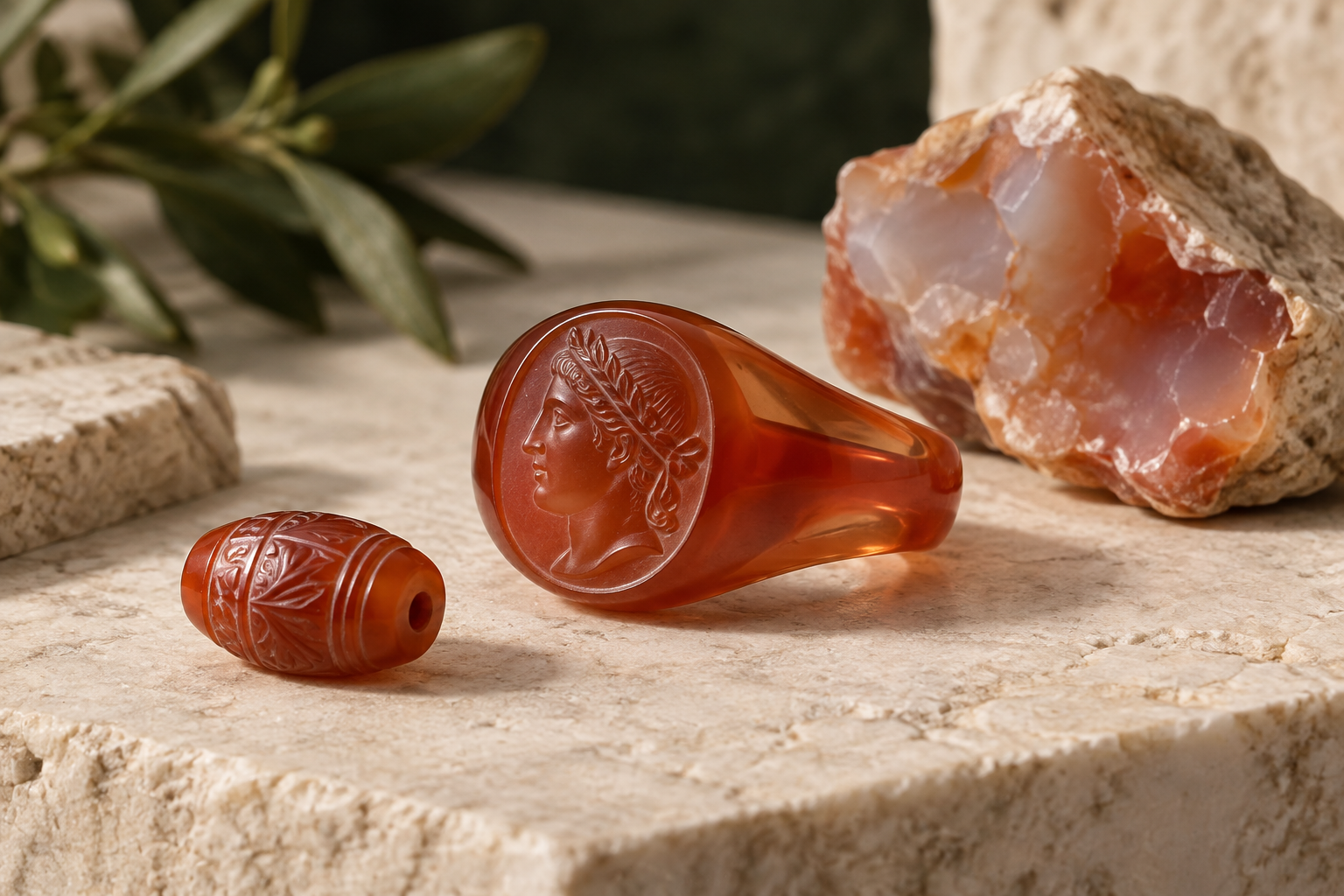
Carnelian appears in jewelry in several consistent ways: as drilled beads strung into necklaces or bracelets, as cabochons set into mounts, and as small carved elements such as intaglios and seal stones that could be worn as pendants or rings. The Metropolitan Museum of Art’s catalog entry for a carnelian necklace illustrates the bead tradition, while the museum’s carnelian seal stone entry demonstrates the carved, signet-like use of the material (The Metropolitan Museum of Art).
Because carnelian takes a good polish and displays a warm orange-to-red palette, it was often chosen for items intended to show color and surface sheen at close viewing distance. In modern jewelry the stone is used both in straightforward settings that celebrate its color and translucency and in motifs that reference historical beads and seals, such as revival-style intaglio pendants or neo-classical signet rings. Designers also combine carnelian with metals such as gold and silver, or with contrasting gems, to highlight its warm tones.
Motifs associated with carnelian depend on cultural context and designer intent. Historically functional motifs like seals and beads became decorative motifs in later periods. In contemporary work, carnelian may be cut into rounds, ovals, or freeform cabochons, and it may be carved with motifs or set as polished stones; the physical qualities of chalcedony make those treatments common choices (Smithsonian National Museum of Natural History).
Practical and respectful guidance for selecting and gifting carnelian
When selecting carnelian, begin by considering color and translucency: carnelian ranges from pale orange to deep reddish-orange, and most buyers choose the color that appeals to them rather than a single ‘best’ tone. Consider whether you prefer uniform color or visible banding and inclusions; both natural and heat-treated or dyed materials exist in the market, so ask the seller about treatments and provenance if those factors matter to you.
Respect the recipient’s personal and cultural background when gifting. If you are giving a piece as a symbol—such as a token to encourage confidence or vitality—be explicit about your intention so the recipient can accept the symbolism freely. Avoid assuming that a stone’s modern symbolic meaning will carry the same weight for everyone; some people prefer a simple aesthetic gift, others appreciate the modern symbolic language, and some may have cultural or spiritual frameworks that differ.
Verify the seller’s return policy and, for higher-value purchases, ask for any available documentation about treatments or origin. Buy from reputable dealers, museums, or established jewelers who will provide clear information. For heirloom or historically styled pieces, consider how the piece will be worn and cared for and whether the style suits the recipient’s usual jewelry wardrobe.
Care and maintenance
Carnelian is a durable material among the opaque to translucent varieties of chalcedony, and with everyday sensible care it can last for generations. Avoid hard knocks and severe impacts that may chip or fracture the stone or its mounting. Protect carnelian from prolonged exposure to strong acids, bleaching agents, and harsh household chemicals, which can damage some finishes or any applied dyes.
For routine cleaning, use a soft cloth and mild soap with warm water; rinse thoroughly and dry before storing. Avoid aggressive mechanical or chemical cleaning methods unless advised by a professional jeweler. If a piece is set in a delicate mounting, consult a jeweler before using any ultrasonic cleaners or steam cleaners.
Store carnelian jewelry separately or wrapped to prevent scratches from harder gemstones or metal edges, and inspect prongs and settings periodically to ensure stones remain secure. For high-value or antique carnelian objects, consult a conservator for specialized cleaning and preservation advice rather than attempting restoration at home.
Summary
Museum documentation shows carnelian’s long practical use as beads, necklaces, and carved seals, and scientific overviews place carnelian within the chalcedony family valued for polish and color (The Metropolitan Museum of Art; Smithsonian National Museum of Natural History). Modern symbolic meanings—often expressed as confidence, courage, or vitality—are contemporary interpretations layered onto that material history and are not universal historical facts. Choose carnelian based on color and craftsmanship, ask sellers about treatments and provenance, gift thoughtfully with attention to personal meaning, and care for pieces with gentle cleaning and protective storage so they endure.
Frequently asked questions
Is carnelian a real gemstone?
Yes. Carnelian is a real gemstone, an orange-to-red variety of chalcedony, which is a cryptocrystalline form of quartz; museums and gem education resources classify it as a genuine gem material (Smithsonian National Museum of Natural History; The Metropolitan Museum of Art).
How durable is carnelian for everyday jewelry?
Carnelian is durable enough for many types of everyday jewelry when treated with reasonable care. Protect pieces from heavy impact and avoid exposure to strong chemicals; periodic inspection of settings helps keep stones secure.
How can I tell if carnelian is natural or dyed?
Distinguishing natural from dyed material can be difficult by eye alone. Look for overly uniform or unnaturally bright color, ask the seller about treatments, check for a return policy, and for higher-value pieces request documentation or have the stone examined by a reputable gemological lab or experienced dealer.
What is the historical evidence for carnelian uses?
Museum collections provide direct evidence: for example, the Metropolitan Museum of Art catalogs a carnelian necklace and a carnelian seal stone, demonstrating historical use of the material in beads, personal adornment, and carved seals (The Metropolitan Museum of Art).
How should I clean carnelian jewelry at home?
Clean carnelian with a soft cloth and mild soap with warm water, rinse thoroughly, and dry before storing. Avoid harsh chemicals and, unless advised by a jeweler, avoid ultrasonic or steam cleaning on set or treated pieces.
Sources and further reading
- Carnelian Necklace — The Metropolitan Museum of Art
- Carnelian Seal Stone — The Metropolitan Museum of Art
- Gems and Minerals: Beauties and Building Blocks — Smithsonian National Museum of Natural History