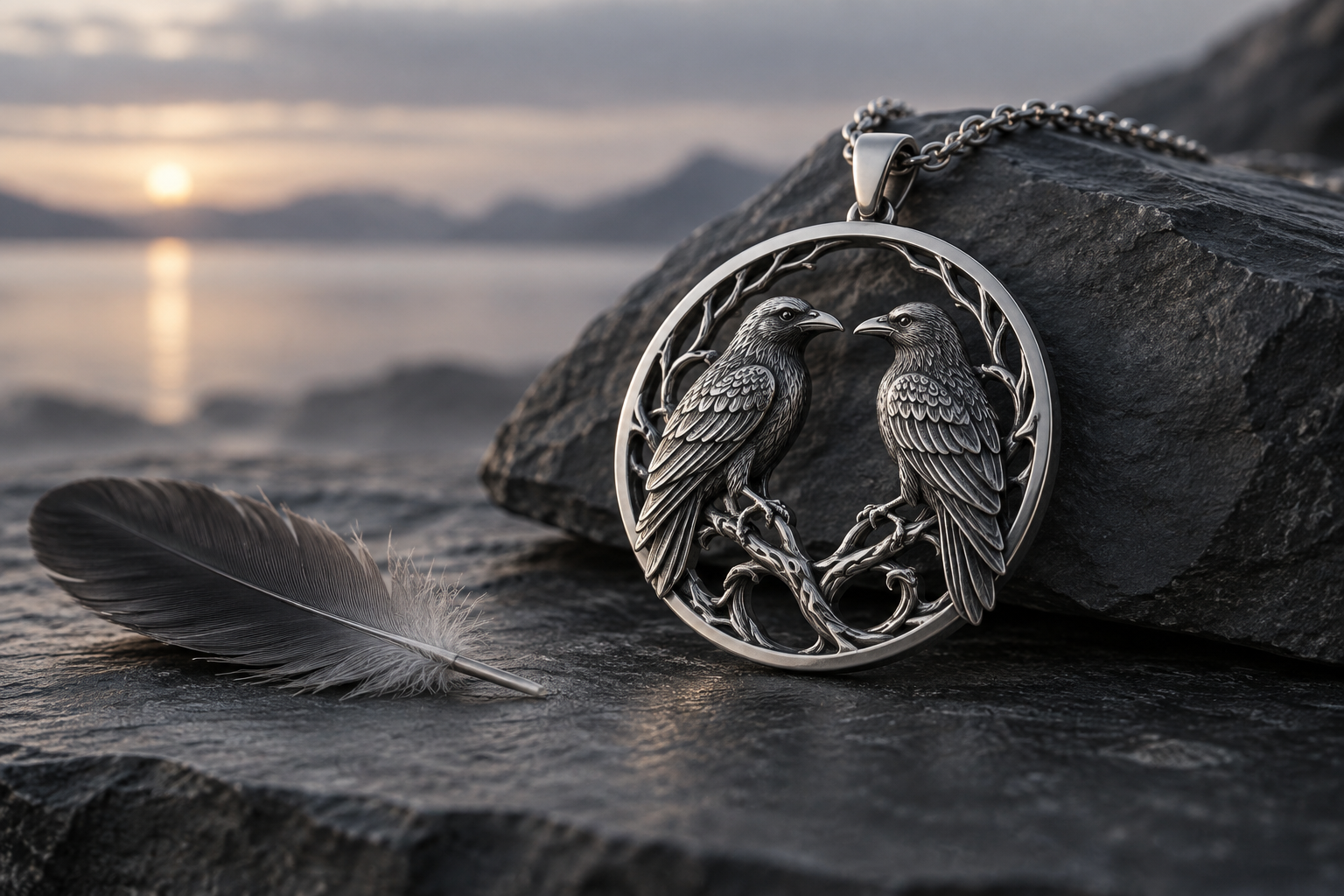
Meaning at a glance
Huginn and Muninn are Odin's two ravens, commonly understood through thought and memory; paired-raven jewelry can express reflection, knowledge, observation, or loyalty, but a modern pendant is not automatically a replica of a Viking Age object.
What the historical evidence actually says
The primary historical and museum summaries make the basic facts clear: Huginn and Muninn are named as Odin’s two ravens and are described as flying out into the world and returning to report what they have seen. The Swedish History Museum presents Huginn and Muninn as Odin’s ravens whose names relate to thought and memory and who travel and report to Odin. The National Museum of Denmark likewise identifies them as Odin’s ravens and notes their role as scouts and informants in the myths.
These summaries are interpretations of Norse mythic material compiled from medieval sources and later scholarship. They reflect how museums present the figure of Odin and his ravens to a general audience. The evidence that museums summarize is literary and iconographic rather than a single archaeological artifact that directly reproduces a wearable design labeled as “Huginn and Muninn” in the Viking Age.
Distinguishing documented historical meanings from modern interpretations
Documented historical meaning: medieval Norse sources, summarized for modern readers by institutions such as the Swedish History Museum and the National Museum of Denmark, identify the ravens as Odin’s companions that gather information and report back to him. The names themselves—commonly rendered as Huginn (thought) and Muninn (memory or mind)—connect the birds to cognitive functions in the mythic narrative, and museums present that connection as part of the traditional story.
Modern personal and cultural interpretations: contemporary jewelry designers, wearers, and retailers have layered additional meanings on the motif. Paired raven pendants, rings, and brooches can be adopted to represent reflective practice, learning, keen observation, trust between partners, or a commitment to remembering ancestors or history. Those symbolic choices are modern responses to the myth rather than claims that a particular style was worn with that precise meaning in the Viking Age.
It is important not to conflate museum summaries of myth with a universal historical usage. The museums provide informed summaries of the myths and their roles; modern jewelry use is creative and symbolic and may borrow freely from the story without seeking to reproduce any specific Viking Age object.
How the Huginn and Muninn motif appears in jewelry
Designers interpret the ravens in many ways. The motif appears as stylized pairings of birds facing each other, as one bird perched or in flight, or as abstract raven profiles incorporated into knotwork or runic compositions. Some pieces show two identical ravens to emphasize pairing, while others use mirror-image layouts to suggest balance between thought and memory.
Materials range from cast silver and bronze to stamped or engraved metalwork inspired by historic techniques. Contemporary makers sometimes combine raven imagery with other Norse motifs such as runes, Yggdrasil, or interlace patterns. Because there is no single authenticated Viking Age 'Huginn and Muninn pendant' known from the archaeological record that is worn in the exact modern way, most examples on the market are creative reinterpretations rather than museum replicas.
Gemstones, metals, and stylistic choices
Metal choice carries both aesthetic and symbolic weight. Silver and bronze tones are commonly used because they echo materials familiar from Viking Age objects, while oxidized finishes and patinas are popular to give pieces an aged look. Gold is used sometimes for contemporary or higher-end designs but is less typical in historically inspired Viking pieces.
Gemstones are rarely required by the myth but are chosen to support a piece’s theme. Black stones such as onyx or black spinel can echo the raven’s plumage and create a graphic contrast with silver. Garnet has historical associations with jewelry from the Viking Age in some regions and can be used where a designer wants an authenticity cue, but its presence is a decorative choice rather than a documented part of the Huginn and Muninn story.
Practical guidance for selecting or gifting paired raven jewelry
Decide what meaning you want the piece to hold for you or the recipient. If your intention is reflection, study, or memory, choose a paired or mirrored design that suggests balance between two qualities. If you want a piece that references the myth straightforwardly, look for artisans who describe their designs explicitly as inspired by Huginn and Muninn and who explain their sourcing and techniques.
If historical authenticity matters to you, look for makers who explain how their work relates to historic finds and who avoid claiming that a modern design is an exact Viking Age object. Museums such as the Swedish History Museum and the National Museum of Denmark offer summaries that can help you distinguish mythic roles from modern marketing claims.
Consider materials and wearability. For everyday wear choose durable metals such as sterling silver or bronze alloys and secure fittings for pendants and rings. If gifting, respect the recipient’s cultural and personal background: some people appreciate mythic symbolism as heritage or literary interest, while others may prefer a purely aesthetic or non-cultural emblem. When in doubt, choose a design with clear intent and an explanation from the maker so your gift carries a thoughtful message.
Respectful usage and cultural sensitivity
Wearing mythic symbols can be a meaningful way to connect with literature, shared stories, or personal values, but it is best approached with awareness. Huginn and Muninn are figures from Norse mythology and have been used in many modern contexts, from literature to fashion. When using the ravens as a symbol of heritage, research the cultural and historical context and avoid treating the imagery as a simplistic or universal emblem.
If you are representing the symbol in a public or institutional setting, attribute its origin to Norse myth and to the primary cultural contexts in which the stories were told rather than implying that your pendant is an exact historical reproduction. Museum materials from the Swedish History Museum and the National Museum of Denmark are useful starting points for accurate, non-sensational summaries of the ravens’ roles.
Conclusion
Huginn and Muninn remain powerful and flexible symbols. Museums summarize the core story: two ravens who fly Odin’s world and bring back information connected to thought and memory. In contemporary jewelry, designers emphasize the pairing to express ideas such as reflection, knowledge, vigilance, or loyalty. That modern symbolism is valid as a personal or stylistic choice, but it should be presented as an interpretation inspired by myth rather than a literal Viking Age replica.
Frequently asked questions
Were Huginn and Muninn actually worn as jewelry in the Viking Age?
There is no documented Viking Age object that is definitively worn and labeled as a 'Huginn and Muninn' pendant; museums summarize the ravens’ roles in myth, and most contemporary raven jewelry is a modern interpretation inspired by those stories.
What do the names Huginn and Muninn mean?
Museum summaries commonly render Huginn as related to thought and Muninn as related to memory or mind, linking the two ravens to cognitive functions in the myths as presented by institutions such as the Swedish History Museum.
Can wearing Huginn and Muninn jewelry express personal beliefs?
Yes. Many people adopt paired raven motifs to symbolize reflection, learning, observation, or loyalty; these modern meanings are personal or cultural choices rather than claims grounded in a single historical practice.
What materials should I choose for everyday raven jewelry?
For everyday wear choose durable metals such as sterling silver or bronze alloys and secure settings; black stones like onyx are popular for raven-themed pieces but are decorative choices, not historically mandated elements of the myth.
How can I ensure a raven piece is respectfully presented?
Select designers who explain their inspiration and sourcing, avoid sellers who claim a modern design is an exact Viking Age reproduction, and acknowledge the symbol’s Norse myth origins when describing its meaning.
Are Huginn and Muninn used in modern Norse or heathen religious practice?
Huginn and Muninn appear in contemporary culture and may be referenced in modern spiritual or cultural contexts; museum summaries describe their mythic functions, but how modern communities use the symbol varies and is not a single documented historical practice.
Sources and further reading
- Odin – leader of the gods — Swedish History Museum
- The Viking gods — National Museum of Denmark