Meaning at a glance
Rose cut engagement ring styling focuses on how the shallow, low-profile shape maximizes apparent spread and finger coverage for a given carat weight, how to choose settings and proportions that balance comfort and presence, and what shoppers must verify with a seller or lab—using trade-offs between diameter, durability, gemstone type and disclosure to make a confident choice.
What 'rose cut' means for styling
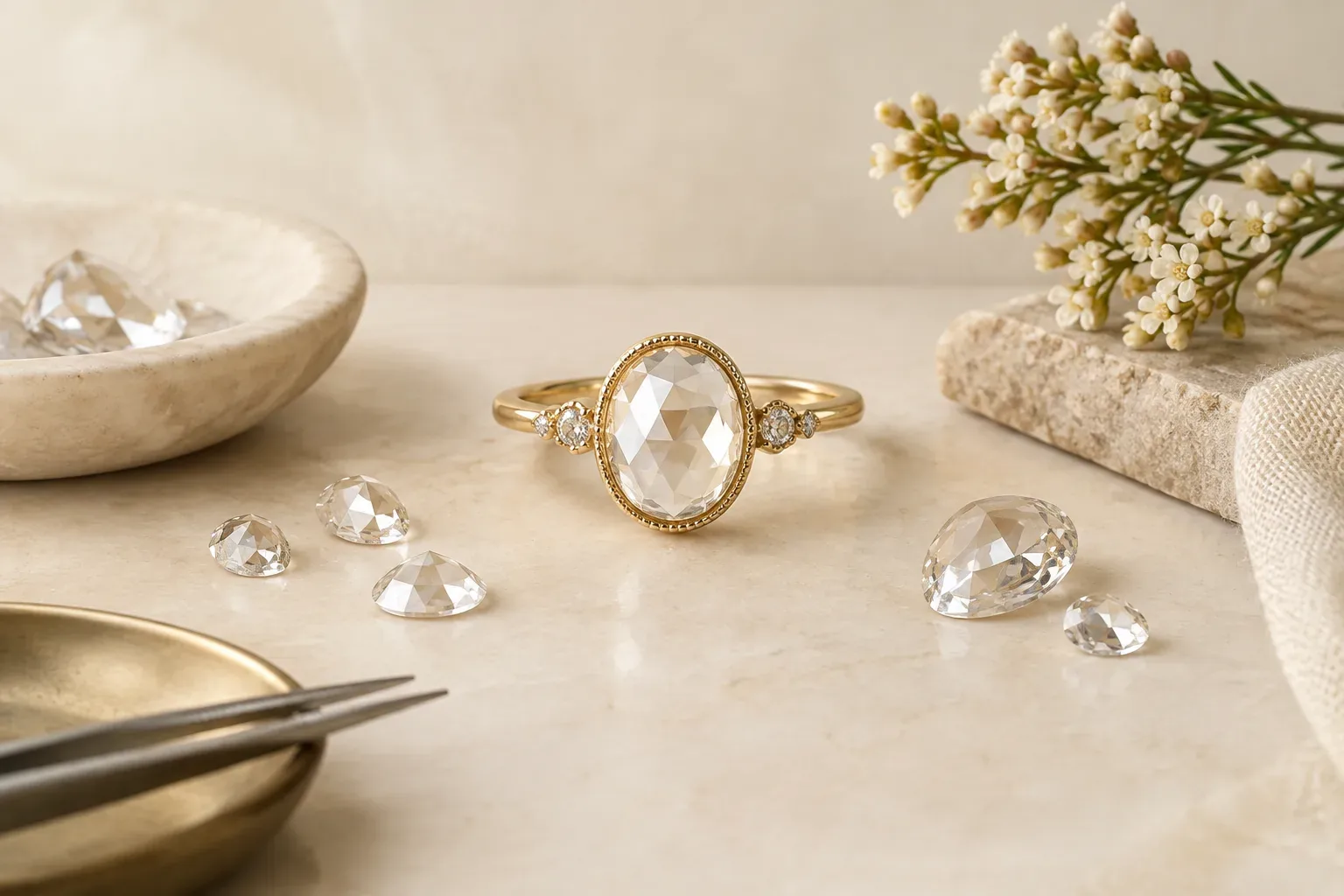
In jewelry terms, a rose cut is a low-domed, flat-backed faceted style that tends to spread more visually across the finger than a deep brilliant cut of the same carat weight. The cut’s shallow pavilion means it sits lower on the finger, which reduces snagging and can read as more understated or vintage depending on the setting. Because rose cuts distribute weight more to diameter than depth, shoppers often perceive a larger face (or finger coverage) for each carat compared with deeper cuts.
Historical evidence and what the sources cover
The approved sources supplied for this guide emphasize modern market trends, consumer protection and gemological verification rather than a detailed historical chronology of cuts. Imaginaire Digital provides contemporary search and demand data for 2026, showing sustained interest in engagement rings and specific shapes in the UK marketplace (Imaginaire Digital 2026). Jewelers Mutual’s 2026 trends report highlights current preferences for fluid forms, modern stacking, colored gemstones, craftsmanship and versatility, which helps explain why rose cut rings are seeing renewed popularity in contemporary styling (Jewelers Mutual 2026).
If you need precise, dated historical documentation about the rose cut’s origin or use in a specific culture or period, those specialized historical details are not contained in the four approved sources here. For definitive museum records, auction catalogues and academic studies that assign dates, regions or cultural meanings to particular rose cut examples, consult primary historical references, museum labels or a qualified jewelry historian.
Documented meanings versus modern personal interpretations
Documented meanings in the approved material are focused on consumer protection, trend signals and gemological care; they do not assign universal symbolic meanings to cuts. Modern personal interpretations — for example, pairing a rose cut with antique-style engraving to evoke romance or giving a rose cut as a symbol of vintage taste — are subjective choices. Always distinguish between a documented fact (for instance, a seller’s disclosure about treatment or origin) and an interpreted meaning you or a recipient attach to the piece.
How the motif, gemstone and tradition appear in jewelry
Rose cuts appear across gemstones and settings. Jewelers use rose cut diamonds as center stones in bezel settings, clusters and low-set solitaires to emphasize face-up size and a subdued sparkle that complements vintage or minimalist motifs (Jewelers Mutual 2026). Colored gemstones are also rose cut to take advantage of larger visible color fields, which fits current demand for colored stones and versatile, gender-neutral styling (Jewelers Mutual 2026).
Design motifs commonly paired with rose cuts include milgrain and engraving for a vintage look, openwork or pierced galleries to let light into shallow pavilions, and halo settings to boost apparent size without increasing weight. Modern trends toward stacking and fluid forms make rose cuts popular in thin bands and mixed-metal sets, where the low profile reduces interference with stacked rings (Jewelers Mutual 2026; Imaginaire Digital 2026).
Styling trade-offs: finger coverage, proportion and practical choices
Finger coverage depends more on a stone’s diameter than its carat weight. Because rose cuts are shallower, the same carat weight often yields a wider face than a deeper brilliant cut; the trade-off is less brilliance and different light return characteristics. If you prioritize visible spread and a low profile, a rose cut is advantageous. If you prioritize maximum sparkle, a deeper brilliant or modern cut may suit you better.
Proportion choices that affect comfort and appearance include band width, face diameter and setting height. For narrow fingers, choose a modest diameter—roughly one-third to two-fifths of finger width—to maintain balance. For wider fingers, a larger face can read proportional without overwhelming the hand. Low-profile settings like bezels and low crowns reduce snagging and are practical for active wearers, while halos and multiple-stone settings increase apparent size but can add height and complexity.
Practical selection and gifting guidance
Ask for the exact measurements: diameter, depth, girdle thickness and total weight. Measurements tell you how much finger coverage to expect. Request written disclosure of origin (natural vs lab-grown), any treatments, and any available laboratory reports because disclosures are legally required and central to value and care decisions (Federal Trade Commission).
Match style to lifestyle and hand anatomy rather than assuming a single 'best' look. For an active recipient or someone who works with their hands, prioritize a low-profile bezel or flush setting. For a recipient who prefers visible presence and vintage aesthetics, choose a wider face with engraving, a halo or decorative shoulders. When gifting, consider whether the recipient values verifiable documentation and be prepared to offer an exchange or resizing plan if the ring is a surprise.
Respectful gifting also means transparency: explain what you know about the stone and what you don’t. If the seller provides a gemological report, include it with the gift. If a report isn’t available, be ready to have the piece appraised or analyzed after gifting if authenticity or treatment is important to the recipient.
Care, verification and what you cannot verify without experts
Safe care starts with knowing the gemstone’s material and any treatments. The Gemological Institute of America documents that treatments and their detectability affect durability and care instructions; some treatments require gentler cleaning or special handling (GIA). For example, certain fracture-filling or coating treatments reduce durability and should not be exposed to ultrasonic cleaners or harsh detergents.
The Federal Trade Commission emphasizes that consumers need clear written distinctions among natural, lab-created, treated and imitation materials and that sellers must disclose these facts. You can and should ask the seller for written disclosures and any lab reports before purchase (FTC).
What you cannot reliably verify at home: whether a stone is natural or lab-grown, or whether it has undisclosed treatments that require gemological instruments. For those determinations, request a report from an independent gemological laboratory or ask the seller for an existing lab report. If a seller refuses to provide documentation or clear disclosures, treat that as a red flag.
Putting styling into practice: quick guides
Small hands and narrow fingers: choose a rose cut with a modest diameter and a thinner band to maintain proportion. A bezel or low-profile halo adds protection without bulk. Because rose cuts already sit lower, a minimal setting preserves the intended low silhouette.
Medium hands: take advantage of the rose cut’s face-up spread and pair it with a moderate band width. A halo increases apparent size if desired, and small side stones can add contrast without much extra height.
Large hands or those wanting a statement: choose a larger diameter rose cut or a cluster setting to maximize face-up coverage. Combine with stronger shoulders or a wider band for balance. Expect less scintillation than from brilliant cuts; consider mixed cuts if sparkle is a priority.
General tip: always compare diameter measurements across stones rather than carat weight alone when assessing perceived size and finger coverage.
Frequently asked questions
Will a rose cut look larger than a brilliant cut of the same carat weight?
Yes — because rose cuts are shallower, more of the carat weight is distributed into the stone’s diameter, so the face typically appears larger than a deeper brilliant cut of the same weight. For precise comparison, request diameter measurements from the seller rather than relying on carat weight alone.
Is a rose cut suitable for everyday wear?
Often yes: rose cuts sit lower on the finger, which reduces snagging, and protective settings like bezels or low crowns increase durability. However, suitability depends on the gemstone material and any treatments; follow care guidance for the specific material and avoid ultrasonic cleaners if the stone has sensitive treatments (GIA).
How can I verify whether a rose cut stone is natural, lab-grown or treated?
Ask the seller for written disclosures and any independent laboratory report before purchase — the FTC requires clear distinctions among natural, lab-grown and treated stones. If no lab report is available, obtain one from a qualified gemological laboratory for definitive identification (FTC; GIA).
How should I choose band width to match a rose cut?
Aim for visual balance: narrow bands suit smaller hands and subtler stones, while wider bands complement larger faces and provide structural support. A practical rule is to keep the band width roughly one-third to two-fifths of the perceived stone diameter for balanced proportion, then adjust for personal taste and comfort.
What cleaning methods are safe for rose cut gemstones?
Safe care depends on the gemstone and any treatments. Many untreated hard stones tolerate warm soapy water and a soft brush, but stones with certain coatings or fillings can be damaged by chemicals or ultrasonic cleaners. Consult seller disclosures and guidance from gemological authorities before cleaning; when in doubt, use gentle hand-cleaning and avoid harsh solvents (GIA).
Sources and further reading
- Imaginaire Digital — Imaginaire Digital
- Jewelers Mutual — Jewelers Mutual
- Gemological Institute of America — Gemological Institute of America
- Federal Trade Commission — Federal Trade Commission