Meaning at a glance
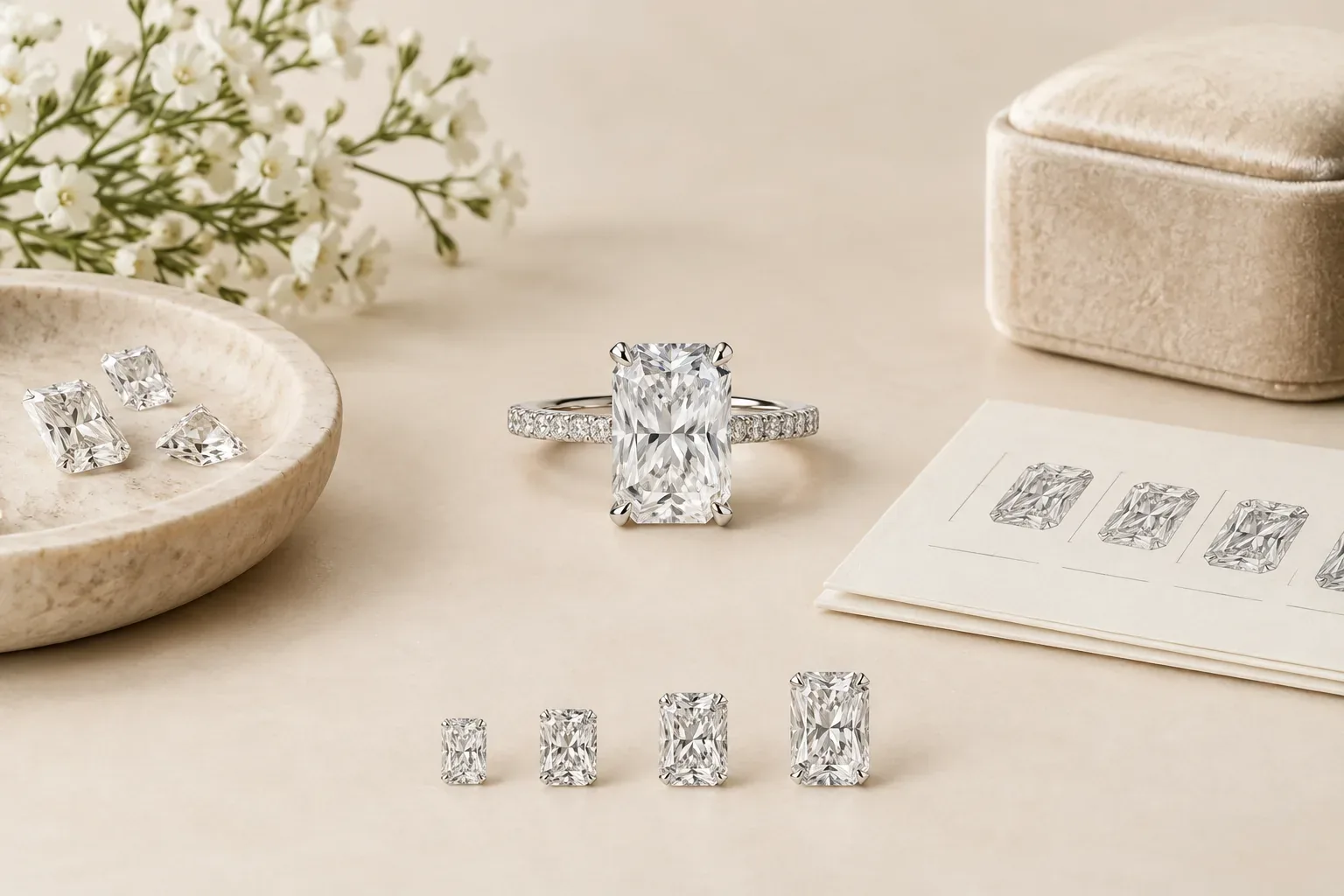
This guide answers how to style a radiant cut engagement ring by defining the shopper’s decision criteria, offering proportion and coverage guidelines, explaining practical trade-offs, advising safe care, and clarifying what must be verified by a qualified jeweler or gemological laboratory.
What this guide covers and why proportion matters
This article addresses the practical search intent behind “radiant cut engagement ring styling” by giving decision criteria you can apply in stores or online, describing visual trade-offs, and listing which technical claims require expert verification. The goal is to help you choose a look that reads as balanced on the wearer’s hand rather than promising a single ‘correct’ proportion.
Proportion matters because the same carat weight can read very differently on different fingers and in different settings. Styling choices—stone dimensions, setting type, shank width, and ancillary stones—change how much of the finger the center stone appears to cover, the ring’s perceived scale, and how comfortable and secure the ring will be in daily life.
Historical evidence and cultural notes
The sources available for this article focus on modern market behavior, gem treatment disclosure, and consumer protections rather than on long-term symbolic histories for specific modern cuts. Market analyses from Imaginaire Digital indicate strong contemporary demand for engagement rings and closely related categories in the UK market context, while Jewelers Mutual highlights 2026 trends centering on fluid forms, versatility, and modern stacking approaches in jewelry styling. These contemporary sources frame how the radiant cut is used in today’s designs, but they do not supply a documented historical lineage or traditional symbolic meaning tied to specific cultures or historical periods.
Because the approved evidence does not record a culturally documented symbolic history for the radiant cut, avoid asserting a historical symbolic meaning as universal. Instead, treat any meaning you read or hear about the cut as a modern or personal interpretation unless you can trace it to a specific, authoritative historical source.
Documented meanings vs modern personal interpretation
Documented meanings are claims backed by historical records, cultural studies, or authoritative primary sources. The working sources used here do not provide such documentation for the radiant cut’s symbolic meaning. Modern meanings—what people say the cut symbolizes today—are personal, market-driven, and stylistic. Jewelers and designers may ascribe modern themes such as ‘vibrant’ or ‘renewal’ to marketing narratives, but those remain contemporary interpretations rather than documented cultural fact.
When choosing a ring for symbolic reasons, distinguish between historically documented symbols (for example, ancient motifs with traceable provenance) and the personal symbolism you or the recipient attach to a modern cut. Use internal considerations—personal taste, lifestyle, and how the ring pairs with other jewelry—to guide your choice rather than assuming a universal historical meaning.
How the radiant cut appears in jewelry and common styling motifs
In modern jewelry assortments the radiant-cut center is often used to emphasize a rectangular or square focal plane with trimmed corners. Designers pair the cut with settings that either emphasize breadth—such as halo and pavé shoulders—or emphasize sleekness—such as solitaire settings with narrow shanks or low bezels. These stylistic pairings influence how much of the finger surface the ring appears to cover and how bold the center looks relative to the hand.
Current consumer trends documented by Jewelers Mutual show a market interest in versatility, stacking, and gender-neutral styling; those trends make the radiant cut popular because it accommodates both bold halos and simpler, more minimalist settings. Imaginaire Digital’s market analysis confirms that engagement rings remain a leading demand driver in jewelry searches, so styling choices that balance trend awareness and personal wearability will remain relevant in contemporary contexts.
Practical proportion and finger coverage guidance
Start with relative width: judge the center’s visible width against the wearer’s finger width at the point where the ring sits. A center that occupies too little of the visible finger can look delicate; too much can overwhelm. Aim visually for balance: many shoppers prefer the center stone to look proportional rather than dominating the whole finger, but exact preference varies with personal style.
Consider length-to-width ratio as a styling control. A longer rectangular face visually lengthens the finger; a squarer face reads broader. If the goal is to make short fingers appear longer, favor a longer aspect ratio. If the goal is to maximize perceived size at a set carat weight, a shallower, wider look or a halo can increase apparent surface area.
Account for setting details: a halo increases apparent diameter and finger coverage, while a thin bezel or low-profile setting reduces the perceived size but increases durability. Wide shanks add visual mass and can balance a larger center stone; narrow shanks keep focus on the stone but may need reinforcement for heavy centers.
Trade-offs to weigh when styling
Sparkle versus apparent size: settings that maximize brilliance (open prong mounts, higher crowns) can make a stone appear brighter but may not maximize table surface area that contributes to perceived size. A halo or a broad table increases apparent size even if the stone is not larger by weight.
Durability versus low profile: higher, more open settings show more light but expose corners and girdles. If the wearer is active, prefer lower, more protected settings or bezel-like designs that reduce snagging and protect trimmed corners.
Matching bands and stacking: a flat or contoured wedding band can sit flush against a radiant-cut engagement setting. For a stacked look, choose band widths and finishes that maintain the intended focal balance without creating visual clutter.
What you can verify yourself and what requires a professional
You can verify certain facts yourself at purchase: visible symmetry and finish, metal hallmarks and karat markings, the presence of a written sales disclosure, and whether the seller provides a grading report or certificate. The Federal Trade Commission requires clear distinctions and written disclosures about natural, lab-created, treated, or imitation materials, so insist on that paperwork when buying.
Do not assume you can visually confirm treatments, origin, or precise identity of a gemstone without expert testing. The Gemological Institute of America explains that treatments, their detectability, and the implications for durability and care create distinct consumer questions; many treatments require laboratory equipment to detect reliably. For claims about natural versus lab-grown origin, clarity about treatments, or detailed grading, consult a qualified jeweler and an independent gemological laboratory for a report.
Safe care, maintenance, and insurance considerations
Routine care for a radiant cut center follows the same general principles that apply to faceted gemstones: keep the setting clean to preserve brilliance, inspect prongs and mounts periodically, and follow any special-care guidance if the seller discloses treatments. The GIA notes that treatments affect detectability and care, so always ask whether the stone has been treated and follow recommended care instructions accordingly.
Consider insurance and repair options as part of your purchase decision. Contemporary advice from trade and consumer sources highlights craftsmanship and durability as trending buyer concerns, so budget for regular inspections and for insurance or a repair plan if the ring will be worn daily. Jewelers Mutual’s 2026 trend guidance underscores buyer interest in well-made, versatile, and durable pieces, which connects directly to longevity and insurance decisions.
Selection and gifting guidance (practical and respectful)
When selecting a radiant cut engagement ring as a gift, prioritize the recipient’s day-to-day lifestyle and existing jewelry habits over purely market-driven trends. If the wearer prefers low maintenance or works with their hands, choose a lower-profile setting and a secure mount. If they favor bold looks or stacked rings, consider halos and coordinating bands.
Ask for and read written disclosures about treatments, origin, and grading. The FTC makes clear that consumers should receive clear distinctions among natural, lab-created, treated, and imitation materials; insist on that documentation and on a seller warranty or return policy. If the purchase is meant to be a surprise, secure return or sizing options up front and keep paperwork and certification accessible so the recipient can verify or exchange as needed.
Respect personal meaning: if symbolism matters, discuss or subtly learn the recipient’s preferences. Modern symbolic descriptions are personal; do not present a contemporary marketing claim as a cultural fact. If you want a ring with a traditional motif or historical provenance, request authoritative documentation from the seller and be prepared to consult specialized historical sources or scholars for verification.
Quick checklist before purchase
Make sure the piece sits comfortably on the intended finger, that you like how much of the finger the center covers, and that the ring style aligns with daily activities and other jewelry. Get written disclosures on treatments and origin, request any grading report offered, and clarify sizing and return policies. If you need confirmation about treatments or origin, plan to obtain an independent laboratory report rather than relying solely on visual inspection.
Frequently asked questions
How do I judge the right size radiant cut for a finger?
Judge proportion visually: compare the stone’s visible width to the finger width where the ring will sit. Aim for a balanced look rather than a fixed measurement—wider stones suit broader hands while narrower, longer stones can elongate shorter fingers.
Does a halo make a radiant cut look larger?
Yes. A halo of small stones or metal can increase the apparent diameter and surface area of the center, making the overall head appear larger without increasing carat weight.
Can I verify treatments or origin myself?
No. While you can request written disclosures and visible inspection, reliable verification of treatments, origin (natural versus lab-grown), and many enhancements requires a qualified jeweler or an independent gemological laboratory report, as noted by the GIA and the FTC.
What setting is best for daily wear?
For active daily wear, choose lower-profile settings and secure mounts that protect trimmed corners. Bezel-like or low-prong settings reduce snagging and offer more protection than high, open crowns.
What paperwork should I ask for when buying?
Request written disclosures about whether the stone is natural, lab-created, treated, or imitation, any available grading or laboratory reports, seller warranties, return policy details, and metal hallmarks. The FTC advises consumers to insist on clear written distinctions.
Sources and further reading
- Imaginaire Digital — Imaginaire Digital
- Jewelers Mutual — Jewelers Mutual
- Gemological Institute of America — Gemological Institute of America
- Federal Trade Commission — Federal Trade Commission