Meaning at a glance
A radiant cut engagement ring checklist should cover the stone type and certification, cut proportions and visual trade-offs, setting and corner protection, treatments and disclosures, sizing and budget, and care and insurance; shoppers can inspect dimensions, weight, visible damage, and written disclosures themselves but must rely on gemological labs or qualified jewelers to confirm treatments, origin, and some durability claims.
Direct answer — what this checklist helps you decide
If you’re searching for a radiant cut engagement ring checklist, focus first on six decision areas: the center stone material (natural diamond, lab-grown diamond, or colored gemstone), certification and treatment disclosures, exact measurements and proportions, setting style and corner protection, seller policies (returns, warranty, insurance), and a practical care plan. You can verify carat weight, visible clarity, measurements, setting security and written disclosures in person or via clear photos, but treatments, origin and precise grading require a gemological laboratory or a qualified gemmologist to confirm.
Historical evidence and cultural context
Unlike ancient motifs or long-used shapes that carry well-documented cultural meanings, the radiant cut is best understood as a product of modern jewelry design rather than a symbol with centuries of cultural associations. Industry and market research emphasize that the recent decades’ interest in cut innovation and versatile design—features that feed demand for styles such as radiant and other brilliant cuts—reflects contemporary consumer preferences for craftsmanship and versatility rather than a shared historical symbolism (Jewelers Mutual; Imaginaire Digital).
Because the cut and its popularity are rooted in twentieth- and twenty-first-century commercial jewelry practice, there is little reliable historical record that ties the radiant cut to specific traditional beliefs, rituals, or cultural periods in the way that antique motifs sometimes are. Market analyses therefore treat the radiant cut as a modern design choice that conveys style and light performance rather than a discrete cultural symbol (Imaginaire Digital; Jewelers Mutual).
Documented historical meanings versus modern personal interpretations
Documented historical meanings are sparse for a modern faceted form like the radiant cut. Trade and professional sources focus on appearance, craftsmanship and market demand instead of inherited symbolism, so any claim that the cut itself carries a centuries-old meaning is not supported by industry reporting (Jewelers Mutual; Imaginaire Digital).
Modern personal interpretations—what the ring means to the giver and wearer—are separate and entirely valid. Buyers and recipients commonly ascribe meanings such as brilliance, modernity, or uniqueness to a radiant cut, but these are contemporary personal or cultural readings, not documented historical facts. When choosing a ring for symbolic reasons, treat historic documentation and personal meaning as two distinct inputs: rely on the former for factual background and lean on the latter for emotional fit.
How the radiant cut appears in jewelry
In practice, the radiant cut is used for both diamonds and colored gemstones and appears across a range of settings. Retail and trade reporting notes that consumers are choosing cuts and settings that support versatility, stacking and gender-neutral styling, and radiant-cut stones are included in those trends due to their combination of stepped and brilliant facet work and rectangular or square outline (Jewelers Mutual; Imaginaire Digital).
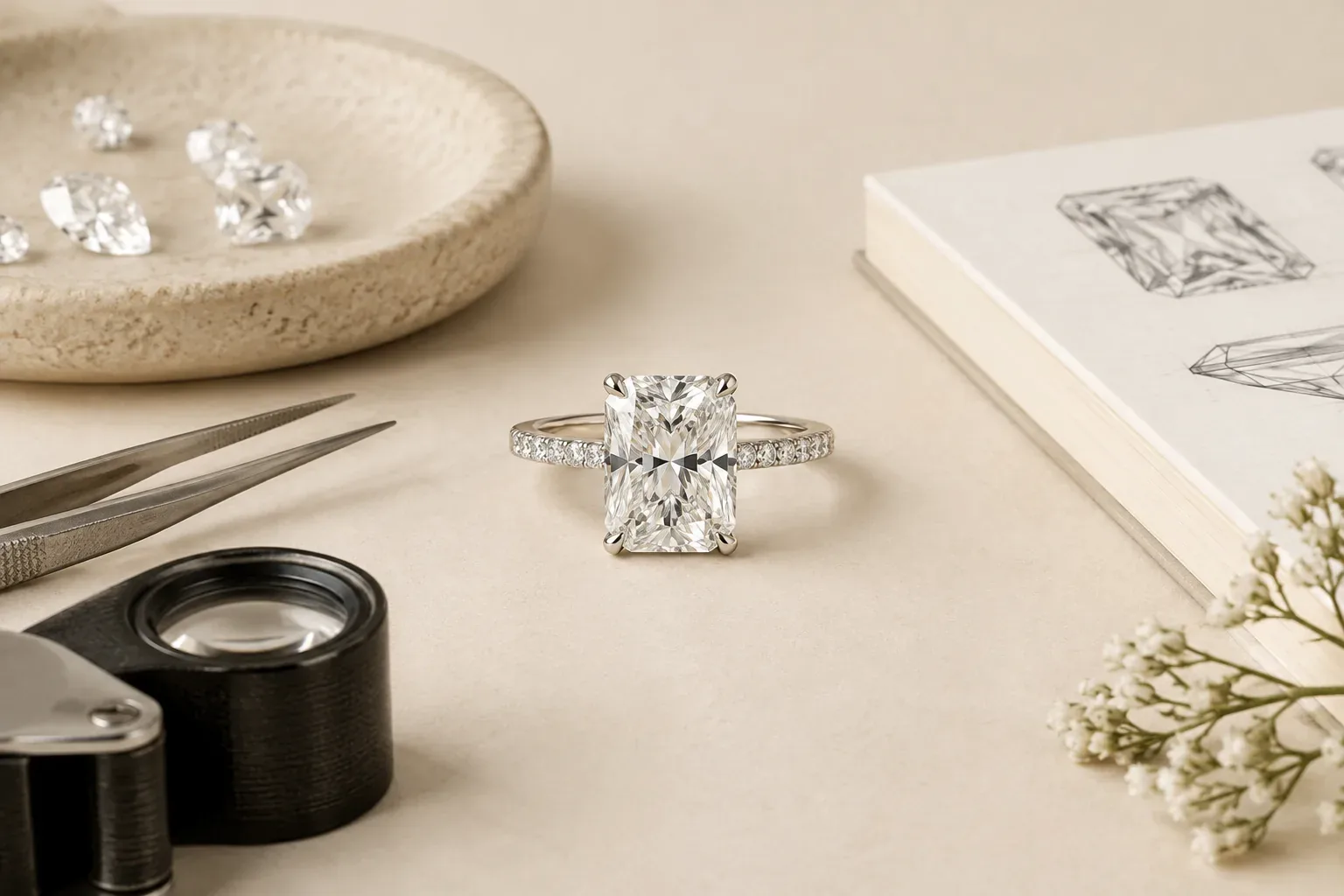
Design-wise, radiant-cut stones are commonly set in solitaires, halos, three-stone rings and bezel or prong mounts that emphasize the stone’s sparkle and protect its corners. Jewelers may also pair radiant centers with side stones or pavé bands to increase perceived size and visual impact while preserving a modern profile favored in current trends (Jewelers Mutual).
Checklist questions to ask before buying
Begin by asking what the center stone is and for documentation: is it a natural diamond, a lab-grown diamond, a colored gemstone, or an imitation? Ask to see any laboratory certificate and written disclosures. The Federal Trade Commission requires clear distinctions among natural, lab-created, treated and imitation materials, so insist on written clarity before purchase (Federal Trade Commission).
If the stone is a diamond, ask for a report from a recognized laboratory and confirm which laboratory issued it. Ask whether the seller discloses any treatments, enhancements or clarity modifications and request an explanation of their durability and detectability. The Gemological Institute of America outlines that treatments, disclosure and detectability affect durability and care, so these are material facts for consumer decisions (Gemological Institute of America).
Ask for precise measurements and a set of clear photographs (top, profile and corner close-ups). Measurements, carat weight and proportions strongly affect appearance; ask how the seller rates the cut proportions and how those proportions influence spread (face-up size) versus brilliance.
Discuss setting details: how are the corners protected, how many prongs hold the stone, and what metal is used? The radiant’s cropped corners are practical but benefit from secure prongs or a bezel. Ask whether the setting is soldered or can be resized, how resizing might affect the stone and warranty terms for repair.
Clarify seller policies: what is the return period, what does any warranty cover, and does the seller offer or require insurance? Learn whether the ring will come with a written appraisal for insurance purposes and whether the seller will assist with valuation documentation.
Ask about ethical sourcing and origin if that matters to you. Request any documentation the seller holds related to sourcing standards. The FTC guidance emphasizes written seller disclosures, so get commitments in writing when provenance or ethical claims affect your purchase decision (Federal Trade Commission).
If you are buying online, ask for a video or a third-party verification and confirm a reasonable return window so you can inspect the ring in person or have an independent appraiser check it. For high-value purchases, factor in the cost of an independent appraisal and insurance into your overall budget.
Practical trade-offs and decision criteria
Expect trade-offs between face-up spread, brilliance and price. Larger table or shallower proportions may increase apparent size but can reduce light return. Conversely, proportions that maximize brilliance may make the stone appear slightly smaller for its weight. Discuss with the seller which visual priority you prefer and inspect comparable stones in-person or via high-quality images.
Corner durability versus visual openness is another trade-off. Settings that shield the radiant cut’s corners add protection but can reduce side visibility; open prong settings emphasize sparkle but require regular inspection. Consider lifestyle and daily activities: an active wearer may prefer stronger corner protection even at a small visual cost.
Budget decisions also intersect with stone choice. Lab-grown diamonds often cost less per carat than natural diamonds; treated colored gemstones may be significantly less expensive than untreated stones. The FTC and GIA recommend clear disclosure of these differences because they materially affect value and care requirements (Federal Trade Commission; Gemological Institute of America).
What you can verify yourself and what requires an expert
On your own you can verify carat weight (reported on paperwork), visible clarity characteristics under a jeweler’s loupe, measurements and proportions from a seller’s documentation, the presence and security of prongs, and whether the stone shows chips or obvious damage. You can also check the seller’s return policy and written disclosures before purchase and confirm warranty and insurance options.
You cannot reliably determine treatments, origin or some lab grading details by eye. Confirming whether a stone has been fracture-filled, laser-treated, high-pressure high-temperature treated, or whether its origin is natural or lab-grown generally requires specialized testing by a recognized gemological laboratory. The Gemological Institute of America explains that detectability and disclosure of treatments create distinct consumer questions and that lab testing is often required to resolve them (Gemological Institute of America).
For legal and consumer-protection documentation—such as distinction among natural, lab-created, treated and imitation materials—insist on written seller disclosures in line with FTC guidance. If anything is ambiguous, get the stone tested by a qualified gemologist or request a full lab report as a condition of sale (Federal Trade Commission).
Care, maintenance and insurance
Follow safe-care practices recommended for fine gemstones and diamonds: remove rings for strenuous activities and household chemicals, clean with mild soap and a soft brush, and avoid ultrasonic or steam cleaning when the seller indicates the stone has been treated in a way that makes it vulnerable to those methods. The Gemological Institute of America notes that treatments and durability affect specific care needs (Gemological Institute of America).
Schedule a professional inspection at least once a year to check prong security and wear, and keep any certificates and receipts with your insurance documentation. Jewelers Mutual’s guidance on trends and consumer protection highlights the value of understanding craftsmanship and warranty coverage when purchasing modern styles (Jewelers Mutual).
Final checklist summary
Before you buy, confirm these items in writing: exact center-stone identity and any treatments; whether a recognized laboratory report exists and which lab issued it; precise measurements and carat weight; setting construction and corner protection; return, warranty and insurance options; and the seller’s written disclosures about origin and provenance. Inspect the ring in person when possible or obtain clear images and video, and budget for an independent appraisal if you need additional assurance.
Market reporting shows contemporary shoppers value craftsmanship, versatility and clear disclosure, so combine those priorities with your personal preferences for appearance and symbolism. When in doubt, rely on a qualified gemologist or an independent laboratory report to resolve technical questions beyond what a consumer can verify by sight (Imaginaire Digital; Jewelers Mutual; Gemological Institute of America; Federal Trade Commission).
Frequently asked questions
What documents should I ask for when buying a radiant cut engagement ring?
Ask for written disclosure of the stone’s identity (natural, lab-grown, treated or imitation), any treatment details, and any laboratory report that accompanies the stone. The Federal Trade Commission requires clear distinctions in these areas, so insist on written documentation before purchase. If a laboratory report exists, verify which lab issued it and whether the report matches the stone you are buying.
Can I tell if a radiant cut has been treated by looking at it?
Not reliably. Some treatments can be visible to a trained eye, but many require specialized testing to detect. The Gemological Institute of America explains that treatment detectability varies and that laboratory testing or a qualified gemologist’s assessment is often needed to confirm treatments.
How should I protect the cropped corners of a radiant cut?
Choose a setting that offers corner protection—secure prongs or a partial bezel are common solutions—or plan for regular inspections to ensure prongs remain tight. If the wearer is very active, prioritize a protective setting even if it slightly changes the ring’s visual openness.
Is a lab-grown diamond an acceptable choice for a radiant cut engagement ring?
That depends on your priorities. Lab-grown diamonds typically cost less per carat than natural diamonds and should be disclosed as such. The FTC recommends clear seller disclosures so you can weigh cost, resale expectations, personal values and any desired provenance when making your decision.
What care does a radiant cut need?
Care depends partly on whether the stone has been treated. In general, avoid harsh chemicals and remove the ring for strenuous chores, clean with mild soap and a soft brush, and have prongs checked annually. If the seller discloses treatments, confirm whether ultrasonic or steam cleaning is safe before using those methods (Gemological Institute of America).
Sources and further reading
- Imaginaire Digital — Imaginaire Digital
- Jewelers Mutual — Jewelers Mutual
- Gemological Institute of America — Gemological Institute of America
- Federal Trade Commission — Federal Trade Commission