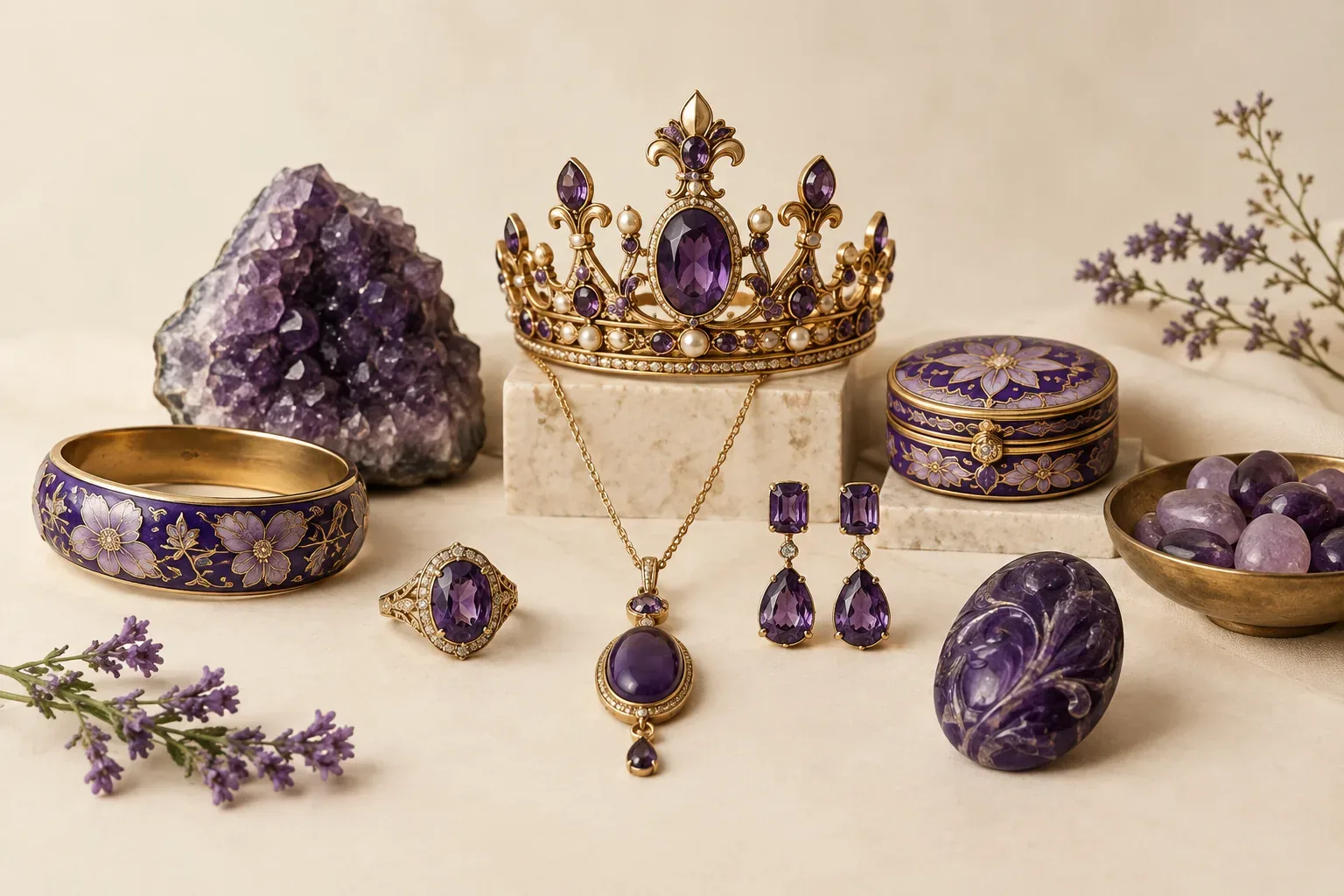
Meaning at a glance
Purple gemstones and purple enamel have long been used in jewelry; museum and gemological research shows purple appears because of specific materials and techniques, while readings that label it royal, spiritual, creative, or individual are historically variable and often modern personal interpretations.
What the historical evidence actually shows
When we look for historical evidence, primary documentation tends to be about materials, techniques, and objects rather than single, universal symbolic meanings. The Metropolitan Museum of Art’s cataloguing and scholarship on jewelry describes how purple pigments and enameled surfaces were used in Islamic jewelry and related traditions, showing that artisans selected colors and techniques for visual effect, durability, and cultural taste. That documentation demonstrates color and technique use, but does not by itself establish a single symbolic meaning across regions or eras.
Gemological institutions also record how purple appears in specific gemstones and how that appearance has affected perceived rarity and value. The Gemological Institute of America (GIA) explains color factors such as hue, tone, and saturation that determine a colored gemstone’s appearance and market value, and its colored stone research provides context on identification, origin and treatments. Those technical records help explain why purple stones were sought and traded, and how their market status has changed over time, without prescribing a single cultural meaning.
In short, museum and gemological records document which purple materials were used and how they were valued or made, but the interpretation of purple as a symbol—whether of high status, religious meaning, or personal expression—varied by culture, context, and period, and must be read case by case.
Distinguishing documented historical meanings from modern interpretations
Documented historical evidence tends to record materials, workmanship, and provenance rather than a universal symbolic dictionary. Where museum records or inventories survive they sometimes note occasions, owners, or religious use; where they do not, later writers or enthusiasts have supplied symbolic readings. For example, a museum catalogue may list a purple-enamelled pendant and describe its materials and style; the catalogue rarely asserts a single, universal symbolic meaning for that color.
Modern readers frequently project meanings onto purple jewelry—calling it regal, mystical, or creative—based on later cultural associations and marketing. Those modern interpretations are valid as contemporary meanings or personal symbolism, but they should be distinguished from claims of a historical, cross-cultural consensus. The cautious evidence-led position is to acknowledge both layers: the physical history recorded by institutions such as The Metropolitan Museum of Art and the GIA, and the varied symbolic readings that developed later or locally.
How purple appears in jewelry: gemstones, enamel, and techniques
Purple in jewelry arises in two main technical ways: colored gemstones that transmit purple light, and applied color such as enamel or inlay that creates purple surfaces. Gemological research explains that a stone’s hue, tone, saturation, and uniformity determine whether it reads as purple and how it will be valued. The GIA’s discussion of value factors for colored gems outlines these properties and the role they play in assessing purple stones.
Enamel and other surface techniques create stable purple color in settings, plaques, and ornament. Curatorial work at The Metropolitan Museum of Art documents the use of enamel in Islamic jewelry and related traditions, where purple and other colors were achieved through specific firing and glazing techniques. Enamel allows artisans to deploy purple as a surface motif without relying on a single rare stone, and it appears in decorative panels, inscriptions, and figure work across many historical jewelry pieces.
Common purple gemstones in modern and historic use include varieties often named or marketed as amethyst, spinel, and sapphire in purple hues, among others. The GIA’s colored stone research provides identification context that collectors and researchers use to distinguish natural material from treated or synthetic counterparts. Those identification tools are practical for buyers and curators assessing whether a purple stone’s color is natural, heat-treated, dyed, or lab-grown.
How symbolism shows up in design and motifs
When symbolic readings appear in objects, they are expressed through design choices such as the prominence of the purple element, its placement near inscriptions or religious motifs, or its combination with other materials like gold. Museum reports documenting jewelry emphasize these design relationships because they help situate pieces within social and ritual contexts, but the same design cue can support different readings in different cultures.
In modern jewelry, designers may intentionally use purple to suggest one or more contemporary ideas—luxury, introspection, creativity, or nonconformity—knowing that recipients will bring their own associations. Because purple can be achieved through both gemstones and enamel, designers have a wide palette for mixing materials, surface finishing, and color intensity to support an intended message or aesthetic.
Practical guidance for choosing and gifting purple jewelry
Decide whether you want the color for material reasons (durability, value, maintenance) or for message reasons (a symbolic association you and the recipient share). If material durability matters, consult gemological identification and care guidance to choose a stone and setting that suit daily wear. The GIA’s resources on colored stone value and research are useful references for understanding durability, treatments, and long-term value considerations.
If symbolism is the primary concern, ask about the recipient’s aesthetic preferences and cultural background before assigning a specific meaning. Because historical readings of purple are variable, a respectful approach is to present the piece with a note about your chosen intention—whether you mean to communicate creativity, remembrance, or simply appreciation of color—rather than asserting a universal cultural meaning.
Consider provenance and treatment disclosure when purchasing. For collectors and gift-givers who care about authenticity, use reputable gemological reports or vendor disclosures to confirm whether a purple gemstone is natural, treated, or lab-grown. The GIA’s research and identification frameworks are the standard that many buyers and appraisers rely upon.
When selecting enamel pieces or jewelry with historic motifs, consult museum publications or curators if you need cultural context. Materials and techniques documented by institutions such as The Metropolitan Museum of Art can clarify whether a piece references a specific tradition and what that tradition’s present-day uses and meanings might be.
Putting it together: respectful choices and clear communication
Purple jewelry can carry many meanings at once—some historical, some personal, and some commercial. The most responsible approach to choosing or gifting purple jewelry is to combine material knowledge (how color is produced and conserved) with cultural humility (recognizing that symbolic meanings vary). Use gemological resources to verify material claims and museum scholarship for historical context, and communicate your personal intent to the recipient so the piece’s modern symbolic role is shared rather than assumed.
Frequently asked questions
Does purple always mean royalty in jewelry?
No. While purple has been associated with high status in some contexts, that association is not universal. Historical documentation tends to record materials and techniques rather than a single symbolic meaning, and cultural readings have varied by time and place.
Are purple gemstones more valuable than other colors?
Value depends on hue, tone, saturation, uniformity and other factors, not color alone. The Gemological Institute of America outlines how these color factors influence a colored gemstone’s value, and identification of origin or treatment also affects market price.
How can I tell if a purple gemstone is natural or treated?
Professional gemological testing and lab reports are the reliable routes to identification. The GIA’s colored stone research explains methods for identifying origin and treatments; ask vendors for documentation or seek an independent lab report for clarity.
Is purple enamel historically common in certain traditions?
Museum scholarship, such as work by The Metropolitan Museum of Art, documents the use of enamel and colored surfaces in Islamic jewelry and related traditions, showing that enamel was an established technique for producing vivid colors, including purple, in historical pieces.
What is a respectful way to gift purple jewelry?
Choose a piece that matches the recipient’s tastes, confirm material and care needs, and include a note about the meaning you intend. Because symbolic readings vary, explicit communication helps the recipient understand whether the gift is meant as a token of status, creativity, spirituality, or simply admiration of color.
Sources and further reading
- Colored Gemstone Value Factors — Gemological Institute of America
- GIA Colored Stone Research — Gemological Institute of America
- Islamic Jewelry in The Metropolitan Museum of Art — The Metropolitan Museum of Art