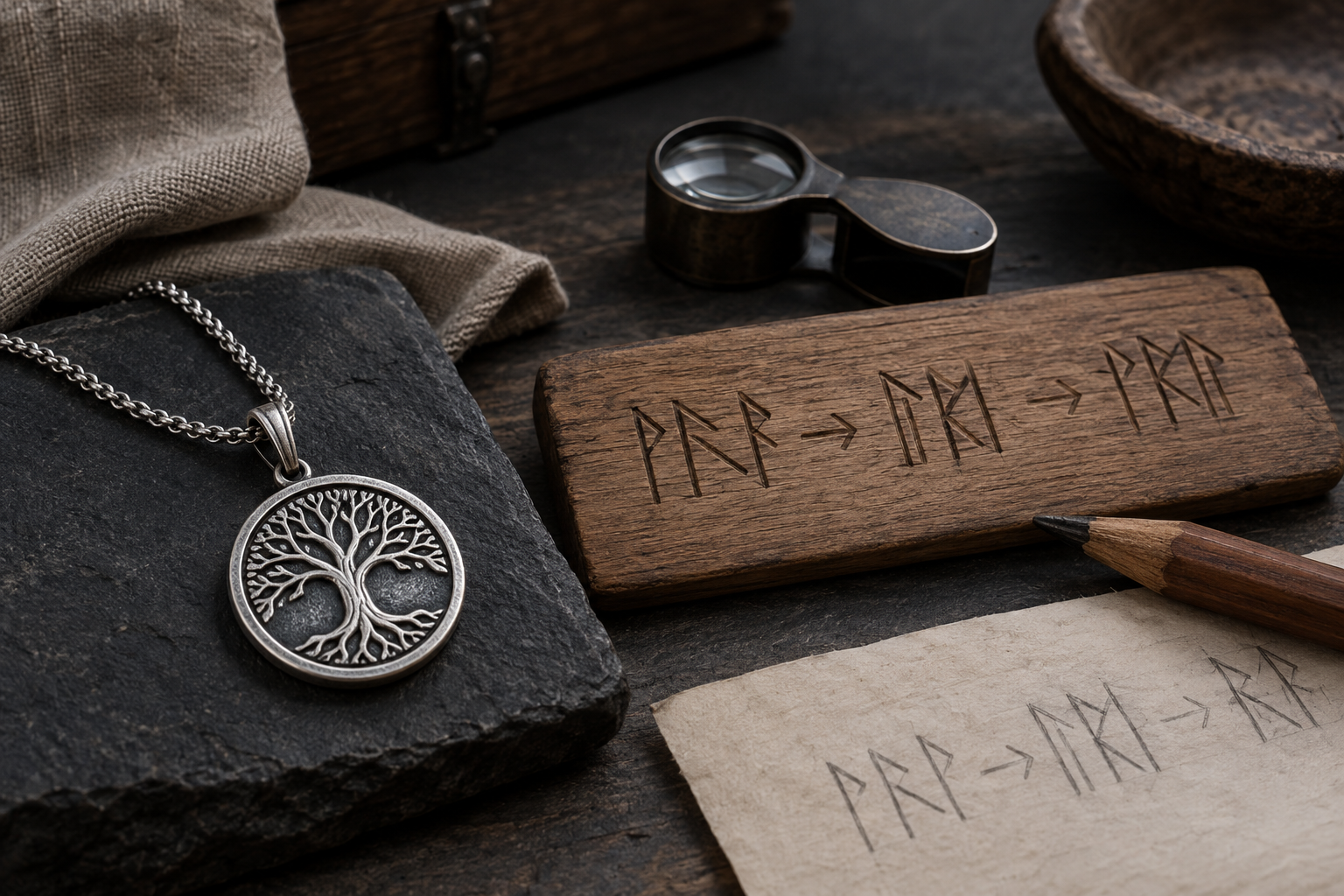
Meaning at a glance
Personalized rune jewelry is most historically responsible when it treats runes as a changing writing system, chooses the rune row for the intended period, and labels transliteration as an approximation rather than an ancient magical formula.
What the historical evidence actually shows
Archaeological and museum scholarship shows that runes were primarily a writing system used in different forms across time and space rather than a single timeless code. The Swedish History Museum explains that runes were adapted and changed; different rune rows were in use in different regions and periods. The National Museum of Denmark collects the documentary sources for the Viking Age and demonstrates that runic inscriptions appear on many object types from that era, indicating practical uses rather than a single, uniform meaning.
The Swedish National Heritage Board outlines principles for transliteration, emphasizing that runic signs and their phonetic values changed and that modern letter-for-letter renderings are conventions designed to approximate sound and spelling. Taken together, these museum and governmental sources show that runes functioned as a living script with local, chronological, and material variation. Respectful use of runes in jewelry depends on acknowledging that variation rather than presenting any modern rendering as identical to an ancient formula.
Which rune rows and cultures to consider
When choosing runes for personalized jewelry, pick the rune row that matches the cultural or chronological context you intend to reference. Museums and runic scholarship distinguish several principal traditions—commonly referred to in modern literature as the Elder Futhark, the Younger Futhark, and the Anglo‑Saxon futhorc—each with different letter inventories and shapes. The choice matters because a particular rune sign in one row may not correspond neatly to the same sound or meaning in another.
Because runes and their values shifted over time and between regions, labeling the rune row used (for example, 'Younger Futhark — Viking Age form') helps receivers understand that the inscription is a historical reference rather than an assumed magical or universal statement.
Documented historical meanings versus modern personal interpretation
Documented historical meanings are limited and specific. Museums and archaeological records show runes engraved for practical purposes such as names, ownership marks, short messages, memorial formulas on stones, and occasional magical or ritual contexts. The Swedish History Museum and the National Museum of Denmark present runes in material contexts—on tools, weaponry, brooches, and other personal items—where they function as writing tied to the object's use or ownership.
Modern personal interpretations—such as assigning one-word personality traits, universal protective powers, or new spiritual systems to runes—are contemporary projects. These modern meanings have cultural value for many wearers but are not the same as documented historical use. If you or the person you are gifting to prefers contemporary or spiritual meanings, treat those as personal layers added today and not as universally ancient facts.
How runes, motifs, and gemstones appear in jewelry
Runic inscriptions appear on historic jewelry in several ways: incised bands on rings, short names or initials on brooches, surface lettering on metal pendants, and occasionally carved on organic objects that survive in archaeological contexts. Museums catalogue such finds as evidence of personal identification, commemoration, or simple messages rather than evidence that every rune was a talisman.
Modern jewelers combine rune motifs with a wide range of metals and gemstones. Gemstones are a contemporary decorative and symbolic choice—artists may pair a transliterated name with a birthstone, a colored glass cabochon, or a historically informed material such as amber. These combinations are design decisions; any symbolic meaning attached to a gemstone (for example, birthstone associations or modern metaphysical claims) belongs to recent tradition or personal belief rather than to the runes themselves.
Practical and respectful selection and gifting guidance
Identify your intent first: are you aiming for historical accuracy, aesthetic reference, or a contemporary personal meaning? If historical accuracy matters, select a rune row consistent with the period or region you wish to reference and state that choice on a card or product description. The Swedish National Heritage Board recommends treating transliteration as a convention and labeling it as an approximation; include both the rune inscription and a clear transliteration and translation to avoid implying ancient certainty.
Ask for or provide a transliteration note. Transliteration replaces runic signs with modern letters according to scholarly conventions, but it often cannot capture exact sounds, spellings, or dialectal features. Present the transliteration as an informed reading, not a verbatim reproduction of an ancient utterance.
Work with a maker who documents their choices. A reputable jeweler should be able to tell you which rune row they used, how they handled ambiguous letters, the size limitations that affect legibility, and whether any modern adjustments were made for design or wearability. For very small inscriptions, opt for a simpler rendering such as a single rune or a short, well-checked name to avoid unreadable letters.
Respect cultural contexts and the recipient's background. If the recipient has living ancestral or cultural ties to regions where runes were historically used, approach the gift with extra sensitivity: explain the choice, offer an option to learn more, and avoid packaging runes as a pan-cultural religious object. If the recipient prefers a contemporary symbolic layer, clearly distinguish it from historical claims.
Include a plain language card with the piece that states the rune row, lists the transliteration and a literal translation, and briefly explains that runes are a historical writing system with regional variation. This simple step makes the piece informative and respectful, and it prevents accidental misrepresentation.
Practical decisions about materials and display
Consider durability and legibility. Metals that hold fine detail—such as silver, gold, or hard alloys—are better for inscribed bands and small letters. Larger pendants allow more accurate runic shapes; tiny charms may force stylization. If you want a name inscribed, choose a format and size that preserves the rune forms rather than compressing them into ambiguous marks.
Think about how gemstones interact with the design. A solitary rune set beside a small gem can create a balanced composition; an array of gems may compete visually with a line of runes. If you select materials for historical resonance, note that archaeological finds often preserve metals and organic materials, but the specific modern choice of gemstones is typically aesthetic or symbolic rather than historical.
When accuracy matters: verifying transliteration
If you require a highly accurate transliteration—because the inscription is a historical quote or a precise name in an older language—consult transliteration guidance and, when possible, a specialist. The Swedish National Heritage Board provides principles that show transliteration involves decisions about letter equivalence, lost vowels, and dialect. For ordinary personalized gifts, a careful jeweler's transliteration with a clear label is usually sufficient; for scholarly or commemorative inscriptions, seek expert review.
Frequently asked questions
How accurate can a rune transliteration on jewelry be?
Transliteration on jewelry can be accurate as an informed approximation, but runic signs and phonetics changed over time. Follow a recognized rune row and label the transliteration method; for scholarly precision, consult a specialist as advised by the Swedish National Heritage Board.
Which rune row should I use for a 'Viking' style piece?
If you want a Viking Age reference, use the rune row commonly associated with that period and region. Museums documenting the Viking Age (for example, the National Museum of Denmark) show that using the appropriate historical rune row improves accuracy and honesty in presentation.
Can I put a modern name into runes?
Yes. You can transliterate modern names into runes, but transliteration is an approximation and sometimes requires choices about how to represent sounds not present in the historical rune row. State which rune row was used and treat the result as a contemporary rendering.
Do runes carry inherent magical power?
Historical evidence shows runes were primarily a writing system used for various practical and occasional ritual purposes; modern claims of universal magical power are contemporary interpretations, not a universal historical fact.
What should I include with a rune-inscribed gift?
Include a small card that names the rune row used, gives the transliteration and literal translation, and notes that transliteration is an approximation; this transparency is recommended by museum and heritage guidance.
Are certain materials more 'authentic' for runic jewelry?
Archaeological finds include a range of metals and organic materials, but the choice of modern metals and gemstones is primarily aesthetic. If historical resonance matters, prefer metals that hold fine detail for legibility and avoid materials that obscure the inscription.
How can I ensure the runes will remain legible over time?
Choose a size and metal that preserve detail, avoid overly fine or shallow engraving, and consider a single rune or short name rather than a long line of tiny characters to maintain legibility.
Should I use online rune generators?
Online generators can be a starting point but often simplify transliteration choices. If accuracy or cultural sensitivity matters, check outputs against transliteration principles or consult a reputable maker or specialist.
Sources and further reading
- Runes — Swedish History Museum
- Begrepp och principer for translitterering — Swedish National Heritage Board
- Sources of the Viking Age — National Museum of Denmark